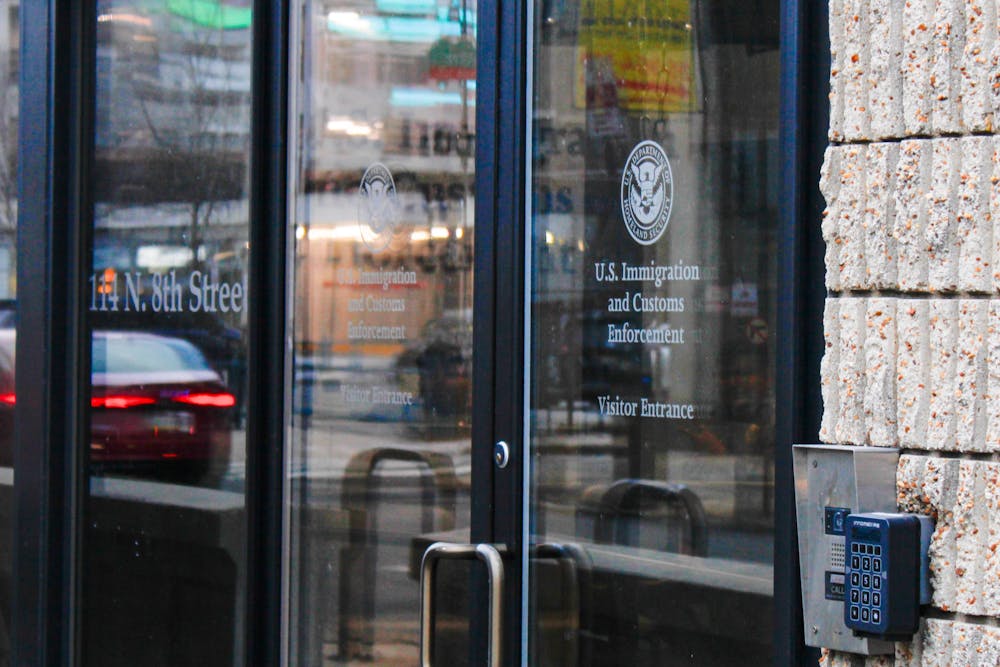
In the past week, Philadelphia’s district attorney and several Pennsylvania police leaders have made a decision that matters more than most institutional responses to injustice in the last decade: they stopped cooperating with the United States Immigration and Customs Enforcement.
District Attorney Larry Krasner has stated that ICE agents who violate Pennsylvania law will be treated no differently than anyone else. Sheriff Rochelle Bilal has declined to provide personnel or institutional support for ICE operations. Both of these decisions are materially consequential. ICE does not function independently — it relies on the cooperation and support of city governments. Local police honor detainers, city jails hold individuals past their release dates, and multiple agencies share access to fingerprint databases and booking records. Federal immigration enforcement is an intergovernmental system sustained by local consent. So when Philadelphia withdrew that consent, it removed the infrastructure that turns federal authority into real enforcement.
After the murder of George Floyd, condemnation was widespread and often sincere. Corporations, universities, and governments announced reform agendas. Yet the underlying permission structure largely remained intact: budgets were preserved, along with inter-agency cooperation, and legal insulation. The language surrounding justice changed; the conditions enabling abuse did not.
Philadelphia’s decision affirms that state violence persists less because it escapes criticism and more because it remains operationally enabled. Detentions and deportations require a chain of cooperation, and enforcement power weakens when that chain is interrupted.
This is clearest in the context of ICE’s expansion under 1968 Wharton graduate and President Donald Trump. That expansion relied on nebulous discretionary authority and federal budget workarounds, which rapidly scaled ICE’s enforcement capacity while minimizing oversight. The implicit assumption was that enforcement could retain legitimacy so long as it remained operationally secure, even as mechanisms of accountability deteriorated.
That assumption actively damages civil society. Civil society is not an abstraction; it is a system of enforceable limits — both institutional and social — that constrain how power is exercised. Social movements such as Black Lives Matter rely on those constraints to function. Protest presumes that institutions remain responsive to public pressure because they can be compelled — through refusal — to stop enabling harm. When enforcement agencies are structured to outrun oversight, and other institutions continue cooperating despite knowing the harm involved, those limits disappear.
At Penn, administrators often urge students to drive the conversation forward through dialogue, even as the University has adopted a policy of institutional neutrality that limits official public responses to events unrelated to campus operations. The University treats conversation as the primary mode of response while declining to endorse material constraints on power beyond campus operations. Penn assumes civil society is intact — that institutions will respond to legitimacy and pressure without being compelled. But when enforcement regimes are designed to evade oversight and persist through cooperation, conversation does not constrain harm. It coexists with it.
Philadelphia’s refusal demonstrates that strong civil society now survives only where institutions are willing to actively reimpose limits that have otherwise eroded. Universities may not wield police power, but they do exercise institutional discretion in ways that determine which forms of state action they will publicly legitimize. Penn could, without breaking the law or engaging in enforcement, affirm that noncooperation with ICE is constitutionally protected, publicly support sanctuary policies, or commit to refusing data sharing or institutional assistance if ever requested. These are not radical demands; they are choices about whether an institution will reinforce limits on power or be a deadweight while others pioneer refusal.
By withdrawing cooperation, Philadelphia laid the groundwork for reimposing limits here — and, by extension, limits elsewhere. Institutions that continue working with ICE are not compelled by law or paralyzed by complexity; they are choosing to preserve operational order over accountability. Universities that decline to make similar choices are not neutral observers of this process, but beneficiaries of the assumption that someone more vulnerable will bear the cost of refusal.
Civil society does not endure through language alone. It depends on limits that check enforcement regimes antagonistic to public accountability. When the limits are weakened by state structures that evade oversight, refusal becomes the only effective corrective. Philadelphia acted on that reality. Penn should be honest about whether it is prepared to do the same.
SOHUM SHETH is a College first year studying philosophy, politics, and economics from Jacksonville, Fla. His email is sheth0@sas.upenn.edu.