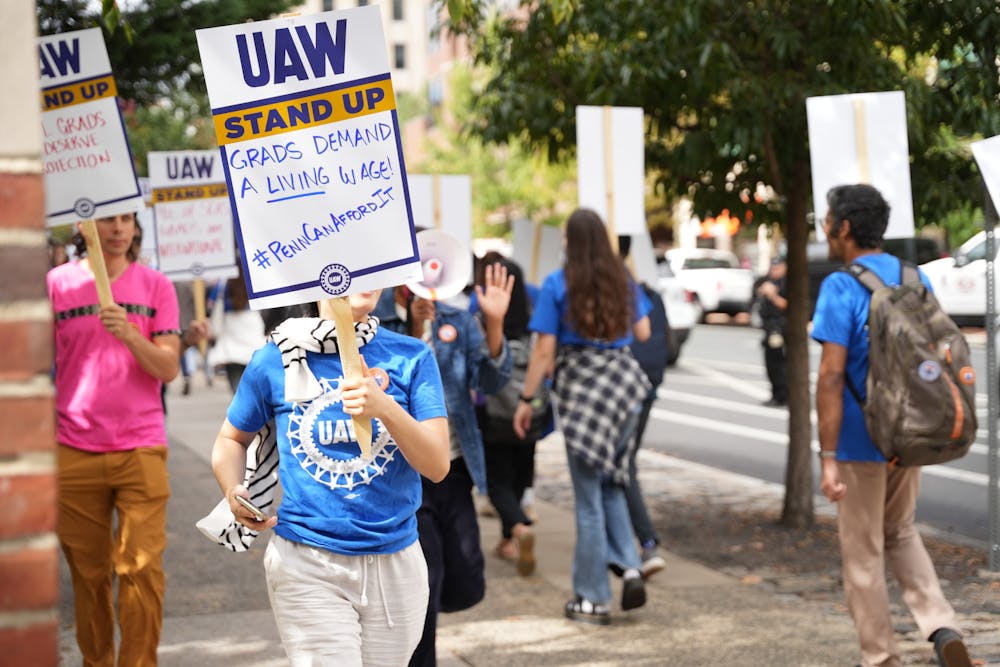
The Penn administration is at a crossroads with its graduate student workers. The University has gotten itself into a serious predicament and is now forced to choose between its own financial interests or the interests of the student body at large. Penn’s graduate student union GETUP-UAW has announced plans to strike on Feb. 17 if a bargaining contract is not reached. This is the University’s fault, and it is integral that they agree to GET-UP’s demands before it is too late.
University administration has a long history of acting in its own interests and failing to support students and faculty who face the brunt of the pain when issues arise. Whether it was the removal of the University’s DEI language or the erosion of shared governance, the administration has a bad track record. These instances have affected the student body at large and led to Penn administration’s outsized control and prioritization of financial interests.
I spoke with Sam Layding, a Ph.D. candidate and member of the bargaining committee, who expressed that a key issue surrounding the strike is pay. Currently, the minimum Ph.D. candidate stipend at Penn is $40,000. This is low compared to other universities. For example, Johns Hopkins University, a peer institution located in a city with a similar cost of living, offers Ph.D. candidates stipends starting at $50,000.
It’s not better for hourly workers like teaching assistants or research assistants, who typically can make as low as $15 an hour and can only work a maximum of 20 hours a week. Combined with the high costs of adding spouses and children to the current insurance plan, graduate students are under a large amount of financial stress.
In the latest bargaining offer the University offered a $45,000 stipend and a $21.50 hourly minimum wage, which is still below the living wage. According to the MIT wage calculator, a single adult in Philadelphia is estimated to require a wage of $23.26 an hour per 40-hour work week before taxes to meet the cost of living. Even when graduate workers are just asking to be paid like their peers, the administration still tries to undercut them.
Penn should not be trying to nickel and dime the very people who keep the University running. The main takeaway from my conversation with Layding is that graduate workers just want things to change. Such an uncomplicated sentiment truly puts into context how Penn’s administration is not meeting basic needs of graduate student workers. The current conditions are not tenable with our University’s value of advancing social good. Penn needs to make an equitable and fair bargaining agreement with graduate student workers.
If Penn doesn’t reach a contract agreement with the union soon, consequences could be dire. Over 3,700 graduate students will cease responsibilities such as grading assignments, performing research, and hosting recitations, effectively paralyzing the University and many of its functions.
Looking back at a recent example, Temple graduate student workers went on strike in 2023 for six weeks, which led to the hiring of unqualified replacement instructors who were unfamiliar with the course material. In some cases, classes were moved online or were even left without instructors. Even after the strike concluded, its fallout still heavily impacted Temple, partially causing the resignation of then-President Jason Wingard and leaving the University with the awkward predicament of dealing with the replacement instructors they had hired.
Suffice to say, Penn has to come to an agreement with GET-UP. In a time of high inflation and economic uncertainty, it is important for Penn to fairly compensate workers. Not only because it is the right thing to do, but also to keep attracting capable graduate students. Great students are a key part of a university’s reputation and its standing. Penn prides itself on being leaders of innovation. Now is the time, in a decade where graduate unions are springing up in record numbers, for Penn to be a guide to other universities and set an example of how to negotiate a fair contract that uplifts graduate student workers.
KAMAU LOUIS is a first-year graduate student studying city planning from Orlando, Fla. His email is louis3@upenn.edu.

Kamau Louis a second-year Weitzman School of Design student studying city and regional planning from Orlando, Fla. His column focuses on student culture and activism. He can be reached at louis3@upenn.edu.