

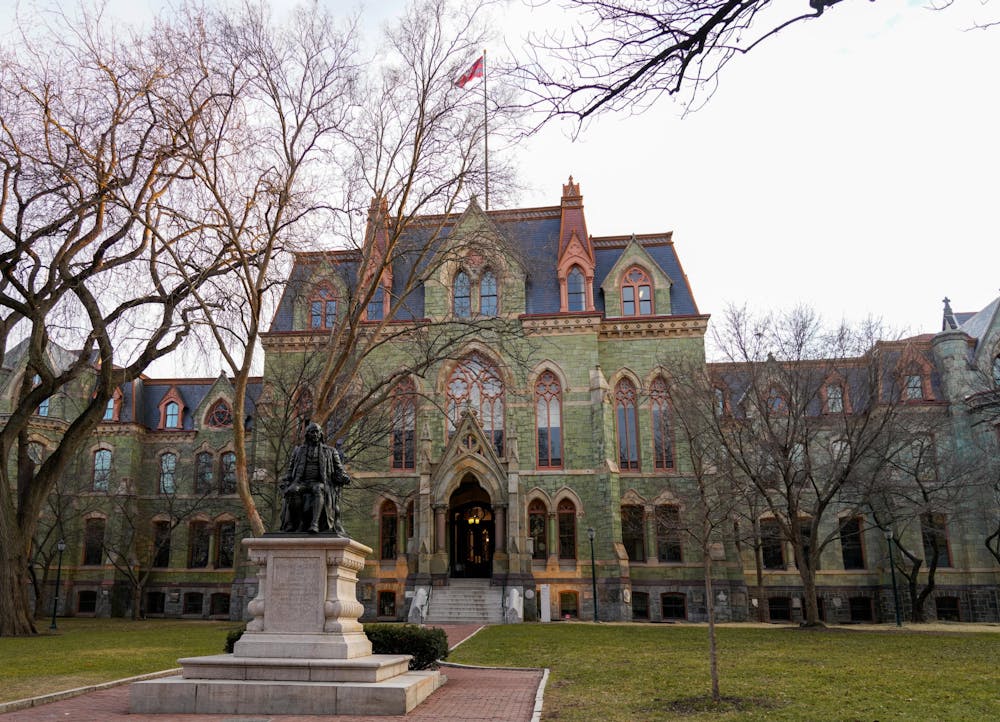
Over the past 12 months, Penn has been a recurring subject of federal scrutiny amid the White House’s attempts to enact reform across institutions of higher education.
This year — which began with 1968 Wharton graduate and President Donald Trump’s inauguration in January — was defined by heightened political attention on the University. The increase in national scrutiny coincided with a series of lawsuits against the University, federal investigations, and ongoing negotiations with the White House.
Trump signed a flurry of executive orders in the first few months of his second presidential term, quickly making good on several promises from the campaign trail.
Diversity, equity, and inclusion initiatives at Penn
On Jan. 20, Trump signed an executive order requiring universities that receive federal funding, including Penn, to terminate any DEI programs that could violate federal civil rights laws.
In response, Penn revised longstanding University-wide policies and engaged in a widespread rollback of DEI initiatives over the following month — including scrubbing staff titles and renaming DEI offices — across the University’s four undergraduate and 12 graduate schools.
The Wharton School’s DEI undergraduate concentration and MBA major were both renamed to Leading Across Differences in March. Last month, a leaked memo from the Department of State identified Penn as an institution that the department will continue to support through federal research programs, claiming that the University showed “no evidence of DEI” in its hiring practices.
Federal immigration policies in action
Trump, who has frequently touted immigration reform over the course of his second presidential campaign, signed an executive order in January directing federal agencies to identify and deport noncitizen participants — including college students — in pro-Palestinian protests. In 2024, Penn was the center of numerous pro-Palestinian demonstrations, which came to a head during the spring Gaza Solidarity Encampment.
Amid visa uncertainty, Penn’s International Student and Scholar Services reaffirmed its commitment to the University’s over 9,000 international students. Among other recommendations, ISSS advised impacted students to avoid nonessential travel and seek guidance from campus and legal resources.
In April, ISSS reported that the federal government had revoked “at least three” Penn student visas and confirmed that five more were terminated later that month through Penn’s visa revocation monitoring.
Although the visas were reactivated later that month, a federal halt on student visa interviews announced in May threatened to delay the arrival of incoming international first years in fall 2025. When the State Department resumed visa interviews, it implemented a thorough social media vetting process to identify messages thought “hostile” to the United States.
Over the course of the fall semester, ISSS continued to issue guidance on immigration policies for students, as a federal government shutdown halted access to most services.
In September, the White House announced a $100,000 fee on new H-1B visa petitions, which The Daily Pennsylvanian’s analysis found put Penn at risk of paying millions of dollars to maintain its level of international employment. The same month, Penn sent a letter to the Department of Homeland Security, opposing a federal immigration rule floated in August that could disrupt international student enrollment.
The University’s Title IX settlement
The Department of Education launched an investigation into Penn in February, claiming that the University’s decision to allow 2022 College graduate Lia Thomas, a transgender woman, to compete for Penn’s women’s swimming and diving team during the 2021-22 swimming and diving season violated Title IX.
The investigation came a day after Trump signed an executive order barring transgender women from participating in women’s sports. That month, three former Penn swimmers filed a lawsuit against the University, alleging that Thomas’ participation deprived them of “equal opportunities as women to compete and win while being denied the opportunity to protect their privacy in separate and equal locker rooms.”
One month later, the White House announced a freeze on $175 million in Penn’s federal funding, again citing the University’s failure to ban transgender student-athletes from women’s sports.
In April, the Education Department found Penn in violation of Title IX and asked the University to “voluntarily” comply with three demands within 10 days or risk losing federal funding. Over the next two months — though Penn was publicly silent — administrators entered closed-door negotiations with the federal government to resolve the investigation.
When Penn entered a resolution agreement with the Education Department on July 1 and complied with all three of the department’s initial demands, it became the first Ivy League university to settle with the Trump administration and got back the $175 million in lost funding.
At the time, a senior Education Department official told the DP that Penn’s approach to negotiations and subsequent settlement — quickly followed by the announcement of agreements made by Brown University and Columbia University — could serve as a “model” for other institutions.
The decision was met with criticism from the Penn community, with some characterizing the move as a “betrayal” and a “dangerous precedent.” The lawsuit filed by three former Penn swimmers in February was also stayed in July, pending a ruling in a similar case.
Lawsuits and investigations against Penn
Over the course of 2025, Penn has faced several lawsuits and investigations alongside federal scrutiny over its alleged Title IX violations.
U.S. congressional Republicans announced an investigation into the Ivy League’s eight universities for alleged violations of antitrust in April. The letter, addressed to Penn President Larry Jameson, accused the Ivy League of colluding to raise tuition costs and engaging in unfair financial aid practices and demanded that the University turn over documents related to admissions and communications in less than two weeks.
In July, Penn was issued a subpoena by the House Judiciary Committee, which accused the University of inadequately submitting documents for the committee’s ongoing price-fixing investigation.
Penn was also named as a defendant in a lawsuit filed in August that alleged that top universities also engaged in price-fixing by misusing the early decision admissions process.
A month later, a federal judge dismissed an October 2024 lawsuit alleging that Penn engaged in a price-fixing scheme that inflated tuition costs for students with divorced or separated parents. Penn is still among the five universities yet to settle an ongoing 2022 antitrust lawsuit — accusing Penn and 16 other universities of forming a “price-fixing cartel” — that could award defendants approximately $2 billion in damages.
In May, the Education Department launched an investigation into Penn’s foreign funding records after alleging the University had “inaccurate” and “incomplete” disclosures. At the time, the Education Department provided Penn with a 30-day deadline to comply with information requests and warned that a failure to do so could result in “civil action by the U.S. Department of Justice.”
The Education Department announced the launch of a new portal for colleges and universities to disclose sources of foreign funding in December, describing the issue as a “top priority” for the Trump administration.
In November, the United States Equal Employment Opportunity Commission filed a lawsuit against Penn, claiming that the University failed to provide documents requested for an investigation into its handling of antisemitism complaints from Jewish faculty and staff. Days after the filing, hundreds of Penn community members signed a petition criticizing the lawsuit’s request for the names of Jewish students and faculty.
On Dec. 2, Penn filed a motion to reassign the case to federal Judge Mitchell Goldberg, who dismissed an antisemitism lawsuit against Penn in June 2025. Penn withdrew its motion just a day later, given that Goldberg had resigned from his post in September and that the previous lawsuit is on appeal.
Trump’s preferential funding compact
In October, the White House approached nine universities, including Penn, with the “Compact for Academic Excellence in Higher Education” — an agreement that would have provided the University with preferential funding treatment in exchange for sweeping institutional reform.
The Oct. 1 document set forth guidelines that would have governed Penn’s admissions, pricing, and hiring practices. Higher-education institutions that signed the agreement were to receive “multiple positive benefits,” including “substantial and meaningful federal grants.”
Several provisions in the agreement directly mimicked a list of reform proposals circulated in 2023 by outgoing Wharton Board of Advisors Chair Marc Rowan. Rowan — the chief architect of the White House proposal — circulated the initial list of questions to the University Board of Trustees just days after successfully orchestrating a pressure campaign to oust then-Penn President Liz Magill and former Board of Trustees Chair Scott Bok.
Despite Rowan’s affiliation with the University, Penn became the third university to reject the compact after a two-week-long review process that involved consulting various members of the Penn community.
In a recent interview with the DP, Jameson stated that Penn hasn’t had “any further contact” with the federal government regarding the compact — but described the University’s historical relationship with the federal government as “powerful, amazing, and valuable.”
Staff reporter Anvi Sehgal can be reached at sehgal@thedp.com. At Penn, she studies philosophy, politics, and economics. Follow her on X @anvi_sehgal.
Isha Chitirala is a News Editor at The Daily Pennsylvanian and can be reached at chitirala@thedp.com. At Penn, she studies economics and political science. Follow her on X @IshaChitirala.





