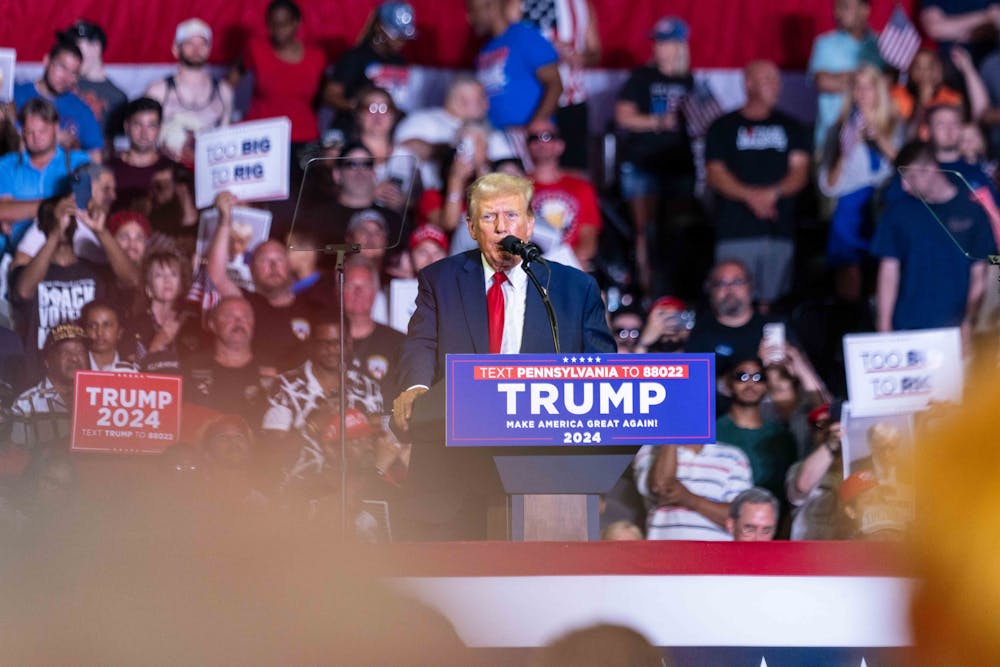
Since taking office, 1968 Wharton graduate and President Donald Trump has embarked on a crusade of reshaping American higher education.
Trump and his administration’s attacks on higher education have included cutting research and grant funding, launching investigations into specific institutions, and issuing demands to Penn and peer institutions. Among the initiatives were also the elimination of diversity, equity, and inclusion programs and ongoing changes to student immigration policies.
As Trump surpasses the 100-day mark of his second term, The Daily Pennsylvanian spoke with higher education specialists, political scientists, and legal scholars to understand the impact of his policies and rhetoric on higher education — as well as potential actions his administration may take in the future.
Federal funding restrictions
On March 19, the Trump administration announced a freeze of $175 million in federal funding to Penn, citing the University’s failure to bar transgender athletes from women’s sports. Just days later, on March 25, Penn President Larry Jameson sent an email to the Penn community, stating that faculty across seven of the University’s schools received stop work orders for research grants, totaling approximately $175 million.
Graduate School of Education professor Jonathan Zimmerman likened the removal of funding to a “terror attack,” sharing that it was “designed to make us feel afraid.” Zimmerman said that the “big-dollar” scale of the funding cuts were “random, punitive, and vengeful.”
In early February, weeks before the funding freeze, the Trump administration announced a National Institutes of Health funding cut that capped funding for indirect costs at 15%. According to a University spokesperson, the cut would cost $240 million for Penn. In response, Penn and 12 other universities filed a lawsuit against the NIH, resulting in a judge temporarily halting the cut.
Although the cut remains temporarily frozen, Penn significantly reduced graduate admissions in response, which included rescinding offers from applicants who had already been accepted.
RELATED:
600 Penn faculty sign open letter urging Jameson to resist Trump‘s ‘assaults’ on higher education
Jameson cites institutional neutrality as reason for Penn’s limited response to federal attacks
In a statement to the DP, Annenberg School of Communication professor Sarah Jackson described the “pain” of having to let go of research staff that the University can no longer afford to pay. She also described “scrambling” to help graduate students find work after job opportunities “in a range of targeted fields have contracted.”
Revocation of student visas
On the campaign trail, Trump made several references to deporting pro-Palestinian protesters, following widespread encampments across college campuses in Spring 2024. After taking office, these campaign promises seem to have become a primary focus for the administration.
In mid-April, eight Penn students had their visas revoked by the Department of State. However, on April 25, the DP reported that the federal government had reinstated the immigration status of those students.
Zimmerman noted the “fear” created by the sweeping deportations.
“None of us imagined plainclothes ICE agents picking up a Tufts [University] student and moving her to an undisclosed location,” Zimmerman said. “All because we think she wrote an op-ed criticizing her university's response to the war in Gaza.”
Academic freedom on college campuses
Trump’s administration also made a concerted effort to limit academic freedom and free speech on university campuses. Multiple experts that the DP spoke to alluded to the period of “McCarthyism” as a similar feeling of academic suppression to the current political period.
Assistant professor Jane Esberg described the similarities between the Trump administration’s targeting of academic freedom and McCarthyism in a written statement to the DP.
“The only period that I can think of as being remotely similar is under McCarthyism in the 1950s. At that time, academics were hauled before Congress and blacklisted for their supposedly communist views,” Esberg wrote. “This process blatantly violated academic freedom.”
University of Pennsylvania Carey Law School professor Kermit Roosevelt noted that Trump’s targeting of academic freedom is connected to encouraging more conservative thinkers and voices at higher education institutions.
“At every level, in every school and in your admissions, that’s an ideological litmus test that they’re imposing on hiring. If you don’t have adequate viewpoint diversity, you must immediately hire a critical mass of faculty who will represent the disfavored views,” Roosevelt said.
He added that the implication is that universities have to “hire conservatives” and “faculty with particular ideological perspective.”
Jackson added that such academic censorship will have a dangerous effect on universities. She wrote that attacking academic freedom is dangerous “not only to scholars, but to the democratic ecosystem we should be a part of.”
Elimination of DEI
The day after his inauguration, Trump signed an executive order requiring all federally funded universities to terminate all diversity, equity, and inclusion programs. On Feb. 17, the Department of Education sent out a letter ordering universities to end all DEI programs within two weeks.
Within the next two weeks, Penn had scrubbed the DEI pages of its four undergraduate schools and 12 graduate schools.
On Feb. 19, the United States Senate Commerce Committee flagged $11 million in National Science Foundation research grants to Penn faculty for projects promoting DEI or “neo-Marxist class warfare propaganda.”
Zimmerman said that censoring DEI in grant proposals puts free speech “under attack.”
“That’s what happens in authoritarian countries. That doesn’t happen in democratic countries, at least not in the way I understand those terms,” Zimmerman added.
Jackson shared that an NSF grant for a project she was working on was canceled. According to her, the project’s goal was to support STEM education and researchers from underrepresented backgrounds.
“There has been a sharp increase in stress and uncertainty, along with requests for support among my undergraduate and graduate students, especially students of color, who feel directly threatened by the removal of DEIA language at the university,” Jackson said.
Restrictions on transgender athletes
The Trump administration has also targeted transgender athletes at the collegiate-level within the first 100 days.
Following the executive order signed on Jan. 20, which stated that only the two biological sexes would be recognized by the federal government, the NCAA altered its policy that had previously allowed transgender women to compete at the NCAA-level.
On March 19, the Trump administration announced a freeze of $175 million in federal funding to Penn over its transgender-athlete policies.
A month later, the Education Department issued demands to the University after it was found to have violated Title IX with its transgender-athlete policy.
Concerns about constitutionality
Roosevelt — who specializes in constitutional law — stated that he believes many of the administration’s policies will not last, either because they will be declared unconstitutional or due to Trump “backtracking” on them.
He added that he believes the Supreme Court has been “more favorable” to Trump than expected, but he sees the possibility of a potential confrontation between Trump and the Court in the future as it continues to review his policies. However, he believes that if Trump were to openly defy the Supreme Court, the Court would come out on top.
“I think that Trump would defy the Supreme Court if he thought he could get away with it, but for at least some kinds of decisions, I don’t think he could,” he said.
He noted that in some smaller cases, he could “see the Court massaging the law to avoid a confrontation.” However, Roosevelt emphasized that on bigger issues, the Supreme Court will “stand up for the Constitution and the rule of law,” adding that he does not think “Trump could survive defying them.”
University response
Several professors spoke to the DP about how they believed Penn and its peer institutions should respond to the Trump administration’s actions.
Zimmerman said that he believes the most important action universities could take is to “speak up,” especially when free speech on campus is being hindered.
“The only answer to attacks on free speech is free speech. It’s raising your voice and using your free speech to denounce the attacks on free speech,” Zimmerman said. “I would encourage Penn, Penn’s leadership and [the] leadership of every other university to keep raising their voice. That’s the only way this is going to change.”
On April 22, Penn President Larry Jameson was one of 150 university presidents to co-sign a letter criticizing the Trump administration’s higher education policies. The letter denounced the administration’s “political interference” into higher education, committing to “reject the coercive use of public research funding.”
Political Science professor Marc Meredith cited the administration’s actions as a reflection of shifting opinions on higher education within the right. He suggested that higher education will have to “make itself more popular” by instituting new policies to avoid future attacks.
“In order to sustain itself in the longer term, higher ed[ucation] can’t just be seen as something that is a tool of the Democratic Party,” Meredith said. “It’s important that it’s seen as a tool that makes America better.”
Proposed future actions
Several professors expressed concern about what the Trump administration’s next steps in higher education reform could be. In March, a senior Trump official told Fox News that the $175 million federal funding freeze was just “a taste of what could be coming down the pipe for Penn.”
Zimmerman conveyed uncertainty and said that “what we’ve learned from the first 100 days is that nothing is impossible.”
In a written statement to the DP, Esberg wrote that “I do not know how Trump’s actions will make universities vulnerable in the future; but I know that it is supremely important that they are protected now.”
Meredith predicted that lawsuits will continue to be filed against the administration, and clarify “where exactly the lines [of] what is and is not allowable.” He said that the coming months will provide insight into which of Trump’s policies will stand and which will be struck down by the courts.
“I think we’re going to be not just learning about what President Trump can do, [but] what presidents to come have the power to do,” Meredith said.
RELATED:
600 Penn faculty sign open letter urging Jameson to resist Trump‘s ‘assaults’ on higher education
Jameson cites institutional neutrality as reason for Penn’s limited response to federal attacks
Senior reporter Alex Dash leads coverage of politics and can be reached at dash@thedp.com. At Penn, he studies history and political science. Follow him on X @AlexBDash.