

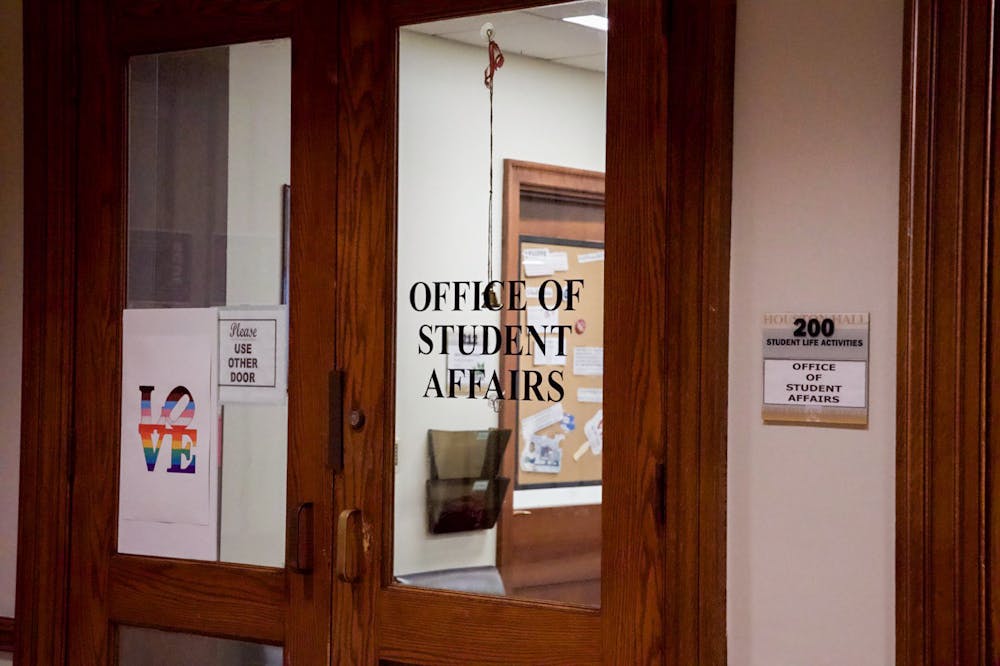
Two months after Penn’s Office of Student Affairs introduced new measures for undergraduate group registration and funding, student leaders expressed mixed reactions about the policies’ implementation and clarity.
The new model — titled “Future of Funding” — was first developed by OSA during the 2023-24 academic year, when members of Penn’s Student Activities Council identified concerns with the previous system. According to OSA Executive Director Katie Bonner, more than 500 student groups now have access to funding under the new model, and about 200 funding requests have been reviewed across its first three rounds.
In a written statement to The Daily Pennsylvanian, Bonner wrote that OSA has “learned a lot throughout this process,” including how challenging “transitions of this scale can be.”
“Both OSA and SAC have the shared goal to create an efficient and equitable system for student organizations and acknowledge this rollout hasn’t been without difficulties,” Bonner wrote. “Students seeking funding have been gracious and patient with the process and we can’t thank them enough for this as we make improvements.”
She emphasized that OSA and SAC are “meeting again to review timelines and refine procedures” to ensure that the new system “fulfills its goal of better serving the student community.”
In addition, Bonner said that OSA has “expanded the student membership of the funding committees” and welcomes “feedback from student users about the funding process."
While some student leaders expressed initial uncertainty about the new model, Marissa Prager — the finance manager of the Penn Glee Club — wrote to the DP that “this process seems more equitable and straightforward than previous years.”
“The new OSA funding model, while stressful and difficult to navigate at first, has opened up new opportunities for the Glee Club,” Prager wrote. “The process was quite tedious … but I am extremely pleased by the outcome for our group. With this additional funding, we have been able to invite guest conductors, fund travel, host events, and order new equipment.”
Prager also noted that “nearly all" of the group's funding requests were fulfilled during the first round of funding.
Other students have continued to describe the system as confusing.
A representative for the West Philly Swingers — a dance troupe at Penn — wrote to the DP that “without the student board and the monthly SAC meetings, there has been very little clarity about what changes are being made [and] how we can access funding.”
According to the representative, the group’s treasurer “was not even able to access our SAC portal for the better part of the semester after a system mix-up during orientation week.”
They wrote that “student-group funding” at large has lacked clarity this semester, which has resulted in difficulties while organizing events, including the Penn Intercollegiate Lindy Exchange — “the longest-running remaining weekend Lindy Hop event in Philadelphia.”
The West Philly Swingers representative added that “the old process for requesting contingency funding” included more transparency “between SAC and our organization,” as opposed to the “counterproductive” structure of the new model.
“We were promised a new system that would run more efficiently and equitably, but have repeatedly been met with roadblocks instead,” they added. “Without financial security, it is difficult to continue club operations as usual, and to be able to provide financial aid to our students in a meaningful way that allows them to participate regardless of their own financial status.”
A member of Wharton Global Research and Consulting — who requested anonymity for fear of retaliation — similarly said that there had been delays as a result of the funding changes.
“We would’ve appreciated a greater explanation behind the budget cuts, and it unfortunately leaves us to limit the number events we can brainstorm for the rest of the semester [sic],” the student wrote. “Funding has been a very big priority for us as we would like to open up many of our events to non-members as well.”
In February 2025, OSA tasked the Funding Guidelines Working Group, which consists of both students and administrators, to propose new guidelines supporting the model.
The guidelines drew on existing precedent from SAC, Penn’s Undergraduate Assembly, the Intercultural Fund, the Sports Club Council, the Performing Arts Council, and various Social Planning and Events Committee subcommittees.
Senior reporter Kathryn Ye covers central administration and can be reached at ye@thedp.com. At Penn, she studies biochemistry and philosophy. Follow her on X @Kathryn__Ye.


