

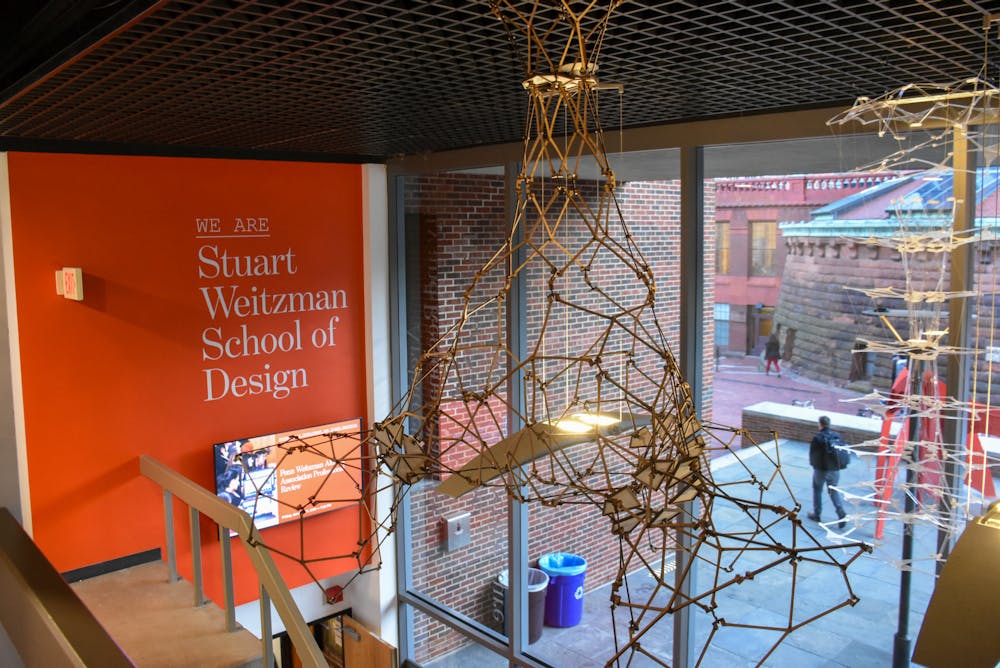
On Nov. 12, the Stuart Weitzman School of Design honored students, architects, and researchers for innovations in climate resilience and public health at its 2025 awards ceremony.
Held at Meyerson Hall, the annual event recognized Master of City Planning candidate Anaushka Goyal and Master of Architecture candidate Junxi Liu. Beyond that, the professional honorees included the Green Heart Louisville Project, which explores the health effects of urban greenery, as well as Marina Tabassum Architects, known for climate-responsive community housing in Bangladesh.
“[We look for] a mix of methods to solve a real problem. When we see a student take design and storytelling with pictures and data together, that’s really exciting to us,” City and Regional Planning Chair Megan Ryerson said at the ceremony.
Goyal won the Witte–Sakamoto Family Prize in City and Regional Planning, which provides a $50,000 scholarship to support a student’s final year in the MCP program. Goyal’s portfolio includes school facilities planning in Philadelphia; she is also an SNF Paideia Fellow whose research focuses on interdisciplinary civic engagement and inclusive public dialogue. Her previous work includes urban policy resarch in Mumbai.
“What I really loved about city planning is how people interact with these spaces, and how data can show it,” Goyal said in a video shown at the ceremony. “Anything that you’re planning, you really need to learn about the people first.”
The Witte-Sakamoto Family Medal in City and Regional Planning went to the Green Heart Louisville Project, a long-term clinical study in Louisville, Kentucky that tests whether planting trees in neighborhoods can directly lower residents’ risk of heart disease.
Two leaders of the project, Aruni Bhatnagar and Ted Smith, attended to represent the team and share their project. After planting thousands of trees in target neighborhoods, the team reported a notable drop in C-reactive protein, an inflammation marker often connected to heart disease.
“It’s about a 22% decline in the CRP level.” Bhatnager said. “The reason this is important [is] because CRP is a very good predictor of your cardiovascular disease risk. So a decrease in CRP level by trees will be equal to about a seven year decrease in age.”
RELATED:
Penn faculty discuss College Foundations pilot program, ’new era’ for general education curriculum
Perelman School of Medicine honors 17 physicians and researchers with Awards of Excellence
Ryerson explained why climate-centered and community-centered projects dominated this year’s awards.
“[Climate change is] absolutely central to what planning is wrestling with today and going forward. These are community access and infrastructure problems that planners are taking on,” Ryerson said. “The connection between humans and the infrastructure and the resources they need ... [is] really central to everything that we do.”
Chair of the Department of Architecture Rossana Hu presented the Kanter Tritsch Prize in Energy and Architectural Innovation to Liu. The award, created in 2017 by alumna Lori Kanter Tritsch, provides a $50,000 scholarship to a rising second-year M.Arch student and recognizes leadership in energy-conscious design.
“[Liu] just had really outstanding projects all throughout his years here in Weitzman,” Hu said. “All the projects were at such a high level of execution that it was quite clear who was at the top.”
Liu’s portfolio features travel-based research and global design work emphasizing direct, on-site study of buildings and cities.
“For me, architecture is a personal statement, a mirror that measures and judges the self,” Liu said in a video shown at the ceremony.
The Kanter Tritsch Medal in Architecture was awarded to Marina Tabassum Architects, a Bangladesh based practice known for climate-responsive design rooted in Bangladeshi materials and cultural traditions. Founded in 2005, the MTA was “celebrated for creating earthquake-resilient, flood-adapted homes designed to keep families together during climate displacement.”
“Being able to keep the family together is absolutely a very impactful thing,” Tabassum said. “So that was also something we learned as architects. There is a huge demand for these houses.”
She went on to describe the medal as an affirmation of working outside mainstream development norms.
“Sometimes you’re trying to pave a path which hasn’t been done before,” Tabassum said. “In those times, when you are acknowledged… it speaks to you.”
A core facet of this year’s award ceremony was recognizing and foregrounding architecture’s role in a sustainable future.
“Architecture has so many dimensions,” Tassabum said. “This one dimension is very urgent today because of the climate crisis. We don’t want to lose sight of that.”
RELATED:
Penn faculty discuss College Foundations pilot program, ’new era’ for general education curriculum
Perelman School of Medicine honors 17 physicians and researchers with Awards of Excellence
Staff reporter Mishal George covers University finances and can be reached at george@thedp.com. At Penn, she studies journalism and political science. Follow her on X @mishalgeorgee.


