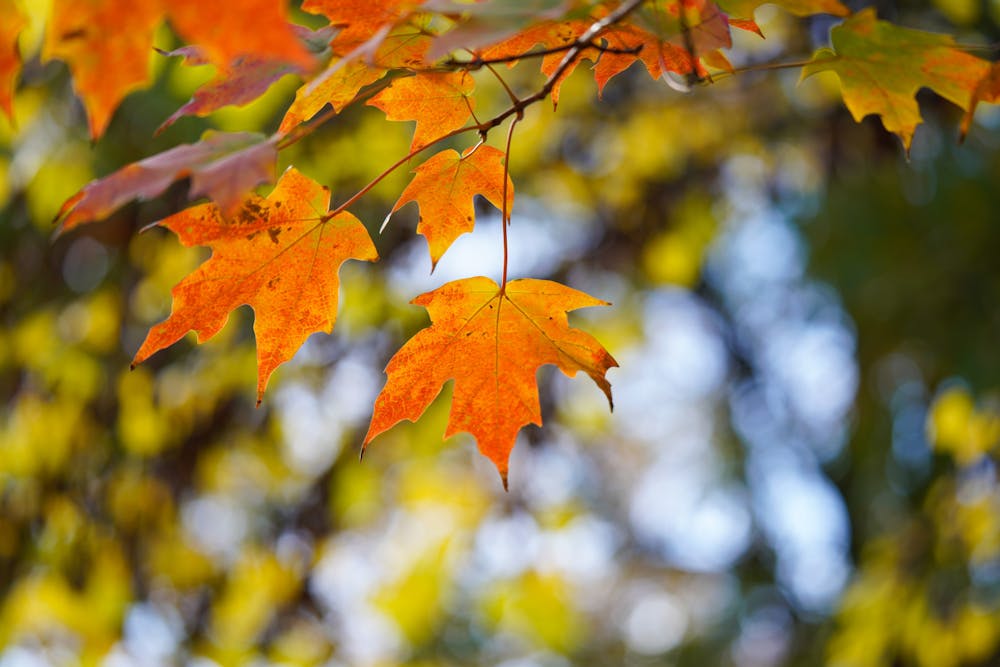
Penn Sustainability announced that it will continue to pilot its “Leave the Leaves” initiative to increase biodiversity on campus.
The plan was promoted in a Nov. 14 post on Instagram, which highlighted the University’s efforts to keep leaves in strategically planned locations. The initiative grew out of Penn’s Climate and Sustainability Action Plan to be 100% carbon-neutral by 2042.
In an interview with The Daily Pennsylvanian, Penn Landscape Planner Chloe Cerwinka explained that the initiative was introduced as a way to help “plan, design, build, and maintain our campus landscapes in a more ecological way.”
Soil science and biogeochemistry professor Alain Plante further explained to the DP the “number of good reasons” to leave the leaves. He emphasized that biodiversity “contributes to nutrient cycling,” so when leaves are removed, the nutrients that plants rely on are removed as well.
“There’s a bigger movement in regenerative agriculture called ‘closing the loop,’” Plante told the DP. “Leaving the leaves allows the nutrients to continue to cycle, as opposed to breaking open the cycle and moving all of this material off-site.”
University Landscape Architect Brent Lewis told the DP that there is a broader global initiative to leave the leaves in order to prevent the loss of the “energy that comes out of our plants every year.”
Plante also highlighted the negative consequences that arise from moving leaves rather than leaving them on the ground.
“We’re burning fossil fuels in the transportation of this material, and oftentimes we end up buying extra mulch because we don’t have enough compost to bring back everything else,” he added.
RELATED:
Penn, Oxford study finds carbon offsetting inefficient at reducing emissions
Penn’s sixth annual Climate Week to highlight global ‘climate hotspots’ with over 50 events
Lewis explained that the initiative sometimes receives pushback from people interested in “a certain aesthetic.”
“In some cases, education can help them understand why we’re doing it, and then it’s a win-win,” he said. “In other cases, they like their aesthetic, so we do have to strike that balance between the two.”
He added that this is why the initiative is targeted to keep leaves in specific locations on campus.
According to Lewis, Penn has also invested in other ecological projects to protect biodiversity such as “bee hotels” to give solitary bees a home during the winter, “bat boxes" for bats to live in on campus, repurposing wood, and looking into transforming turf areas into garden beds and meadows when applicable.
RELATED:
Penn, Oxford study finds carbon offsetting inefficient at reducing emissions
Penn’s sixth annual Climate Week to highlight global ‘climate hotspots’ with over 50 events
Staff reporter Addison Saji covers Penn Medicine and can be reached at saji@thedp.com At Penn, she studies English. Follow her on X at @addisonsaji.