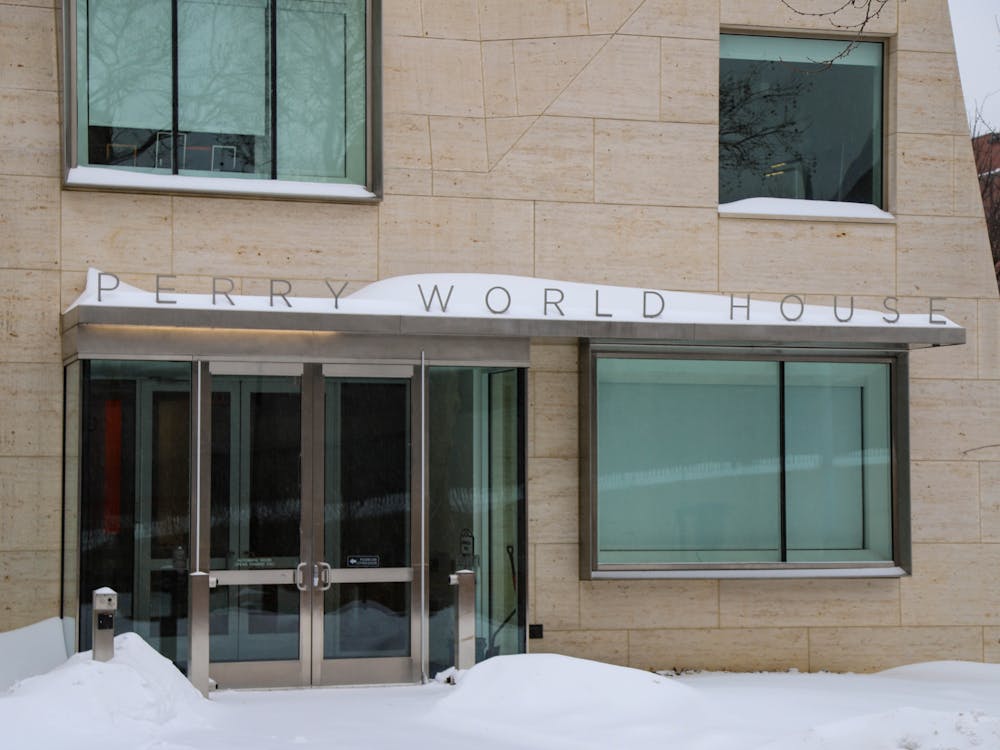
Perry World House recently launched the Penn International Climate Observatory to develop global policy and action.
The initiative began in July 2025 in an effort to translate climate science into information that can be used in current policy contexts across the world. This program attempts to sustain Penn researchers’ engagement in climate policy amid the U.S. government’s January withdrawal from the Paris Agreement.
PICO Project Director Koko Warner told The Daily Pennsylvanian that the initiative’s mission is to build “affordable, reliable, sustainable energy systems” and act as “a conduit” for “world class” research to connect.
“We want to make sure that society is safe and resilient, and we also need the high quality finance to make all of that happen,” Warner said.
She explained that climate discussions have traditionally centered around assessing long-term risks — which creates challenges for elected officials.
“The whole climate negotiations community has defined largely the issue of climate change as something to be avoided — they’re thinking about it in terms of a future that’s kind of far away,” Warner said. “We’re trying to bring it closer in the next one, two, three, four years when decisions are being made.”
Warner emphasized that the project is designed not only to generate research, but also to present information in ways that are directly relevant to policy leaders.
“In the real world, decision makers are bombarded with facts all day long, but what they need is something that’s reliable,” she said. “We want to help decision makers understand what they can do today.”
RELATED:
Perry World House set to commemorate 10th anniversary this fall
Perry World House hosts president of Namibia for talk on democracy, gender, and leadership
Michael Weisberg, Deputy Director of PWH, said that PICO addresses limitations in how climate issues are often framed by introducing a geopolitical lens to policy that is often “very siloed."
“The initial impetus of the project was to try to take that strategic understanding of where the world is, but also where it’s going,” Weisberg said.
Weisberg added that one of PICO’s main goals is expanding access to strategic climate information — particularly for “vulnerable countries that wouldn’t have that capacity.”
“The ministries of environment are incredibly talented, hard working people, but they have to cover so many fields, more or less on their own,” he said.
With PICO, PWH hopes to “globally democratize" the strategic information that big countries are able to develop through the work of their government experts.
Director of PWH Michael Horowitz said the initiative reflects the institution’s broader focus on climate policy. Of PWH’s many pillars — including security, climate change, global justice, and human rights — he noted that the climate change pillar has been one of its “most successful.”
PICO operates as a cross-disciplinary effort involving collaboration across multiple schools, including Penn Carey Law School and The Wharton School.
Warner described the observatory as “a bridge” between students, faculty, and policymakers. She added that PICO aims to “go where conversations are being held” and present information in ways that are relevant to decision makers.
PICO produces biannual Global Climate Trend Reports intended to help policymakers prioritize actions amid an increasingly complex climate landscape. Since its launch, the program has been involved in several international policy forums.
Ahead of COP30, PICO leaders contributed analysis focused on operationalizing global climate frameworks. The observatory also debuted programming on the sidelines of the Munich Security Conference, where it co-convened discussions on climate intelligence and strategic preparedness.
Looking ahead, Weisberg told the DP that PICO plans to become increasingly “demand-driven” by tailoring its research and outputs based on the needs of global policymakers and partner institutions.