

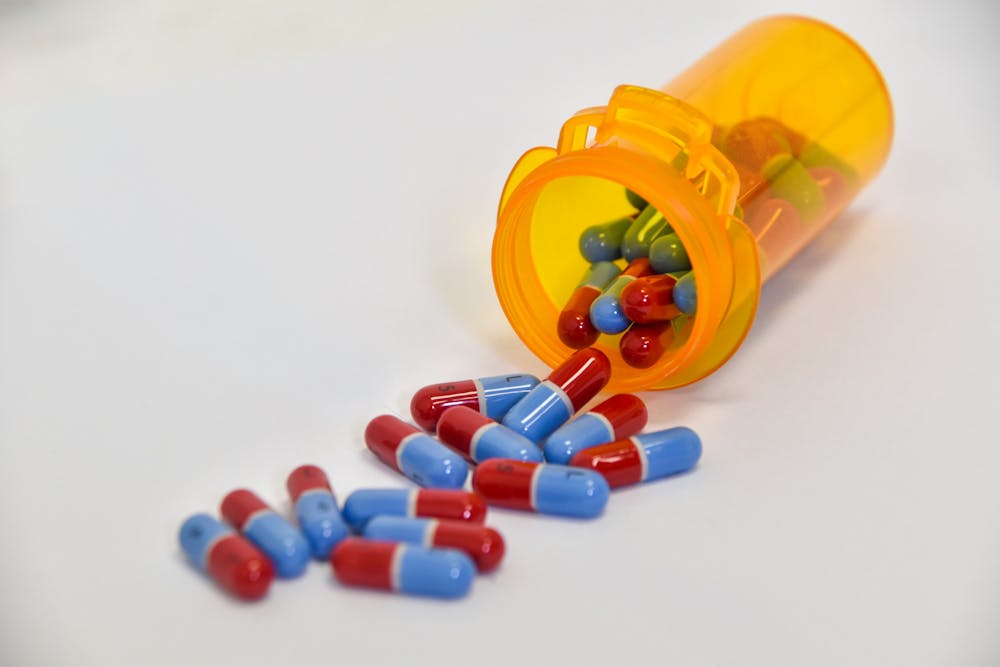
Penn faculty members discussed the Trump administration's recent announcement of a broad initiative coined TrumpRx aimed at reducing medication prices.
Operated by the federal government, TrumpRx aims to reduce the amount that Americans — including Medicaid patients — pay for medical drugs. The Daily Pennsylvanian talked to two leading health economists to understand the role TrumpRx may play in the national drug pricing landscape across.
The initiative seeks to reduce prices to what is paid by consumers in other developed countries, a principle known as most-favored-nation pricing.
The operation has received support from large pharmaceutical companies, with Pfizer, AstraZeneca, Eli Lilly, and Novo Nordisk having negotiated deals with the administration to market certain drugs at steeply discounted prices.
In return, the companies have received a range of benefits, including tariff relief; Eli Lilly and Novo Nordisk have stated that they will be exempt from Trump’s 100% tariff on pharmaceutical imports over the next three years. Many of the companies have also been promised expedited review of new drug applications they file with the Food and Drug Administration.
Economics professor Mark Pauly — who also serves as a faculty member in the Health Care Management and Business and Public Policy departments at The Wharton School — has worked extensively on measuring the effects of insurance on healthcare and patient spending. He wrote in a statement to the DP that TrumpRx resembles the structure of private sites that offer discounted prices to cash-paying customers.
Leonard Davis Institute adjunct senior fellow Robert Field noted that with TrumpRx, consumers can buy drugs directly from the manufacturer at a reduced price. However, he said the program would be of “little help” to people who already have insurance, since their copays would likely already be lower than the discounted price.
Pauly similarly noted that since only a small fraction of the population does not have drug insurance, the effects of TrumpRx may be limited.
RELATED:
Penn experts analyze off-cycle Democratic election wins, implications for 2026 midterms
Penn professor finds increase in political conversations between like-minded people, intolerance
According to Field, even with the discounted prices, uninsured consumers may still find these drugs inaccessible.
“In other Western countries, almost all of the population has coverage for prescriptions, so it's a question of how much the governments pay to make those drugs available,” Field said. “Here we're talking about people without insurance. So if the prices are comparable to what countries in western Europe pay, they're gonna have to pay that whole price. They're not going to be buffered by insurance,” Field added.
Still, Field noted that TrumpRx had a “potential” to work on a limited basis, specifically benefitting those without existing prescription coverage.
“I don't see it as a solution to the overall problem of drug prices. I think that it's more of a band-aid ... it's not going to change the overall dynamics. Drug pharmaceutical companies charge high prices in the US to counteract the lower prices in other countries, and they can't really afford to stop doing that,” Field said.
Pauly also wrote that attempts to regulate drug pricing were addressing the symptoms of the problem, rather than its source.
“Drug companies can only charge high prices because they get patents from the government that keeps competitors out for the term of the patent,” Pauly wrote. “It is ironic that the government is attacking the results of a system that it put into place [when it is] better just to change the terms of patents so there can be more generic competition sooner if you want lower prices.”
Both Pauly and Field noted concerns about TrumpRx being a federally operated program that partners directly with drug companies.
Field said that while there have previously been calls for the U.S. to regulate drug prices, there have also been concerns that this regulation could impede research and innovation of new drugs.
“A government site gives the president the opportunity to praise some drug firms that discount prices (free advertising) while blaming others who may choose not to,” Pauly wrote.
Field noted the presence of a “political dimension” created by the inclusion of the government in deciding what drugs will be available through this program.
Despite these concerns, Pauly noted that if TrumpRx operated successfully as a government-run platform, more government oversight could become widespread throughout the healthcare system, such as with Medicare, Medicaid, and Obamacare.
RELATED:
Penn experts analyze off-cycle Democratic election wins, implications for 2026 midterms
Penn professor finds increase in political conversations between like-minded people, intolerance
Staff reporter Sameeksha Panda covers science and health and can be reached at panda@thedp.com. At Penn, she studies chemistry.


