

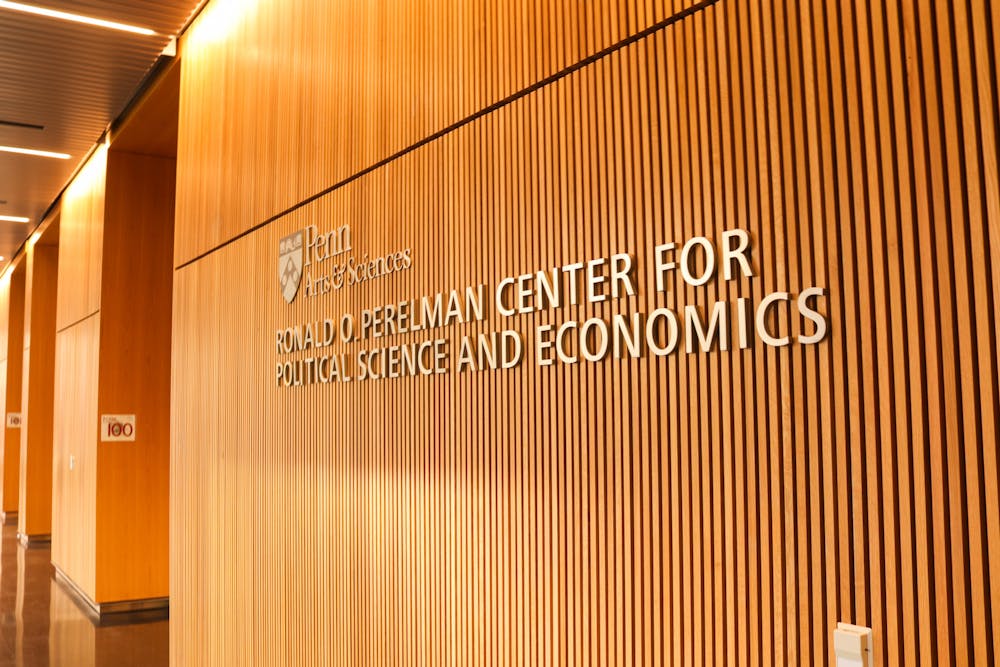
Multiple Penn political science experts spoke with The Daily Pennsylvanian about the results of the recent off-cycle election.
Democrats made major electoral gains nationwide on Nov. 4, winning by large margins in competitive gubernatorial races in New Jersey and Virginia and a special redistricting proposition in California. Penn professors attributed the heightened Democratic turnout to voters’ opposition to 1968 Wharton graduate and President Donald Trump’s policies, while cautioning against over-interpreting the implications of the results for elections in 2026 and 2028.
This year’s election results were part of a larger pattern where the party not in power performs better in off-cycle elections, Penn political science professor Daniel Hopkins said, citing Democratic wins in 2017 and Republican victories in 2009.
“This is a continuation of that trend, but it’s also an exaggeration of that trend, for a couple of reasons,” Hopkins told the DP. “One is that the Trump administration, because it has moved aggressively on a number of public policy fronts, has generated more opposition and a greater sense of threat among Democrats.”
Penn political science professor Stephen Pettigrew — who also serves as the Director of Data Sciences of Penn’s Program on Opinion Research and Election Studies — noted that high turnout has been a defining feature of elections since Trump first took office in 2016.
“It continues the trend that we’ve been seeing since the first time Trump got into office, where seemingly every election — even ones that are typically very low attention, low turnout — have been seeing relatively high turnout,” Pettigrew said.
Pettigrew added that opposition tends to be a stronger motivator than satisfaction with the status quo.
“It's much easier to motivate people to take action and go vote when there’s something kind of that they’re not happy about, versus getting people to go out and vote because they’re happy with how things are going,” Pettigrew said. “Arguably, 2024 was a similar story where people were unhappy with the Biden administration, and to some extent, blaming them for inflation and what had happened over the previous four years.”
RELATED:
2025 election marks highest Penn off-cycle voter turnout in past decade, DP analysis finds
Penn political science professor Matthew Levendusky suggested the results indicate support beyond just the traditional Democratic base, noting that Democrats Mikie Sherrill in New Jersey and Abigail Spanberger in Virginia won by unexpectedly large margins. He also pointed to the California redistricting initiative passing by a wider margin than expected.
“This can’t just be explained by Democrats mobilizing Democratic voters,” Levendusky said. “It does seem like some independents and people who probably supported Trump in the past did switch over to supporting these Democrats.”
PORES director John Lapinski noted that this year’s pre-election polling had been unreliable, as political pundits made “bad assumption[s]” based off of the 2024 presidential elections.
Lapinski said he expected both Sherrill and Spanberger to win but was surprised by their margins of victory. He cited dissatisfaction with the Trump administration’s handling of the economy as a key reason for the Democratic wins.
“Trump now owns the economy, and he made a lot of promises to people that did not turn out to be true,” he added.
The New York City mayoral race, however, Lapinski described as a “unique race” that wasn’t defined along traditional party lines. Instead, he characterized the outcome as a result of internal Democratic divides between “old versus young” and “progressive versus centrist conservative Democrat.”
Pettigrew similarly emphasized that economic concerns consistently dominate voter decision-making.
“In virtually every election, the biggest issue on people’s minds is almost always the economy or something related to their personal economic situation,” Pettigrew said. “There’s no reason to think that 2026 will be that different.”
Levendusky cautioned against overemphasizing “partisan fights and these hot-button issues” when understanding voter motivations. He echoed Pettigrew’s observation that most voters are motivated by “more prosaic” concerns like affordability and the economy.
Levendusky also pointed to demographic patterns that favor Democrats in lower-turnout elections.
“More college-educated voters tend to vote democratic,” he said. “So because education is positively correlated with turnout, Democrats are going to do better in these low-propensity elections.”
Multiple experts cited the recent government shutdown as a factor that energized Democratic voters and hurt Republicans.
“Trump is underwater — that’s mobilized Democrats,” Lapinski said. “The Republicans were losing the public opinion war, at least on the shutdown, and it juiced up the Democrat side a little bit.”
Levendusky also noted that the shutdown had a particularly significant impact in Virginia, where Spanberger won.
“I think one thing that helped Abigail Spanberger is that the largest set of federal workers live in Northern Virginia,” Levendusky said. “That was a place I think felt especially hard hit by the DOGE cuts in the spring [and] the government shutdown this fall.”
Several professors also spoke to the implications of this year’s races for the midterm elections and Pennsylvania Gov. Josh Shapiro’s reelection campaign in 2026.
Hopkins said that the president’s party typically fares worse in the midterm elections of the president’s second term, but the four-year gap between Trump’s two terms could negate that phenomenon.
“I think an interesting question is the extent to which 2026 is going to be more like a first-term midterm … or if it’ll be like a second-term midterm, which more frequently does go badly for the party in power,” he said.
Hopkins also noted that he is interested to see how demographic trends play out in 2026.
“Donald Trump in 2024 saw atypically high support among Latino voters, and to some extent among African American voters, as well as among younger voters,” he told the DP. “One of the questions going into 2026 is going to be, ‘Was 2024 a one-off… [or] did 2024 represent a meaningful and durable realignment?’”.
Democratic gains this year could create a “very healthy” political climate that could be favorable for Gov. Josh Shapiro’s reelection campaign in 2026, Pettigrew argued.
Lapinski similarly said that Shapiro will enter next year’s race as the favorite, but Pennsylvania’s status as a swing state will keep the race competitive.
Political science professor Marc Meredith warned against overstating the importance of this year's election in predicting what will happen in 2026.
“Politics seems to move very rapidly right now. What we’re talking about this week might not be at all reflective of what we’re talking about next week,” Meredith said. “That gives me pause from trying to draw too many conclusions about what’s likely to be 51 weeks from now.”
Contributing reporters Ananya Karthik, Rachel Erhag, and Arti Jain contributed reporting.
RELATED:
2025 election marks highest Penn off-cycle voter turnout in past decade, DP analysis finds
Senior reporter Riana Mahtani covers national politics and can be reached at mahtani@thedp.com. At Penn, she studies political science. Follow her on X @Riana_Mahtani.
Senior reporter Alex Dash covers administration and can be reached at dash@thedp.com. At Penn, he studies history and political science. Follow him on X @AlexBDash.


