

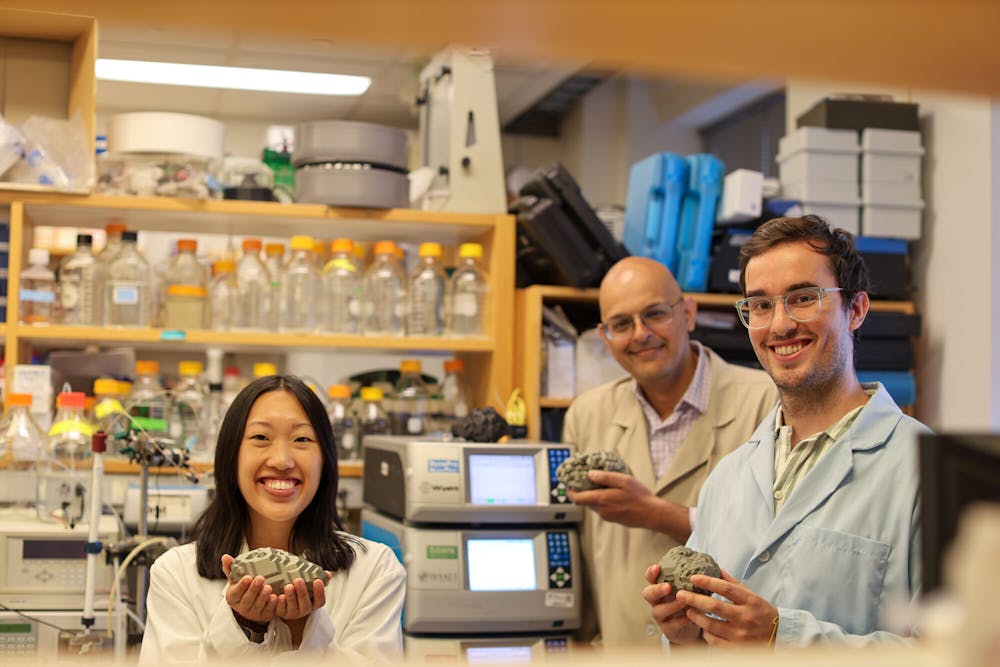
Penn researchers published a study revealing the effectiveness of lipid nanoparticles in delivering medicines to patients’ cells.
The study was published in Nature Biotechnology last month and marks a shift in scientists’ understanding of how to efficiently cure specific diseases. Michael Mitchell, a bioengineering professor at the School of Engineering and Applied Science, led the research team and co-authored the paper alongside Kushol Gupta, a professor at the Perelman School of Medicine.
Penn’s team collaborated with researchers from Brookhaven National Laboratory — a United States Department of Energy national laboratory — and Waters Corporation — a scientific instrumentation and analytical laboratory technology company.
Mitchell explained that understanding and utilizing the specific structures of LNPs could make them better suited to dealing with specific mRNA-based treatments.
“Treating LNPs like one model of car has worked, as evidenced by the millions of people these particles have helped, but LNPs are not one-size-fits-all for every RNA therapy,” Mitchell wrote in the Penn Engineering blog. “Just as pickups, delivery vans, and freight trucks best suit different journeys, we can now begin to match LNP designs to particular therapies and tissues, making these particles even more effective.”
Prior to this study, many scientists believed that all LNPs were in “more or less the same blueprint.” The Penn researchers challenged this notion, opening up a new frontier for mRNA-related research. Mitchell explained that the new study provides a “road map” for more “rationally” designing LNPs.
“These results deliver a more fundamental understanding of how the composition and shape of these therapeutic particles relate to their biology,” Gupta wrote in the blog. “These particles have already proven themselves in the clinic, and these insights will make them even more powerful by helping us tailor delivery to specific diseases more quickly.”
The study’s methods — including the use of a particle accelerator — make it possible for other scientists to replicate and build on its results. Specified LNP design could allow for advancements in various medical and pharmaceutical fields, from cancer to vaccines to drug development.
RELATED:
Penn researchers find children, adolescents who contract COVID twice at higher risk for long COVID
Perry World House hosts panel to discuss the future of global public health
In February, Mitchell spoke to The Daily Pennsylvanian about how new mRNA treatments are uniquely able to adapt to combat different types of diseases.
“What’s powerful about mRNA technology is all we have to do now is simply go in and alter the sequence of mRNA, and it can alter from a vaccine to a drug,” Mitchell told the DP.





