

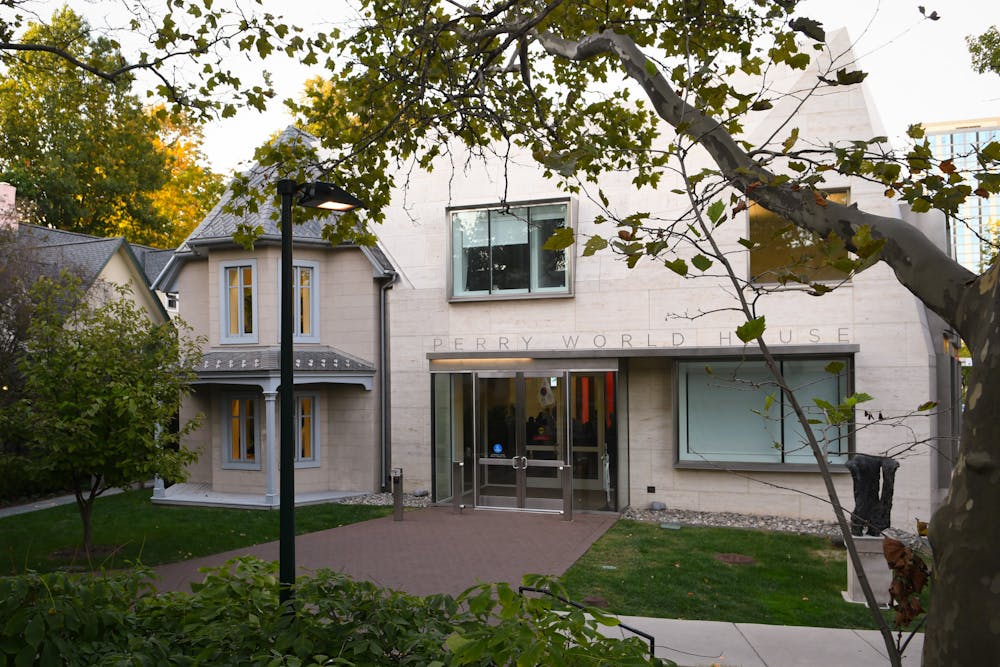
On Tuesday, professors across multiple Penn schools co-sponsored a discussion at the Perry World House on the future of global public health with Japanese Senior Assistant Minister for Global Health, Ministry of Health, Labour, and Welfare Satoshi Ezoe.
The Sept. 30 event featured an introduction by professor and Margaret Bond Simon Dean of Nursing Antonia Villarruel, followed by an expert panel that was moderated by Penn Carey Law professor Eric Feldman. The panelists emphasized the importance of cooperation within public health, stressing how international challenges require global action.
One of the panelists, School of Veterinary Medicine Assistant Professor Louise Moncla, drew several parallels between COVID-19 and her own studies, which have largely been focused on the highly pathogenic avian influenza.
She explained how the pathogens she studies initially developed domestically before evolving to transmit in wild birds. Consequently, migratory birds began carrying the viruses globally.
“A virus doesn't know any geographic boundaries,” Moncla explained.
The panel spent a large portion of its time discussing the globally varying responses to the COVID-19 pandemic. All three panelists agreed that communication is essential in tackling global health issues but also commented on the difficulty of doing so successfully.
Viola MacInnes/Independence Professor of Nursing Jennifer Pinto-Martin, explained that there was a lack of trust in government policies.
America was “building the plane as they were flying it,” she said, referencing the fact that policies were constantly changing.
The Centers for Disease Control and Prevention does not hold any regulatory power over government policies, Pinto-Martin said, so regulations were left for the state governments to enforce individually.
“It created this sense of ‘who's steering the ship?’” she said. “Do we even know what's happening?”
In doing so, she explained that it is important that we have a “thorough retrospective” of what went right and what went wrong.
Ezoe — the event’s guest speaker — weighed in by comparing the American and Japanese experiences.
He highlighted how actions that naturally reduced the spread of the pandemic were already ingrained in Japanese culture before the pandemic happened, both through their establishment of an equitable universal healthcare system and their sanitary measures, such as mask-wearing and hand-washing.
However, he also noted that the Japanese response and preparation was not flawless, and they had to draw inspiration from other countries.
“We didn’t have a clear line of command prior to the COVID crisis,” Ezoe said during the event. “We didn’t have — like in the American case — a CDC at the federal level. We learned from the US system, and we ended up creating our own version of the CDC.”
Ezoe was Japan’s main negotiator for the World Health Organization’s Pandemic Agreement. He explained that one of the main goals of the agreement was to facilitate a “pandemic access and benefit sharing system” through which pathogens could be shared immediately in order to develop vaccines as quickly as possible.
The panelists expanded their discussion to the United States’ decision to leave WHO and the consequences this might have for national and global health care.
Following the event, Moncla spoke to The Daily Pennsylvanian about the decision and how it may affect research nationally and internationally.
“It makes me deeply sad — we as a country are well equipped to respond to public health threats, and it's really sad to throw away that information,” she told the DP.
Staff reporter Rachel Erhag covers student government and can be reached at rerhag@sas.upenn.edu. At Penn, she studies philosophy, politics, and economics. Follow her on X @RErhag.


