

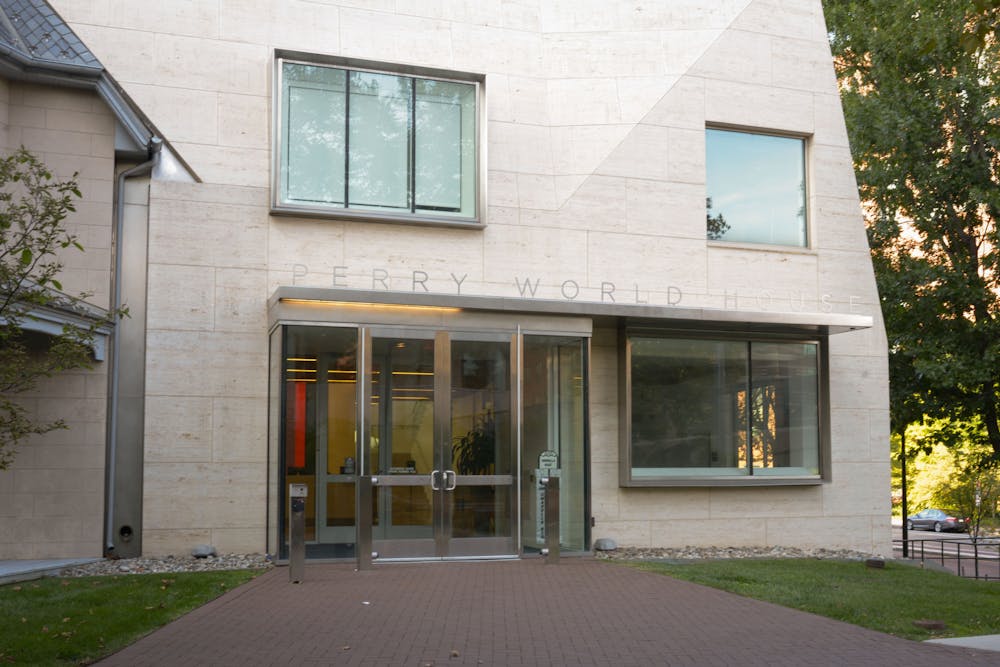
Perry World House and the Center for the Study of Contemporary China hosted a policy roundtable event about the evolving state of relations between the United States, China, and Taiwan.
The event, hosted Oct. 3 at the Perelman Center for Political Science and Economics, was moderated by University of Pennsylvania Carey Law School professor Jacques deLisle and featured Brookings Institution’s Taiwan expert Ryan Hass and Davidson College’s Asian studies professor Shelley Rigger. The panelists discussed the state of the political and economic relations between China and Taiwan, the democratization of Taiwan, and the United States’ administration’s actions related to the cross-strait relations.
This event, which had an in-person audience of over 35 Penn students and faculty as well as virtual viewers on Zoom, was the first Perry World House policy roundtable of the 2025-26 school year.
“The Taiwan issue has been one of chronic significance. … It has been seen as the most likely focal point of a potential U.S.-China conflict,” deLisle said in an interview with The Daily Pennsylvanian.
Previously, the United States utilized a policy of strategic ambiguity, deLisle explained, in which China was deterred from attacking Taiwan, while Taiwanese leaders were deterred from declaring formal independence.
“There has been significant concern about whether the Trump administration’s policy changes will affect the relationship,” deLisle added.
1968 Wharton graduate and President Donald Trump has expressed that he can avoid a war in the Taiwan Strait, according to Hass, though Trump believes Taiwan has taken advantage of the U.S. security umbrella.
“How do you put these in an equation to make a mathematical output? I don’t know,” Hass said during the event with regards to Trump’s beliefs on cross-strait relations.
RELATED:
Center for the Advanced Study of India and Perry World House host talk on Indian climate change
In an interview with the DP, Rigger reflected that the panel was “just providing a bit of an update to the audience … because of the changes in US foreign policy, or China’s Taiwan policy, or Taiwan’s position between the two.”
About the speakers, deLisle said that “these are two of the top experts in cross-strait relations, in U.S.-Taiwan-China relations, and in Taiwan politics.”
deLisle also noted the importance of roundtables in framing issues within an academic context, which differs from a general audience or even a more policy-oriented one.
“The idea with these roundtables is to get people who can speak to policy-relevant issues … put it in a perspective that is appropriate to a more academic audience, and to an audience of people who are not just doing day-to-day policy, but are kind of looking at the bigger picture,” he added.
RELATED:
Center for the Advanced Study of India and Perry World House host talk on Indian climate change
Staff reporter Samantha Dasika contributes to data and enterprise reporting and can be reached at dasika@thedp.com. At Penn, she studies neuroscience.


