

The Center for the Advanced Study of India (CASI) hosted a lecture by Princeton professor and climate policy expert Navroz Dubash on climate change policy in India.
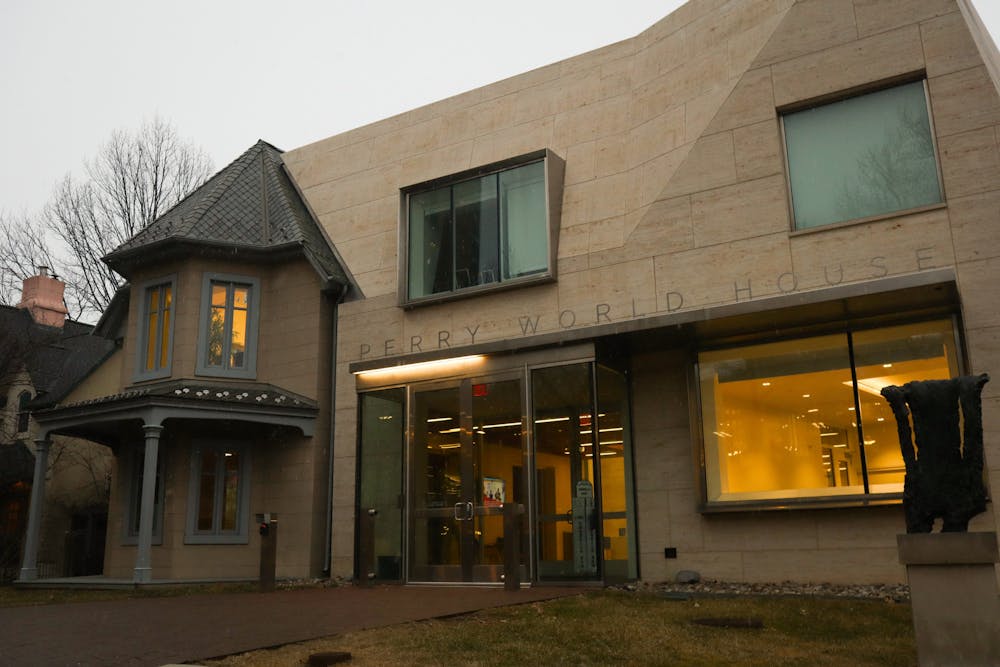
The event, held at Perry World House on Sept. 25, featured a talk by Dubash followed by a panel discussion with CASI-affiliated students and faculty. Dubash stated that “domesticating” climate change in India was an urgent yet complex issue.
Dubash, who previously spent 15 years at the Centre for Policy Research in New Delhi explained that “domestication” means bringing global climate goals into conversation with the realities of domestic politics and development needs.
“Climate change is not just an emissions issue,” he said in his talk. “It’s about jobs, infrastructure, agriculture, and energy.”
Dubash explained that India needs to move beyond a “development-climate dichotomy” in which only one or the other can be prioritized and added that India must identify pathways to low-carbon and climate resilient futures.
He also described how different policy pathways can lead to very different emissions outcomes and futures. Dubash claimed that India’s long-term strategy should focus on low-carbon sectoral transitions, especially in electricity, transport, urban buildings, land use, and finance, each guided by specific questions that focus on both the development and the climate. He explained that the conversation around climate change must be framed around India’s developmental trajectories so that climate policy becomes a pathway to inclusive growth, rather than an emissions tally.
In an interview following the event, Dubash elaborated on his belief that no single group can lead climate action alone.
“It’s about developing the technology, deploying it, making sure jobs are created, and making sure that supply chains are managed,” Dubash told The Daily Pennsylvanian. “It always takes groups of people. It includes the government and the state. Engineers have to be very much part of that conversation, and it has to be a collective event.”
RELATED:
Former White House economist Heather Boushey appointed Stuart Weitzman School of Design professor
Public confidence in U.S. health agencies has decreased, Annenberg Public Policy Center study finds
The event also featured insights from Vaishnavi Chandrashekhar, a science and environment journalist and CASI’s visiting fellow for the fall. Chandrashekhar has reported on both scientific research and community experiences across India.
Chandrashekhar also noted that while climate change is global, its impacts are local. For example, she explained how fishing communities on the coast face sea level rise and warming oceans, while communities in the Himalayas “might see melting glaciers or the landslides.”
“The impact of climate change has been felt by people in different places in particular ways,” she said.
She added that India is investing in technological responses, from better weather forecasting to research on climate-resilient crops, but cautioned that translating global goals into domestic action remains difficult.
“[It can] be difficult to translate these global goals and global negotiations and ideas into country-level implementation,” Chandrashekhar said.
For Penn students in attendance, the event connected climate change to their own academic and professional interests. College of Arts and Sciences first year Laura Dragomir said she appreciated the framing of climate change through domestic politics rather than just “going green.”
“It made me realize how important it is to build connections across levels of government to work together on policy issues to enact a change that is actually tangible,” Dragomir said.
College first year Kyle Zachary Chua-Unsu commented further that macro-level global policies such as the Paris Agreement “haven’t necessarily been translated into direct action to solving climate issues, especially on a more local level.”
He said that countries should try to make the policies “politically attractive to pursue these climate projects or initiatives.”
Both Dubash and Chandrashekhar stressed that climate change cannot be siloed. Penn students resonated with this message, seeing how environmental solutions will increasingly become politically attractive and economically viable in their careers.
College first year Ellery Spikes said that climate and sustainability are “inherently ingrained within other industries” and “are very helpful to prepare students to see how it’s very applicable across a wide range of fields.”
For Dubash, the challenge remains turning this global urgency into a domestic issue.
“Domestication, for me, means taking into account the domestic political context when you’re making climate policy in a way that seriously engages with its complexities,” Dubash said.
RELATED:
Former White House economist Heather Boushey appointed Stuart Weitzman School of Design professor
Public confidence in U.S. health agencies has decreased, Annenberg Public Policy Center study finds
Senior reporter Rachel Kang contributes to data reporting and can be reached at kang@thedp.com. At Penn, she studies neuroscience. Follow her on X @rchllkng.


