

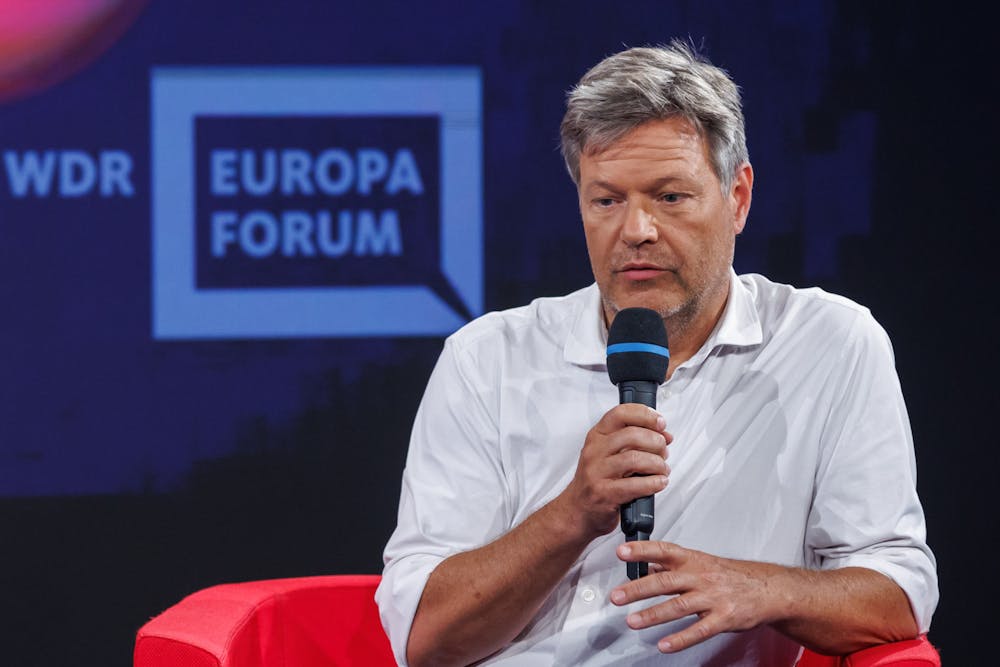
Perry World House's Distinguished Visiting Fellow and former Vice Chancellor of Germany Robert Habeck took part in a PWH Climate Week discussion on Oct. 16.
The Saturday discussion — attended by around two dozen students — was part of the sixth annual Climate Week at Penn, which featured over 50 scheduled events from Oct. 13 to 17. During the conversation, Habeck discussed climate policy, democratic governance, and the personal dimensions of political leadership.
“As the climate crisis intensifies, governments must navigate an increasingly difficult trade-off: how to advance ambitious climate and energy goals while safeguarding national security and economic prosperity,” PWH wrote in their event description.
As a member of Alliance 90/The Greens, Habeck oversaw major reforms in Germany’s energy transition in the period following the Russian invasion of Ukraine and the German and European energy crisis. He stated that implementing policies like phasing out fossil gas ovens and other decarbonization measures often required political courage.
“Working for the government means you are the state, and the state does not make mistakes,” he said during the event. “If you want to reduce bureaucracy and regulations, you have to make a trade-off with the people who are writing the laws, who are responsible for everything.”
Throughout the discussion, Habeck — who served as a member of the German Parliament and party leader of the Green Party — often returned to the tension between political ideals and public opinion.
“Politics is about winning the argument,” he said. “There’s a conflict, sometimes [between] the demands of reality, and the demands of your party. When your party’s under stress, the tendency to act to the demands of the party becomes stronger.”
Habeck emphasized that renewable energy is “not a political decision,” but rather a “market decision” as the global energy market has "decided that renewable energy in some form or another is the main source of energy of the future."
RELATED:
Bill Nye lecture, new art installations highlight Penn's sixth annual Climate Week
Penn's sixth annual Climate Week to highlight global 'climate hotspots' with over 50 events
When asked about his approach to negotiations in politics, Habeck named trust and empathy as central to his diplomacy.
“The best approach is to be honest to your partner,” he said. “Be honest, find a relationship, be trustful, maybe laugh a little bit — and in the end it’s people who make compromises, not machines.”
Habeck stated that his interest in the PWH Visiting Fellows Program stemmed from his acquaintance with former Penn President and United States Ambassador to Germany Amy Gutmann, in whom he had found “not only a true partner, but a real friend.”
“I have also now the feeling that I can give something back,” he said about his ongoing lectures on German and European politics as a fellow.
Niklas Romberg, president of the Penn German Society, wrote to The Daily Pennsylvanian that “talking to Robert Habeck [...] was an incredible opportunity.”
“Many of us still lived in Germany or Europe while Dr. Habeck was in government,” he wrote.
For Romberg, what stood out most was Habeck’s candor.
“He answered in a very frank manner to many of our questions, and did not shy away to say outright how he felt in some of his most difficult situations,” he wrote. “Many of us left this discussion deeply moved and inspired, hopeful as well as worried about the state of democracy in Germany and the world.”
Penn hopes to promote advocacy among students through the events hosted by Climate Week. As stated on their website, Climate Week offers “opportunities for every member of the Penn community to learn about and act on the climate crisis.”
RELATED:
Bill Nye lecture, new art installations highlight Penn's sixth annual Climate Week
Penn's sixth annual Climate Week to highlight global 'climate hotspots' with over 50 events
Staff reporter Candice Felderer covers admissions and can be reached at felderer@thedp.com. At Penn, she studies philosophy, politics, and economics.


