

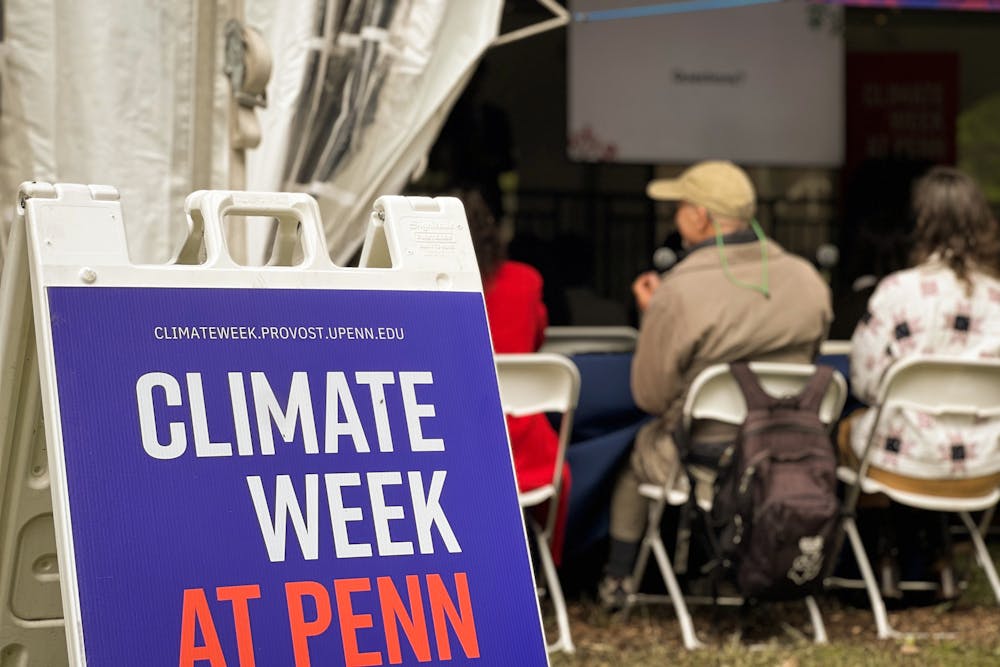
Penn’s sixth Climate Week took place last week, engaging students, faculty, and community members through more than 50 events.
Climate Week, which ran from Oct. 13-17, was themed “Hot Spots,” bringing attention to both literal and metaphorical hotspots caused by the climate crisis both in the United States and around the world. Events ranged from interactive workshops to lectures by Penn faculty and visiting scholars. Of these, perhaps a highlight of the week was a Friday conversation between Penn professor Michael Mann and scientist and engineer Bill Nye, which drew a large crowd to Irvine Auditorium.
They discussed Nye’s journey from starring on the children’s show, “Bill Nye the Science Guy,” to becoming a key voice in the climate advocacy movement.
“When you learn the fundamentals of biology, you realize the importance of ecosystems,” Nye said. “And then, you realize the importance of the environment for our [individual] health — let alone the health of the world or ecosystems or species around the world.”
Nye also emphasized the importance of youth involvement in climate advocacy — and remaining “optimistic” about the ability to make change.
“When it comes to climate science, eschewing and ignoring mainstream science, we are headed in the wrong direction,” Nye told the crowd. “The situation is going to turn around, but I’m asking you guys to turn it around right now.”
On Oct. 15, nine professors across a variety of concentrations from the Wharton School participated in an “Iron Chef”-style research showcase in which each participant presented a five-minute summary of their climate-related research. Topics ranged from an estimation of the United States economy’s “carbon burden” to the effects of desalination plants on global warming and the impact of climate risk on insurance markets.
Wharton professor Brian Berkey called for firms to reject the profit-maximizing principle in light of the climate crisis.
RELATED:
Penn’s sixth annual Climate Week to highlight global ‘climate hotspots’ with over 50 events
Inside Penn Dining’s plan to achieve ‘near-zero waste,’ improve sustainability
“Maximizing profits very well could destroy the planet,” Berkey said. “Managers, ethically speaking, must take things like effects on the climate directly into account in their decision making.”
Wharton professor Witold Henisz spoke on the effects of shareholder engagement and climate laws on firms’ carbon dioxide emissions.
“In countries like the United States now, where our climate laws are being withdrawn to some extent and one might argue we don't have a strong rule of law, climate activism becomes really important if we want to reduce emissions,” Henisz said.
On Wednesday, the School of Arts and Sciences and the Environmental Innovations Initiative hosted the annual 1.5 Minute Climate Lectures on College Green, featuring seven speakers who related this year’s “Hot Spots” theme to their research or professional work.
Political Science professor Guy Grossman discussed migration as a form of climate adaptation, Environmental Science professor Leigh Stearns emphasized the need for coordinated satellite and artificial intelligence in navigating the rapidly changing Arctic glaciers, and Architecture professor Dorit Aviv described her work on passive cooling systems in reducing urban heat.
Additionally, Robert Habeck reframed climate action as a defense of freedom, saying during his lecture that “climate protection is not about protecting the climate, but protecting freedom.”
The event concluded with a question-and-answer session, in which Penn community members asked the speakers about carbon storage, migration policy, and the role of universities in addressing the climate crisis.
“Every tenth of a degree is worth fighting for,” moderator and Francophone, Italian, and Germanic Studies professor Simon Richter said.
On Oct. 14, Climate Week hosted the inaugural Transform Penn event, supported by Penn’s Green Fund, which provides financial support for innovative, sustainable projects. Students were invited to pitch sustainability projects and initiatives in a “Shark Tank”-style live competition.
The competition was judged by Penn faculty members from the School of Engineering and Applied Science, SAS, and Penn Sustainability. The winning pitches were awarded support and mentorship for their projects, specifically towards applying for the Green Fund. The event consisted of five-to-ten minute presentations from student groups followed by a brief Q&A session.
One pitch was titled “Green OR” and focused on reducing waste generated by Penn Medicine, the Children’s Hospital of Philadelphia, and the Veteran’s Affairs Medical Center through medical tray optimization, smart waste segregation, and a friendly competition between the three hospitals based on sustainability performance.
Another pitch, titled “BikePenn,” proposed creating a biking service on Penn’s campus that would provide loans, free maintenance, safety training, and bike mentors.
Engineering first year Kaovya Vel came across the competition from the Climate Week newsletter and expressed her excitement about the event.
“It was interesting to see how students can get involved to actually change something about Penn,” Vel said.
Throughout the week, an art exhibit by Jeanne Blissett Robertson sat in the lobby of Hayden Hall. Titled “Another Way of Knowing,” the exhibition was a collaboration between Robertson and Penn biogeochemist Jon Hawkings, drawing on two weeks of fieldwork in Greenland and lab analysis of mercury in meltwater. Large porcelain iceberg sculptures were displayed near 3D-printed numerals of mercury levels glazed in Greenlandic fjord sediment.
“When I describe the project, it’s like looking at things in both a macro and a micro way — the landscape and the feeling it gives you and then, the really exact data set of numbers,” Robertson said in an interview with the DP.
RELATED:
Penn’s sixth annual Climate Week to highlight global ‘climate hotspots’ with over 50 events
Inside Penn Dining’s plan to achieve ‘near-zero waste,’ improve sustainability
Senior reporter Kathryn Ye covers central administration and can be reached at ye@thedp.com. At Penn, she studies biochemistry and philosophy. Follow her on X @Kathryn__Ye.
Senior reporter Norah Findley leads coverage of science and health and can be reached at findley@thedp.com. At Penn, she studies environmental studies. Follow her on X @NorahFindley_.
Senior reporter Phoebe Anagnos covers student life and can be reached at anagnos@thedp.com. At Penn, she studies architecture and earth science. Follow her on X @phoebeeanagnos.


