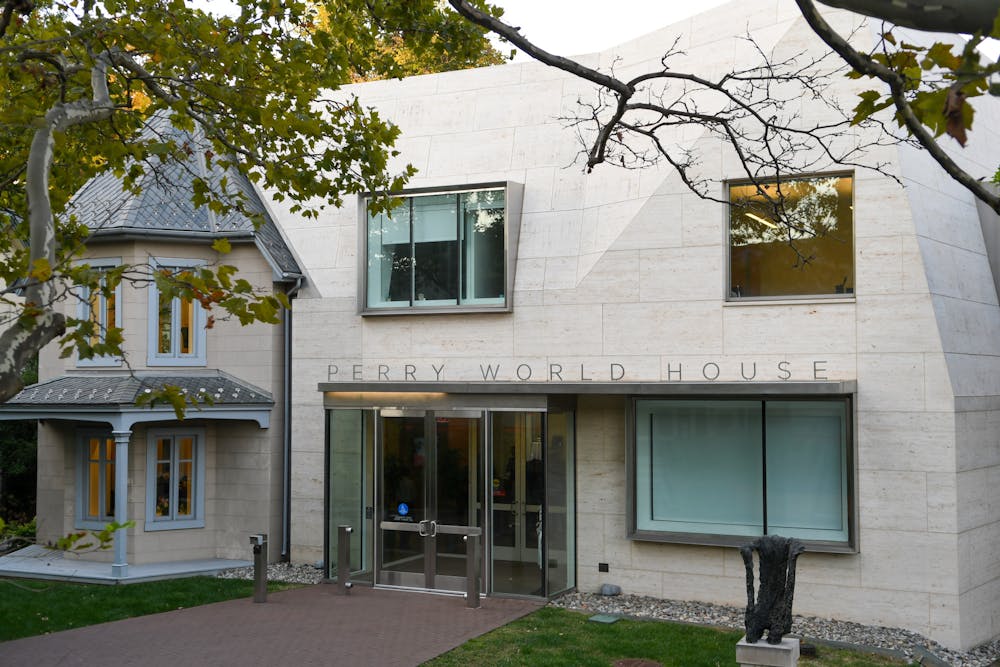
Perry World House hosted Netumbo Nandi-Ndaitwah, the president of Namibia, on Thursday for a conversation on democratic governance, gender parity, and Africa’s economic future.
The event, titled “Democracy, Gender, and Leadership in Africa,” attracted an estimated 200 to 250 attendees. President Nandi-Ndaitwah was introduced by Wharton School Dean Erika James, who framed the event around leadership and the role of universities in strengthening democratic institutions.
Nandi-Ndaitwah, who became Namibia’s first female president in March 2025, began her prepared opening remarks by thanking Penn for what she called its “enduring commitment to global leadership.” She went on to describe Namibia as “one of the most stable democracies on the African continent,” pointing to its constitutional separation of powers and tradition of peaceful elections since independence in 1990.
“We have maintained a democracy grounded in respect for the rule of law, institutions, peace, and political stability,” she said.
Nandi-Ndaitwah outlined seven domestic priorities: agriculture; sports; youth empowerment; quality education and training; creative industries; quality health services; and land, housing, and sanitation. She paired these with what she called “economic enablers,” including mining, energy, oil and gas, tourism, agriculture, fisheries, transport and logistics, and infrastructure.
She also highlighted youth unemployment as an urgent challenge and pointed to her administration’s goal of generating 500,000 jobs.
“More than 44.4% of Namibian young people are unemployed, so everything we are doing now is to create jobs [for them],” she said.
Nandi-Ndaitwah also emphasized shifting Namibia’s role in the global economy. According to her, for decades, African nations exported raw resources without capturing their full value.
RELATED:
Perry World House announces scholars, policy experts in 2025-26 visiting fellows cohort
Meet three faculty members joining 17th cohort of Penn Fellows
“We are now seeking a strategic investment in local processing, refining, and manufacturing,” she said. “The objective is clear: to ensure the value of our resources benefits our people.”
With regard to the role of women in government, Nandi-Ndaitwah said that her administration has moved “beyond mere representation” to meaningful inclusion. With women holding half of cabinet posts, she argued that their presence reflects competence, not symbolism.
“Gender equality and leadership excellence are not mutually exclusive; they are mutually [reinforcing],” she said. “Women in leadership is not a favor; the people of Namibia see value in me and believe deeply in me.”
Joseph Asunka, the CEO of Afrobarometer — a Pan-African research network — was the moderator of the conversation. Asunka drew on Afrobarometer’s research, noting that survey data from North Africa shows widespread concern about gender-based violence. Nandi-Ndaitwah acknowledged that gender-based violence is an issue, saying that “[it’s] not just an Africa problem; it’s a world problem.”
She emphasized the need for long-term societal change to combat gender-based violence.
“The biggest problem is mind change,” she said. “It’s wrong to think that just because there’s a woman president, there is gender equality. We must go deeper and find what’s the problem.”
Appealing directly to students in the audience, Nandi-Ndaitwah urged collaboration between Namibian institutions and American universities — including Penn — on research, entrepreneurship, and workforce development. She added that education “remains the greatest equalizer all over the world” and highlighted Penn as a natural partner for youth empowerment and innovation.
“To the students: you are not the witnesses of the future, you are the actors,” she told the audience. “We invite you to collaborate with Namibia as strategic partners. Together with you as our partners, we can deliver on our commitment as a continent that is ready to lead and take care of its citizens.”
College senior Collin Schneider, studying political science and African studies, said he tries never to miss the opportunity to hear from a head of state.
“It’s such a unique opportunity to have access to somebody who most people would not be able to hear speak so candidly,” he said, adding that he was struck by Nandi-Ndaitwah’s point about electing “women of substance” rather than having token female leaders.
Schneider said he saw lessons for the United States in her emphasis on unity and resilience.
“I think every lesson she mentioned could apply to the United States, [like when she talked] about electing people based on who they are and the substance of their character,” he said.
RELATED:
Perry World House announces scholars, policy experts in 2025-26 visiting fellows cohort
Meet three faculty members joining 17th cohort of Penn Fellows
Senior reporter Ananya Karthik covers central administration and can be reached at karthik@thedp.com. At Penn, she studies communication and economics. Follow her on X @ananyaakarthik.