

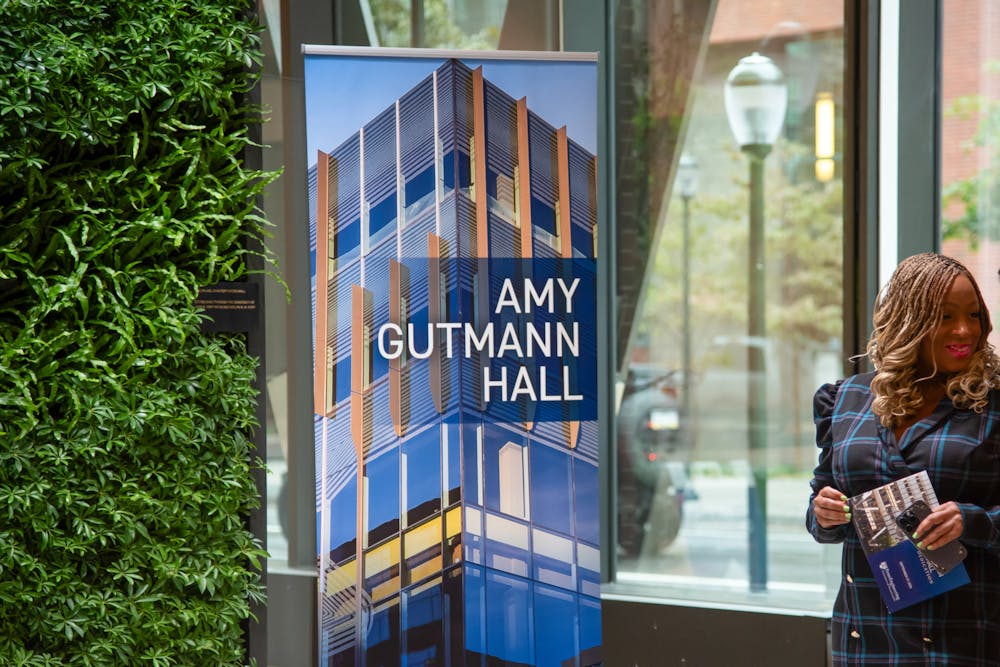
Multiple buildings on Penn’s campus have been designated with certifications from the Leadership in Energy and Environmental Design program.
The buildings — which include the Vagelos Laboratory for Energy Science and Technology, Amy Gutmann Hall, and the Ott Center for Track and Field — were recognized for their sustainable construction and design. Granted by the United States Green Building Council, LEED certifications represent an international standard for sustainability.
The recent designations bring the total number of LEED-certified buildings at Penn to 55.
“These LEED certifications reflect Penn’s commitment to sustainable building design,” Mark Kocent, Penn’s principal architect, told Penn Today. “Each project is designed with energy efficiency, ecological integration, and occupant wellness at its core.”
Kocent noted that the recognitions reflect Penn’s commitment to sustainable innovation as part of the “In Principle and Practice” strategic framework, which was first launched in 2023 by former Penn President Liz Magill.
The Vagelos Laboratory for Energy Science and Technology — an energy research project formed in collaboration between the School of Arts and Science and the School of Engineering and Applied Science — received a platinum certification. The seven-story building features multiple outdoor spaces, interior developments, and architectural hallmarks. VLEST's floor layout allows for a significant amount of natural light to enter the building, a component kept throughout the architectural design of the lab.
Amy Gutmann Hall, Penn’s six-story center for data science and artificial intelligence, was recognized with a gold certificate, and the Ott Center for Track and Field received a silver certificate. Previous LEED-certified projects on campus include the renovations to Penn’s Graduate School of Education, the Penn Medicine Pavilion, Gutmann College House, and Tangen Hall.
The certifications align with Penn’s commitments under the Climate and Sustainability Action Plan. CSAP — which entered its fourth iteration in 2024 — targets waste reduction and sustainable purchasing while highlighting a new action plan for the University of Pennsylvania Health System.
RELATED:
Penn renames behavioral science building after donor ends support over antisemitism concerns
Year in Review: Penn completes two new buildings, first phase of Quad renovations
Under the new plan, the University will prioritize sustainable purchasing practices, including piloting zero-emission vehicles and exploring zero-waste operations in dining facilities. The plan also calls for the creation of a working group aimed at reducing single-use plastics on campus by 2029.
Penn achieved 100% progress towards all seven initiatives under CSAP 3.0, including a 47% reduction in greenhouse gas emissions from the 2009 baseline, joining the City of Philadelphia's Zero Waste Partnership Program, and enrolling over 5,000 students in environment-related courses during the 2023-24 academic year.
Penn also partnered on a Solar Power Purchase Agreement that will eventually generate approximately 70% of the electricity used by Penn's academic campus and the Health System in the Greater Philadelphia area. The solar energy comes from two new solar facilities in Franklin and Fulton counties, which became operational in December 2023.
RELATED:
Penn renames behavioral science building after donor ends support over antisemitism concerns
Year in Review: Penn completes two new buildings, first phase of Quad renovations
Finn Ryan is a News Editor at The Daily Pennsylvanian and can be reached at ryan@thedp.com. At Penn, he studies political science and Russian. Follow him on X @FinnRyan_.


