ITHACA, N.Y. — The Ivy League has a new king, and Penn men’s basketball wears the crown.
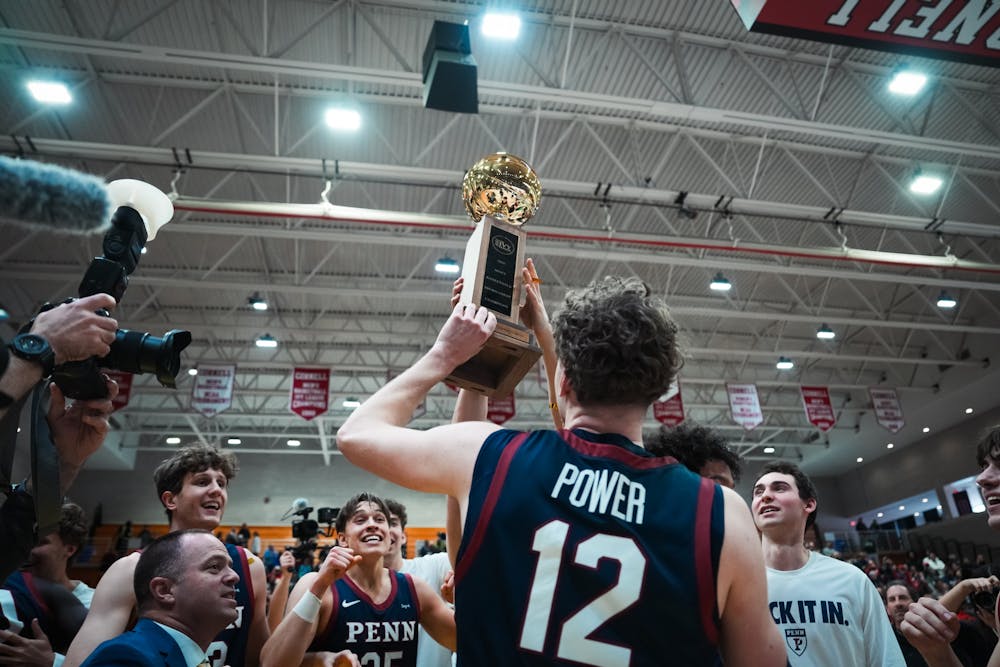
On Sunday, the Quakers delivered a title win of epic proportions, punching their ticket to the NCAA tournament with a thrilling 88-84 overtime victory over top-seeded Yale. In their first season under coach Fran McCaffery, the Red and Blue claimed their first championship since 2018 behind a legendary game from junior forward TJ Power, who broke the men’s Ivy Madness scoring record with 44 points and 14 rebounds.
It took what the Ivy League communications liaison called “a game for the ages” for Penn to knock off the two-time reigning champions. Let’s break down how the Quakers summited the mountaintop.
First, the tournament MVP-sized elephant in the room. Power’s performance hangs in the rafters as one of the greatest not just in Penn history, but in Division I. His 44 points are the second most in a men’s conference tournament final over the last 30 seasons. He also scored Penn’s final 10 points in regulation.
The former five-star recruit connected on 14 of his 26 shots, including seven of 14 from beyond the arc, a varied scoring barrage highlighted by a pair of improbable threes to send the game to overtime.
After a pair of free throws gave Yale a four-point lead with 12 seconds to go, McCaffery dialed up one of the simpler plays he’d used to scheme Power open throughout the day. He caught the inbound, dribbled up the floor, and drilled a pull-up triple in Player of the Year and Yale forward Nick Townsend’s face to trim the deficit to one.
The next was slightly more complex, but infinitely more cold-blooded. Penn ran a simple action to break the Bulldogs’ full-court pressure and got the ball to Power, who changed pace only slightly as he got to the wing and fired the equalizer over the outstretched arm of Yale guard Casey Simmons, the Ivy League Defensive Player of the Year.
RELATED:
Next stop March Madness: Penn men’s basketball upsets reigning champion Yale in Ivy Madness final
“I thought I was gonna catch, and they were gonna foul, but they didn’t — they kept backing up,” Power said. “So, I just kept pushing it down the floor. And [Simmons], he’s a good shot blocker, so I put a little extra arc on it, and it sunk through.”
“When it left my hand, I knew that if I could get one off, it was going in.”
“There’s really nothing overly complicated about that,” McCaffery said of Power’s tying triples. “Yeah, we ran some action, but we’re going to [Power]. We put the ball in his hands. That doesn’t put me in the Hall of Fame … Anybody who was at the game [knew]: ‘Throw the ball to TJ.’ That’s what we did.”
Many of Power’s other 38 points were the result of more careful construction. His 23-point first half displayed the full scoring diet that made him a unanimous first team All-Ivy selection — extended dribble isolations, swift post spins, and quick-trigger catch-and-shoot jumpers.
Here, Power gets the ball back after his own missed three and gIves Townsend a taste of his own medicine, sizing him up and rotating for a tough post bucket.
Here, on a baseline out-of-bounds, Power fakes a screen for senior guard/forward Michael Zanoni before darting to the corner. A pick from freshman forward/center Dalton Scantlebury shakes Townsend, and Power’s jumper is pure.
Here, Power (6-foot-9) gets the matchup he wants on Yale guard Trevor Mullin (6-foot-1), backs him down, and gets position down low. Even after drawing help from Yale forward Isaac Celiscar, he timed his lay-in right to bring Penn within two.
There is not sufficient ink to pen the impact of Power’s performance. As Yale coach James Jones put it, Power could play Sunday’s game “100 more times,” and not replicate the same production.
“But he did tonight,” Jones said.
Power’s masterpiece was supported by a senior running mate, but not the one Quakers fans have grown accustomed to this season. Senior guard/forward Ethan Roberts, the team’s leading scorer on the year, missed the tournament with a concussion, leaving a sizable scoring gap in Penn’s lineup.
That hole was filled by senior guard Cam Thrower, who delivered a career-high 19 points on 6-for-10 shooting, including 4-of-6 from three. Thrower has been in and out of the rotation for Penn this season — there was a five-game stretch in Ivy play where he averaged 6.6 minutes per game and did not score.
But Thrower was up to the task in Ithaca, first netting 11 points in Penn’s semifinal win over Harvard and turning up the heat another notch for the finale. The lone holdover from the Quakers’ last Ivy Madness appearance had a number of baskets at critical junctures, including five straight Penn points near the end of the first half.
Thrower’s greatest contribution came as a perimeter finisher for Penn’s penetration and ball movement. Here, he moves off the ball to space the floor, and after Celiscar collapses on a drive from sophomore guard AJ Levine, Thrower has all the space he needs.
Here, Thrower shows another dimension. As Power receives the inbound, Thrower catches Yale guard Jordan Brathwaite’s ball-watching and smartly cuts to the rim, finishing the and-1.
“I appreciate the man to my right for trusting me to make those types of plays,” Thrower said, referring to McCaffery. “Throughout the course of the year, it’s been about how I can help this team win, no matter what capacity. And tonight, I was able to hit some shots, make some plays, and it paid off.”
“From minute one, he separated himself,” McCaffery said of Thrower. “Early workouts, early practices … He’s also a versatile guy. He can play the point, he can play the off-guard position, he makes threes, but he also defends and rebounds, so you can switch with him. And he’s smart, and he’s sort of fearless.”
“When I said to him, ‘[Roberts isn’t] playing,’ he goes, ‘Don’t even worry about it, I got you.’ And right after the game, he said, ‘I told you.’”
Defensively, it took a full 45-minute effort for Penn to finally vanquish the conference’s top seed. In two regular-season matchups with the Bulldogs, Penn majorly struggled to contain Yale’s rare combination of size and strength. On Jan. 24, Townsend barreled through the Quakers for 17 points on just nine shots. On Feb. 21, Celiscar bulldozed his way to 16 points and 14 rebounds.
Penn would not be bullied again. While Yale’s big three of Townsend, Celiscar, and Simmons each found success (all three players scored 17 points, while Mullin added 22), there were enough small victories to keep the Bulldogs from pulling away. The Quakers, who lead the conference in forced turnovers during conference play, forced three apiece on Townsend and Mullin, including one on the latter in overtime that led to a Thrower three-pointer to put Penn ahead at a score of 82-78.
The Quakers’ defense in the extra period was ultimately the difference in the game. Penn held the Bulldogs to 3-for-9 shooting from the field, a clip that stemmed from the ways McCaffery adjusted his team’s front.
In regulation, Yale found tremendous success when it was able to situate Townsend and Celiscar in their offices on the block. When the post phenoms weren’t scoring for themselves, they were dishing to others — the pair combined for 11 assists on the day.
Here, Celiscar draws three Penn defenders near the rim, and from there, it’s pick your poison. Levine takes Mullin away, so Celiscar finds Townsend for an easy top-of-key triple.
In overtime, Penn deployed a few different approaches, including isolated instances of zone, which it also utilized in the second half. Those tactics helped limit Townsend and Celiscar’s post-wrecking while simultaneously containing their kickout options. The result? One of the nation’s most patient, methodical offenses forced several contested looks, including Mullin’s missed three with 25 seconds to go.
“We mixed in a little bit of zone there, just to give them a different look,” McCaffery said. “They gotta run some different stuff. I think that was helpful. [They] can’t go as much backdown game when you’re in zone.”
Finally, Penn’s championship triumph was fueled by substantial mental toughness and an ability to withstand Yale’s punches.
In the first half, Penn went scoreless for over four minutes as Yale rattled off an 8-0 run, and shortly thereafter, a Townsend free throw put the Bulldogs ahead 25-16. The Quakers then went on an 8-1 run to cut the lead to one.
The game featured eight ties and 13 lead changes as the Red and Blue refused to let Yale out of reach in the second half. And of course, after trailing by six with under three minutes to go, Penn outscored the Bulldogs 10-4 the rest of the way, with all 10 points scored by Power.
“It’s just a will that we have,” Power said. “We’ve been building that all year. We expected close games; we didn’t expect two overtime games. But I knew once it went to overtime, that’s our advantage every time. We’re fighters.”
There are countless storylines to recollect in the wake of Penn’s stunning victory. The Quakers finished seventh in the Ivy League in each of the last two seasons before hiring McCaffery, who became just the fifth coach in D-I history to lead five different programs to the NCAA tournament. Penn was picked seventh again in this year’s preseason poll and sat 2-4 in conference play before winning nine of their last 10 games. After losing their senior captain a few days before the tournament, the Red and Blue pulled out victories against the conference’s top two seeds en route to their first March Madness trip in nearly a decade.
The preparation process will soon begin anew for the Quakers after drawing Illinois as their first-round tournament opponent. But for now, and forever, Sunday’s win is etched in gold.
WALKER CARNATHAN is a College senior and former DP Sports editor from Harrisburg studying English and cinema and media studies. All comments should be directed to dpsports@thedp.com.