ITHACA, N.Y. -- For Penn men’s basketball, breaking an eight-year drought took an extra five minutes.
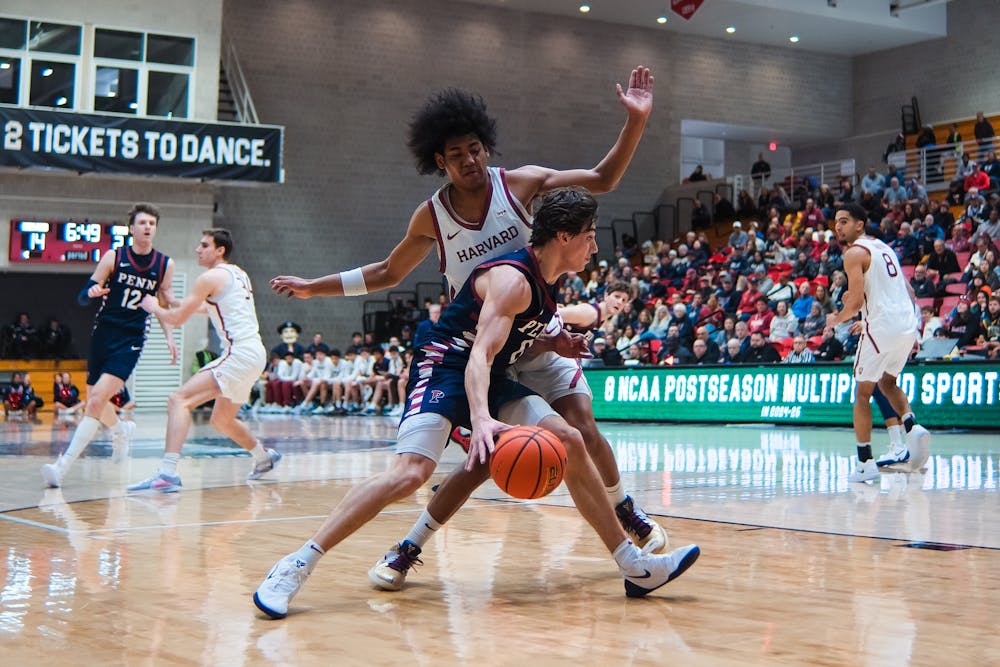
On Saturday, the Quakers advanced to their first Ivy League championship game since 2018 behind a nail-biting 62-60 overtime victory over Harvard. After sophomore guard AJ Levine banked in a go-ahead layup with five seconds to go, the Crimson’s answer was no good, sending Penn to the title tilt in its first season under coach Fran McCaffery.
The Quakers advance to play Yale on Sunday at noon with a spot in the NCAA Tournament on the line. Levine’s late-game heroics were the result of what McCaffery distilled as the game’s X factor: connectedness.
“We had a lot of different guys make plays, and I think that’s the key to our team,” McCaffery said. “I just can’t say enough about the number of different guys who contributed in this game.”
In a matchup the Quakers played without their leading scorer senior guard/forward Ethan Roberts, Penn received key play from up and down the lineup — four players scored nine or more points, including Levine, who notched the most critical basket of Penn’s season off a clever play design from his coach.
Levine has added a major dimension to Penn’s offense as a downhill slasher this season, and his hard driving was in full effect on the difference-maker. As Levine began his attack, senior forward TJ Power, who had already hit three threes in the game, flared toward the ball as if he were about to receive a dribble-handoff. Instead, Levine kept rolling all the way to the rim, with the Power fakeout freezing Harvard guard Ben Eisendrath just long enough to open the lane.
RELATED:
Madness Managed: Everything you need to know for Penn men’s basketball’s Ivy League tournament trip
Penn men’s basketball’s Ethan Roberts out for Ivy League tournament with concussion
“We talked about that action all week … we knew it was going to be successful when [McCaffery] called it,” Levine said. “I knew what to expect in their defense, whether they’re going to switch or mess up the switch, and when I came off it, I saw a clear path to the rim.”
“There’s no way I was going to miss that to send us to a chip,” Levine added.
“That’s a great job by them of faking the handoff and turning the corner,” Harvard coach Tommy Amaker said. “Put us on our heels there for a second, and it was enough to get to the rim and lay it.”
The play was particularly effective given Power’s success earlier in the afternoon. The unanimous All-Ivy first team selection was on fire in the first half, scoring 11 of Penn’s first 18 points, including his trio of triples.
With Harvard stalwart Chandler Piggé limiting Power’s back-to-the-basket play, McCaffery made it a point to scheme the 42.9% three-point shooter open on the perimeter — Power’s first three to put Penn ahead 5-3 came off a baseline-out-of-bounds action, while his others were the result of sound fundamentals. Penn went ahead 13-10 after Power connected on a catch-and-shoot triple coming off an off-ball screen, and 18-12 after he lost his defender with a pump fake.
McCaffery also drew up plays to get Power moving off the dribble. Here, a bump screen from freshman forward/center Dalton Scantlebury puts Piggé a step behind Power, and he takes full advantage — faking, handling, and spinning into the lane for a pretty baseline floater.
Defensively, Penn came out on top of what Amaker called a “rockfight.” Both teams shot under 41% from the field, a relative constant in their matchups this season — across three games between the Quakers and Crimson, no team has scored more than 64 points.
Harvard got 16 points from guard Tey Barbour, whose driving layup tied the game at 60 before Levine’s winning shot, and 15 from Eisendrath, who recorded a personal 5-0 run to push the Crimson ahead late in the second half.
But the more significant note is who did not excel for the Crimson — when Penn played Harvard on Feb. 28, guard Robert Hinton and forward Thomas Batties II combined for 39 points on 17/28 from the field. On Saturday, the two All-Ivy selections managed just 14 points on 6/24.
Hinton, the Ivy League’s third-leading scorer, was blanketed on the perimeter (0/6 from three) by a Penn front that rotated well and closed out with abandon. When Hinton got to the paint, the Quakers did well to contest while keeping him off the charity stripe — Hinton did not attempt a free throw, while the Crimson as a whole shot only nine. Penn also forced 17 turnovers on the day.
“[Hinton’s] obviously a terrific player,” Power said. “I think one of the benefits of playing a team three times is you start to understand tendencies. Coach [McCaffery] and coach [Ben] Luber— I thought they did a great job of making it clear how we wanted to defend [Hinton]. It’s not one guy, it’s five guys with him, getting to the gaps and understanding when he’s looking to be aggressive late-game.”
“Give credit to Penn for how they defended [Hinton],” Amaker said. “They really closed off the lanes in terms of his driving opportunities.”
Despite Hinton’s struggles, Harvard led for much of the second half, thanks to a stretch of cold shooting for Penn, as well as a dominant advantage on the glass. The Crimson won the rebounding battle 44-31, including an 11-6 advantage on offensive boards. One of those second chances led to a Piggé three that capped a 10-0 Harvard run.
But Penn was able to punch back, thanks in large part to the varied contributions highlighted by McCaffery. With Levine in foul trouble late in the second half, freshman guard Jay Jones rose to the occasion with a run of critical clutch baskets. First, he connected on a contested running floater to knot the game at 51.
Then, on the first play of overtime, Jones again finished through contact, this time drawing an and-1.
Sophomore forward Lucas Lueth also made an impact late. After a Penn miss, Lueth dove on a loose ball as it careened toward Penn’s sideline, beating Batties II to the punch and calling timeout to preserve possession. On the ensuing play, Power drew a foul and converted a free throw to pad the Quakers’ lead.
“There were a number of game-winning plays,” McCaffery said. “But Lucas Lueth diving on the ball, calling timeout, those are game-winning plays. Those are understanding the situation [plays] that lead to great things.”
In the game against Yale, the Quakers face a championship opponent that they have fallen to twice this season. On Jan. 24, the Bulldogs held Penn to 60 points on 37% shooting, and on Feb. 21, they pulled out a tight home win without Ivy Player of the Year forward Nick Townsend.
“You look at their record, you look at what they’ve done, you can’t have lapses against them and expect to win,” McCaffery said.
The top-seeded Bulldogs will be favored, and they’ve earned that distinction. But a year ago, the thought of a Penn championship appearance would have seemed outlandish. The same could be said of the Quakers defeating Harvard in the absence of their leading scorer. At every turn, the Red and Blue have faced obstacles, and at every turn, they have found a way to win. Now, with a championship on the line, they’ll face their greatest challenge yet.
40 minutes stand between Penn and a trip to the NCAA tournament. Buckle up.
WALKER CARNATHAN is a College senior and former DP Sports editor from Harrisburg studying English and cinema and media studies. All comments should be directed to dpsports@thedp.com.