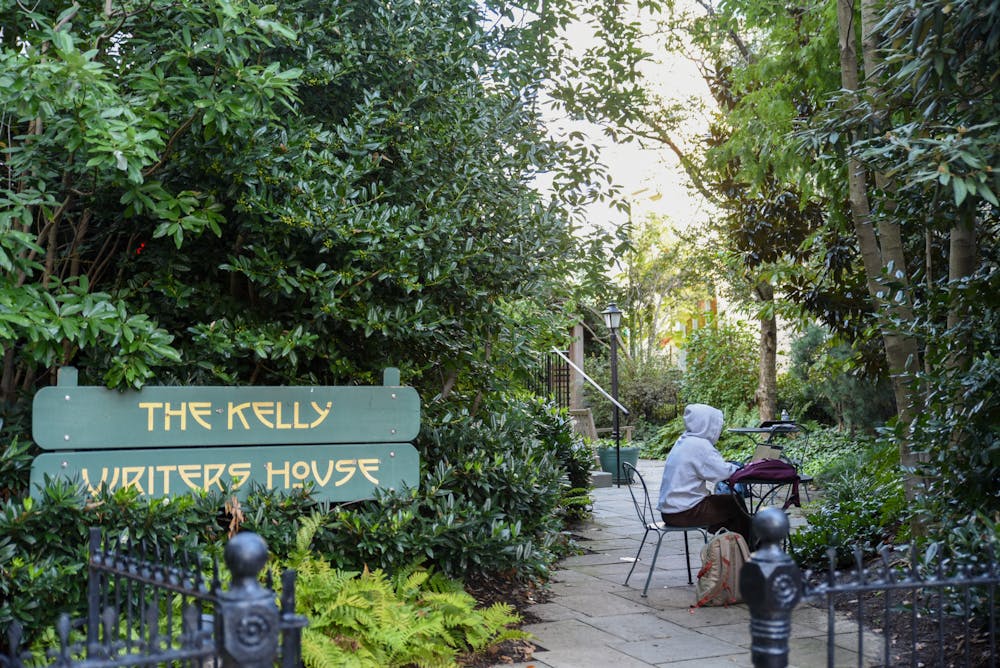
The Kelly Writers House hosted a panel on the long history of computer-generated text and its impact on experimental pieces.
At the event, panelists discussed “Output: a Celebration of Computer-Generated Text,” a collection of works generated by artificial intelligence from the 1970s to the present to which they all contributed. They read aloud to the audience from the anthology and their own AI-generated text before discussing the impact of technology on creative works of writing.
Five members of the anthology’s team were present: University of Maryland professor Lillian-Yvonne Bertram and Penn Ph.D. graduate Nick Montfort organized and co-edited the anthology, and writers Jim Carpenter, Steve McLaughlin, and Syd Zolf contributed to the work. The event was hosted by Michelle Taransky, a creative writing lecturer at Penn.
Taransky spoke to The Daily Pennsylvanian about her personal motivations for facilitating conversations about AI in a creative space, even before ChatGPT’s release in 2022.
“I’ve been talking to my students about creative writers who have been using these technologies for a long time, not just since 2022,” Taransky told the DP. “I felt very motivated to show them the different ways that people are writing with generative AI.”
The panelists also discussed the possibilities and limitations of algorithmic writing, how to understand the relationship between human and machine authors, and the ethics of generative technologies.
Jim Carpenter, a former faculty member at the Wharton School, spoke about his Electronic Text Composition project — titled Erica T. Carter — which started as a school-sponsored experiment before eventually developing a unique persona.
“As Erica published more, her character began to develop through her query letters,” Carpenter said during the event. “I actually started to feel satisfaction through that narration.”
2008 College graduate Stephen McLaughlin, another panelist, collaborated with Carpenter on “Puniverse,” a collection of algorithmically generated puns. He emphasized the damage AI can pose to the environment.
“The climate crisis has changed my idea of what is cool — I just don’t think it’s cool to be using this much electricity and water,” McLaughlin said.
He added that “these giant server farms” write “bad term papers” and make “bad art.”
“I think a lot of us who are not in that discipline or industry have only learned about AI through GPT — it was because ChatGPT became popular that I was able to play around with this stuff,” Taransky told the DP. “Since ChatGPT came out, there is more fear, more anxiety, and more worry about the role this technology is playing in our lives."
The event was co-sponsored by the Department of Computer and Information Science, Truth and Disinformation in the Writing Arts, and the But Company. It ended with a 15-minute question and answer session with the audience. A recording of the event is available on YouTube.
Staff reporter Cathy Sui covers politics and can be reached at sui@thedp.com. At Penn, she studies finance and statistics.