If you would like to be humiliated tremendously, ask yourself whether you control your thoughts or your thoughts control you. Are you able to turn your mind on and off with the same seamlessness as your laptop? Winning internships and accolades has its merits in the realm of grueling work, but we must confront our impotence and admit the most difficult pursuit of all is to free oneself from thought. The more you try to free your mind, the more impossible it gets. You are the slave; your mind is the master. The prototypical Penn student spends four tormented years in reflective purgatory over the repetitive convulsive cycle of clubs, grades, and jobs. You elude the present, set goals, project, desire; all pleonasms for thinking. What does it take to live a life at Penn and beyond in the thoughtless here and now or, as the popular song goes, freed from desire?
That grit is great, I hope we all know by now. It is the muddier side of our self-sucking ambition unveiled as we turn off the bedside lamp that intrigues me. Holidays are a particular trial for the Penn student whose right to exist seems contingent exclusively on frantic activity. Freed from work and objectives, one is confronted with two reductionist but nonetheless true options.
The first is banal: to, literally, be freed from work. This is impossible because to be freed from an occupation means to be absolutely alone with oneself. It means confronting the unfathomable vastness of one’s interiority which, understandably, we would rather not do. The abyss terrifies. To be alone with yourself without doing anything is, at least in theory, the deepest ecstatic experience humans could bestow on themselves, yet the scariest too. Let us call this state meditation.
The more appealing alternative is to reengage in activities resembling, although not quite, work. Hobbies of some sort. We earn our due three minutes of consolatory Nirvana in Monday club meetings, Tuesday consulting coffee chats, Wednesday SoulCycles, Thursday happy hours, Friday date nights at Castle, Saturday Center City runs and Sunday church choirs. Remove projected preordained calendar invites and I will feel empty. How could I possibly admit that I am in fact seeking distraction?
Put simply, substance is preferred to vacuity at Penn. Materiality is unquestionably superior to a demonized emptiness because why have nothing when you can have something? I tell you, why have something when you can have nothing? The irony is that by seeking substance, you are confronted with emptiness because you are unable to find absolutely anything. In the wiser words of Hermann Hesse: “When someone is seeking, he is only thinking of the thing he is seeking, because he is obsessed with his goal. Seeking means to have a goal but finding means to be free, to have no goal.”
They are all just clichés, but each one makes sense because I have experienced them. As is my wont, I burned out last spring trying to figure out the ridiculous but burdensome task of what to do over summer. I spend my falls thinking about springs, springs about summers. For once, all I wanted was to stop wanting.
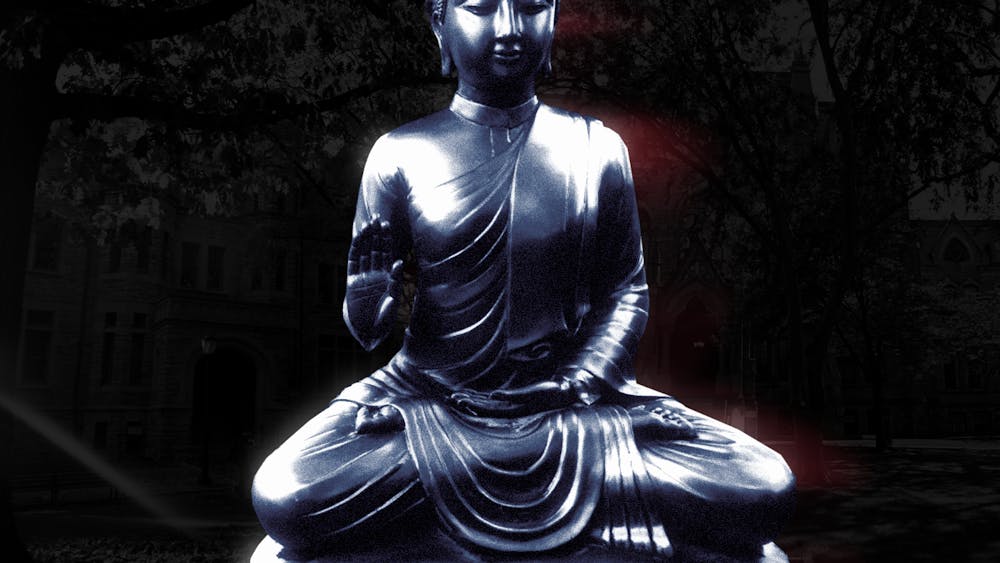
So in true Penn’s fashion, I maximized my junior summer, only differently: three weeks sponsored by SNF Paideia in a fishing village in rural Japan, living in a Buddhist temple with a Rinzai Zen monk. Like my peers waking at six in frigid Manhattan for intense workdays, I started at six with ninety minutes of zazen (sitting meditation) and samu (service to the 600-year-old temple). As they worked through lunch or dinner, I also fasted seventeen hours a day following the Nishi health system. We both learned, just different lessons.
Zen is not taught with words but unequivocal silence because you either get it or you do not. Still, I can avoid trivializing and share the lesson that saved my life: As long as we desire, we will never cease to think because a thought without desire is like a fish outside the pond, an unsurvivable oxymoron. We do not desire infinity; we desire ad infinitum, therefore we think incessantly.
SEE MORE FROM FRANCESCO SALAMONE:
Neuroscience taught me that to think at all is to think about yourself (hello default mode network). Philosophy taught me that it is not the thinking you hate but the fact that you yourself are perennially inside your thoughts. However, only Buddhism and reading mystic Osho taught me what the heck you are supposed to do with it: observe your thoughts without identifying with them.
Become indifferent to thoughts, undisturbed, a mere witness. Do not label them as good or bad because commenting and coding breed identification and attachment. Let them instead flow like water, do not give them any importance, sit silently inside, distance yourself from them. Revert the energy you use to feed your thoughts to quiet them down. It is by appeasing thoughts that you govern them, not by governing them that you appease them.
Progress is slow. We first conceptually understand that life need not be thought because it can just be lived, but it takes time for us to truly feel it. Midterms start, rejections hit the inbox, and roommates leave filthy dishes in the sink. We regretfully throw ourselves into the next deadline, next application, next scream at our incompetent friend. We feel like imbeciles for having learned nothing about controlling our thoughts, but we may still be on our way because we will fill our weary lungs with patient breaths. Until one day, meditation after meditation, without even realizing it, we will have left the stormy shores of Stakhanovite rumination in favor of the more grounded and peaceful seas of Zen.
FRANCESCO SALAMONE is a Wharton senior studying decision processes from Palermo, Italy. His email address is frasala@wharton.upenn.edu.