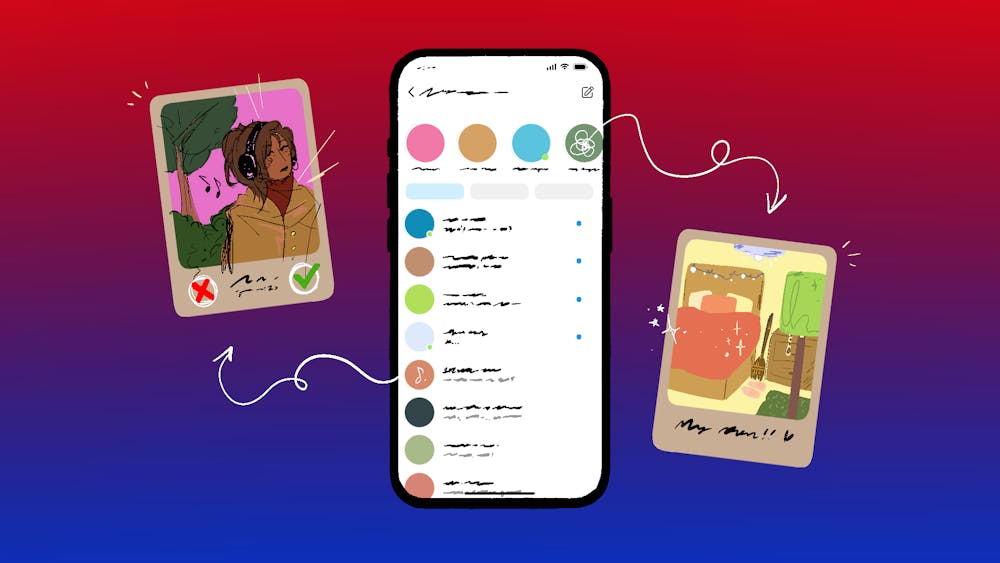
A quintessential pre-first-year experience is looking for a roommate online before school starts. Stalking Instagrams, scrolling through pictures, and sending that all-important first message. Conversations feel like dating bios with lines like: “Looking for someone who laughs at my terrible jokes, won’t judge my midnight ramen obsession, and loves going out … and staying in!”
But beneath the Instagram DMs and curated bios, which honestly feels like a weird pseudo-dating ritual, is something bigger: the first time since getting in that you’re really being perceived by your new college community. It’s also one of the first moments that students start to adjust themselves based on what they find the Penn community expects.
Here’s how it goes: You follow each other back on Instagram (it’s a match!), you slide into their DMs (anyone know any roommate pickup lines?), you have your first conversation filled with nervous small talk and subtle tests to establish trustworthiness. Maybe you part ways politely. Maybe you get ghosted. Maybe, if you’re lucky, you FaceTime!
Of course, much like dating, everyone’s trying to seem cooler and way more put together than they really are. Because just like dating, we’re making ourselves vulnerable to rejection by people we think are good for us. There’s nothing wrong with wanting to put your best foot forward, especially when you’re swiping for a potential roommate as if Instagram is a dating app. Letting that instinct make its way into every interaction is when it becomes inauthentic.
When I was finding a roommate, I caught myself starting to perform a version of myself I thought college demanded. I introduced my interests by talking about popular music artists I liked because I thought mentioning my “Hamilton” obsession outfront would make me cringey. What starts as trying to find someone to live with becomes the introduction of a polished image meant to win approval, not just from a potential roommate, but from a whole new realm of people.
It’s a form of social risk management, a natural response to new surroundings driven by human emotion. Simply put, we do not want to be isolated from our community for the next four years. We often think inability to resist peer pressure is a personal failure, but what if a structure around them perpetuates that stress? Finding a roommate is just the first step. An obvious answer may be to stop caring about what others think altogether. But honestly, that’s kind of unrealistic. A school like Penn creates huge expectations for unrivaled access to opportunities, and networking is a big part of taking advantage of those.
The truth is, by letting first years pick their own roommates, Penn begins to corporatize relationships before students even step foot on Locust Walk. We start to treat conversations like a sales pitch — only, we’re the product. Rather than trying to convince students to get rid of the normal urge to fit in, it’s time to call for institutional change instead.
While Penn does give students the option to go random, the issue lies in the fact that it also gives students the opportunity to pick their own roommates. This choice reinforces the idea of social bubbles, which create pressure to act a certain way in the first place. So while Penn’s options might be comfortable for some students, they can make the situation worse for others.
Many top schools choose all students’ first-year roommates for them, including Harvard, Yale, Stanford, and Dartmouth. If picking your own roommate is like using a dating app, then letting your university decide your roommate is like being set up by a mutual friend.
A third party sees the traits you have in common and matches you accordingly based on compatibility, such as sleeping habits and cleanliness, instead of optics. This makes us stop worrying about finding a roommate who is exactly like us, or exactly like who we want to be, and open our minds to new possibilities while (probably) minimizing the discomfort of rooming with someone with whom you have incompatible living habits.
What’s more, a third-party roommate match is likely to increase diversity. When you pick your own roommate, it’s tempting to minimize that social risk by trying to choose someone with similar traits to you, maybe the same hometown or intended major. It just feels a lot safer. But when schools assign roommates, it removes that pressure and broadens student perspectives. A study done across Duke, Stanford, and Tufts even showed a significant increase in cross-race friendships and more positive interactions across people from different backgrounds when universities randomly assign all incoming first years a roommate.
Choosing your own roommate might feel like you get to swipe left or right on endless options to find “the one,” but it can actually function more as a loop of endless talking stages. Suddenly, your terrible jokes and midnight ramen obsession become things you carefully hide, because you’re terrified of being ghosted. It forces incoming students to turn their genuine need for connection into a marketing pitch.
This pressure to get it right reduces the chance of making unexpected, meaningful friendships. If Penn removes the option to choose your own roommate, it would take away the idea that people need to impress their way into belonging on campus. It gives students the chance to show up as who they truly are and meet people they might not have initially thought that they would get along with.
Because let’s be honest, there are far more productive things to prepare for in college than pretending you’re someone you’re not. Most first years are still googling “How to do laundry?” and hoping no one notices. It’s time for Penn to make sure students can focus on the right kind of growth.
KANISHKA AGARWAL is a College first year from Cypress, Texas. Her email is agarwa1k@sas.upenn.edu.