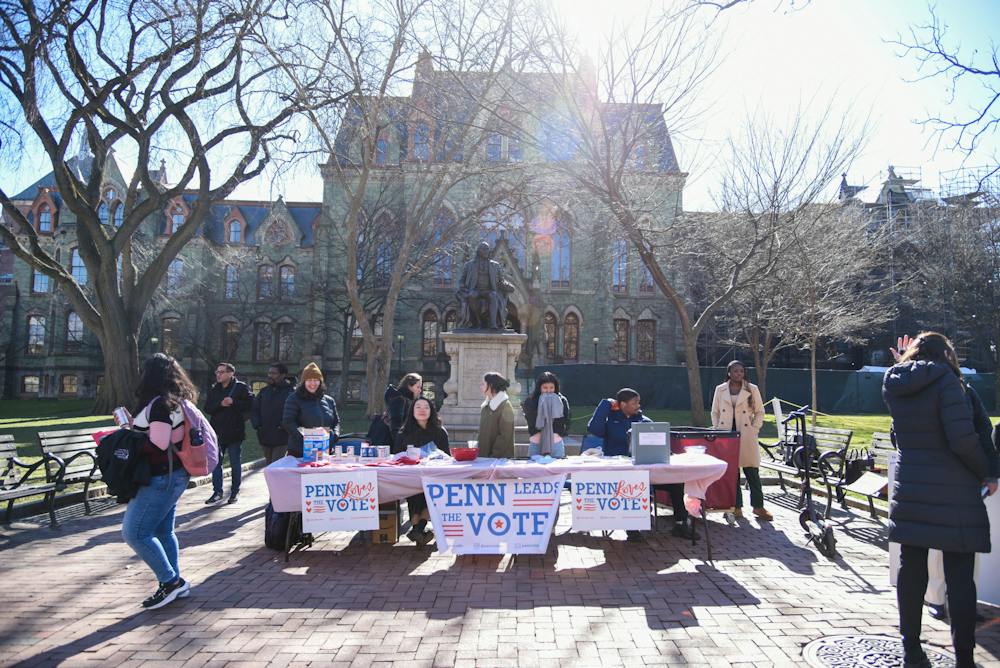
In 2020, then-Penn President Amy Gutmann made an ambitious pledge: that within eight years, every eligible member of the campus community would be registered to vote and would cast a ballot.
The commitment was part of a national push in higher education to increase voter registration at colleges across the country. Six years later, the University’s nonpartisan voter registration group, Penn Leads the Vote, continues to work toward that goal.
Internal PLTV data shows that 43.1% of eligible students voted in the 2022 midterm elections, outpacing the national institutional rate — and earning Penn a “Most Engaged Campus for College Student Voting” designation that year. Penn still lagged behind nearly every other Ivy League institution in registration, but 58% of its registered voters cast a ballot, far exceeding peer institutions’ yield rates.
Penn Leads the Vote helped spur a nearly 450% increase in campus voter turnout between 2014 and 2018. Though turnout has continuously fluctuated since 2012 — with upticks in presidential election years, when civic engagement renews — it has generally risen over the 10-year period.
More than three-quarters of eligible Penn students voted in the 2020 presidential election, a 9% increase from 2016. In 2024, in-person turnout far exceeded 2020’s, which was severely curtailed by the COVID-19 pandemic.
Last year’s off-cycle election drew record turnout at Penn. Over the past decade, the November 2025 contest was the only election without a national race to bring more than 1,500 voters to campus polling locations.
RELATED:
Penn experts say Trump EPA rollback will drive nation off ‘climate cliff’
Penn SAS hosts inaugural event dedicated to democracy and knowledge
Penn Leads the Vote spent the run-up to this year’s midterms hosting registration drives on Locust Walk to drive sign-ups and turnout. The group also works with members of the College House system to hold events and encourage students to register.
According to Ashley Kim, a College senior and the group’s director, volunteers registered 170 people on National Voter Registration Day alone.
Marc Meredith, a political science professor, said in an interview that he expects this November’s midterms to match the record turnout the University has seen in recent years — though “we won’t really know that until election day itself.”
“I think young people often feel like they have more knowledge about the presidency than perhaps they have about their state governments,” Meredith said. “I think a lot of it is this feeling that you have an ability to know who you want to vote for president in a way you might not feel the same about a governor or a senator.”
Noting a marked decline in campaign presence and television commercials, Meredith said Pennsylvania’s political climate is a far cry from the charged environment of two years ago.
“Given the vibes around the governor race this time and the polling that suggests it’s not as close as we usually experience statewide elections here, I wonder if that is going to have some effect on the ultimate turnout outcome,” he said.
According to a September poll, 58% of Pennsylvania’s likely voters said they would vote for incumbent Pennsylvania Gov. Josh Shapiro over Republican challenger Stacy Garrity, who currently serves as the state’s treasurer.
Earlier this month, Penn Democrats hosted Shapiro for a meet-and-greet. State Rep. Chris Rabb (D-200), who is running to represent Pennsylvania’s third congressional district in the United States House of Representatives — which includes Penn — spoke at a panel on reproductive justice on campus last week.
The deadline to register to vote in Pennsylvania is Oct. 19. Election Day is Nov. 3.