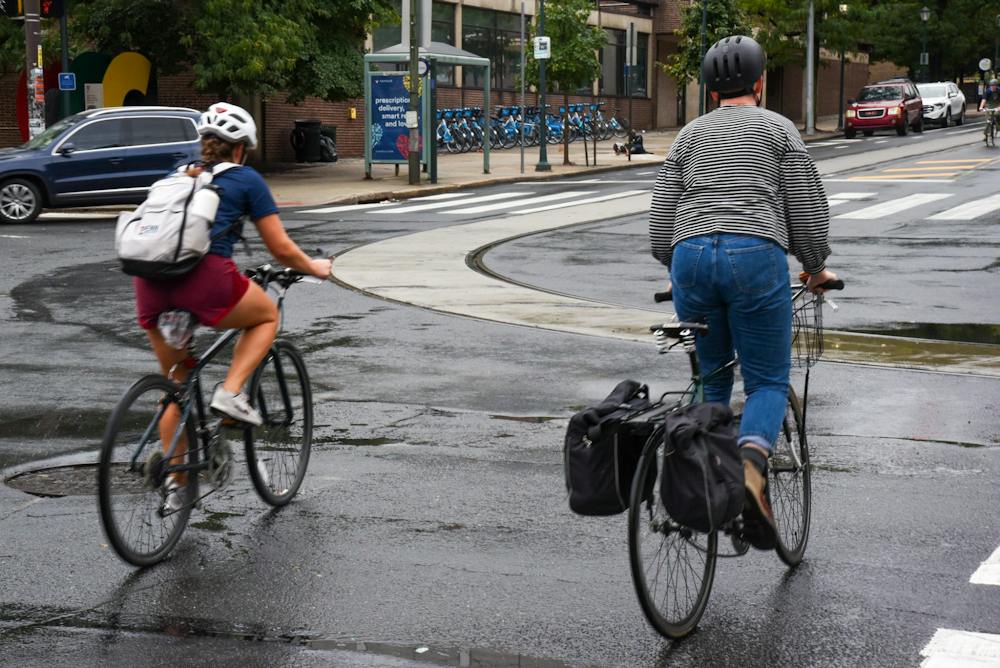
Philadelphia’s bike-share stations offer an easy way to get around University City, but they may figure into a larger debate about how the neighborhood is changing.
Indego — the nonprofit behind the city’s signature blue rental bikes — came to Penn in 2015 and now operates eight docks on campus. While Indego claims to expand access to cycling in “historically disinvested-from” communities, Penn experts have linked the transportation infrastructure to broader patterns of gentrification.
University Architect Mark Kocent said in an interview that bike-share usage is highest along Civic Center Boulevard, near the Penn Museum, and on Health Services Drive. He attributed lower undergraduate usage to the walkability of Penn’s campus.
According to Kocent, the “most frequented ridership” is around the University of Pennsylvania Health System, which employees often bike to from Center City.
Indego’s expansion is at the center of a broader conversation on “Penntrification” — a term Stuart Weitzman School of Design assistant professor Xiaoxia Summer Dong described in a statement as a “catchall” for the “impact on the surrounding neighborhoods of the expanding footprint of University City.”
School of Design professor Erick Guerra also acknowledged the link between transportation investments and gentrification.
“People sometimes perceive these investments as being designed primarily for newer or wealthier residents rather than existing residents,” he wrote in a statement.
Indego offers a discounted monthly and annual pass to Pennsylvania ACCESS cardholders who receive public benefits, such as food assistance. A request for comment was left with an Indego spokesperson.
RELATED:
Urban planners see improvements in plan for new 76ers, Flyers arena
Penn summer program trains West Philadelphia high schoolers to conduct public health research
School of Design assistant professor Akira Rodriguez said in an interview that the school’s Department of City and Regional Planning regularly meets with West Philadelphia residents to hear how specific changes are affecting them.
Rodriguez stated that new amenities like bike-sharing stations can intensify the “negative impacts” of urban renewal by making neighborhoods more attractive. The convenience of Indego, she added, could be one of those “game-changers” by raising the demand for nearby housing.
“There’s multiple things happening at once,” Rodriguez said. “Indego intentionally goes into underserved neighborhoods to select ideal places for their docks, but also those docks can act as another component of gentrification.”
Dong highlighted that while gentrification can make communities “less affordable,” those developments may bring about “positive” changes like improved safety and services.
“I do not think resisting improvement out of fear of gentrification is the answer, because that would petrify the progress of our neighborhoods,” Dong wrote. “I think the critical issue is to make sure the benefits of the improvements do not exclude disadvantaged groups.”
RELATED:
Urban planners see improvements in plan for new 76ers, Flyers arena
Penn summer program trains West Philadelphia high schoolers to conduct public health research
Staff reporter Tanvi Shah covers science and health and can be reached at shah@thedp.com. At Penn, she studies neuroscience.