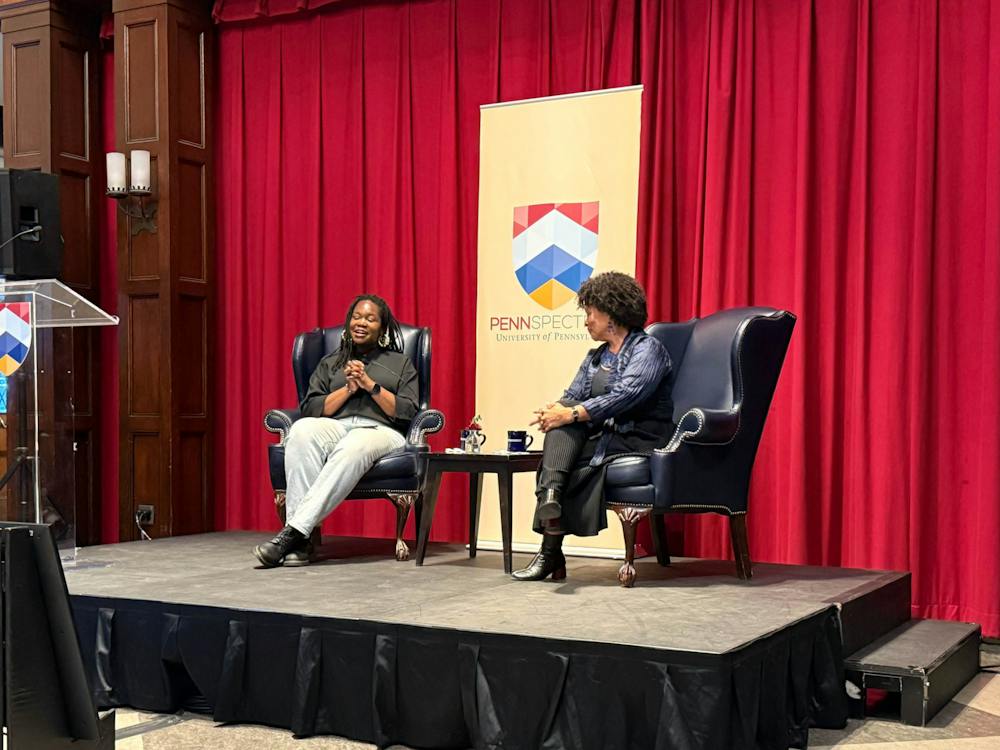
Penn Alumni hosted its triennial weekend of programming to celebrate careers in the arts and media.
The Oct. 15-17 affair featured interactive events including a Platt Performing Arts panel and a luncheon discussion with Vice Provost for the Arts Timothy Rommen. Penn Spectrum Weekend was hosted across a variety of locations campuswide and brought in over 225 attendees — including alumni, students, staff, and faculty.
In an opening luncheon on Friday, 1996 College graduate and former English professor Salamishah Tillet and 2005 College graduate Paul Farber discussed the current state of public art.
In an interview, Tillet discussed the growing significance of activism and community service in her life — emphasizing a prevalence of racial tension and gender-based violence that has shaped her career.
Tillet — who works as a critic for The New York Times — co-founded “A Long Walk Home,” an organization that uses art to empower young people and help put an end to gender-based violence. She discussed how art forms can help individuals understand their trauma while simultaneously enabling them to reconnect with themselves, heal, or even become activists themselves.
She credited Penn for introducing her to the idea of pursuing a career in the arts and academia — recalling the “dynamic experience” she had in the English and Africana Studies departments at Penn, which helped forge her professional life.
“I’m really grateful for my ability to grow and evolve with this institution over time,” Tillet added.
On Friday evening, 1987 College graduate Sara Lomax discussed her journey as a black woman who became a media entrepreneur and president of Philadelphia’s only black-run radio talk show.
RELATED:
Kelly Writers House offers a different kind of college recruitment
Penn Bookstore hosts College alum, author to discuss new novel
During the event, she emphasized that “it’s really important, especially in a city like Philadelphia, for everyday, average, regular Black people to have access to information and resources that they might not know.”
In an interview, Lomax attributed her ability to overcome the challenges she faced as a black leader to her belief in herself. She expressed that Penn offered her the opportunity to explore different aspects of herself, adding that the University “built a level of confidence in” her.
On Saturday, a lunchtime panel featured Rommen in conversation with the founders of various Penn art organizations — including 1994 College graduate Raqiba Bourne, 1989 College graduate Lolita Jackson, and 2004 College graduate Carlos Andrés Gómez.
The panelists discussed their experiences with building art communities on campus and called for more institutional support for such organizations.
“In order to receive funding and recognition, you have to have experience and exposure,” Bourne said during the event. There is a circular “conundrum,” however, because “in order to have experience and exposure, you need funding to receive recognition.”
In an interview, Gómez — co-founder of the Excelano Project — described his connection to the performing arts community as “a really important anchor” during his time at Penn. He added that it directly contributed to how “meaningful” his experience with the University was.
After initially facing rejection when attempting to create the club, Gómez reflected that he believed the project was “a very unlikely long shot.” He emphasized that “the spirit of challenge and constructive provocation” has always been at the center of the club.
He expressed hope that “Excelano remains a foil in a world that is increasingly disconnected, lonely, divided, and where humanity is being outsourced to large language models,” referring to the dawning age of artificial intelligence.
Bourne founded African Rhythms — a dance group that existed at Penn for 27 years but has not been active since 2021.
She explained that she started the group to “foster a sense of belonging,” emphasizing the importance of individuals engaging with the arts.
Art, she said, is “oxygen in life” and “has a way of reaching your heart and your soul in ways that data sets can’t necessarily touch.”
“We’re at a place where people don’t think it’s okay to be learning and making mistakes and growing, and art is one of the best places to do that,” Bourne added.
Attendees were required to purchase a ticket — priced at $75 for alumni or guests and $25 for current students.