

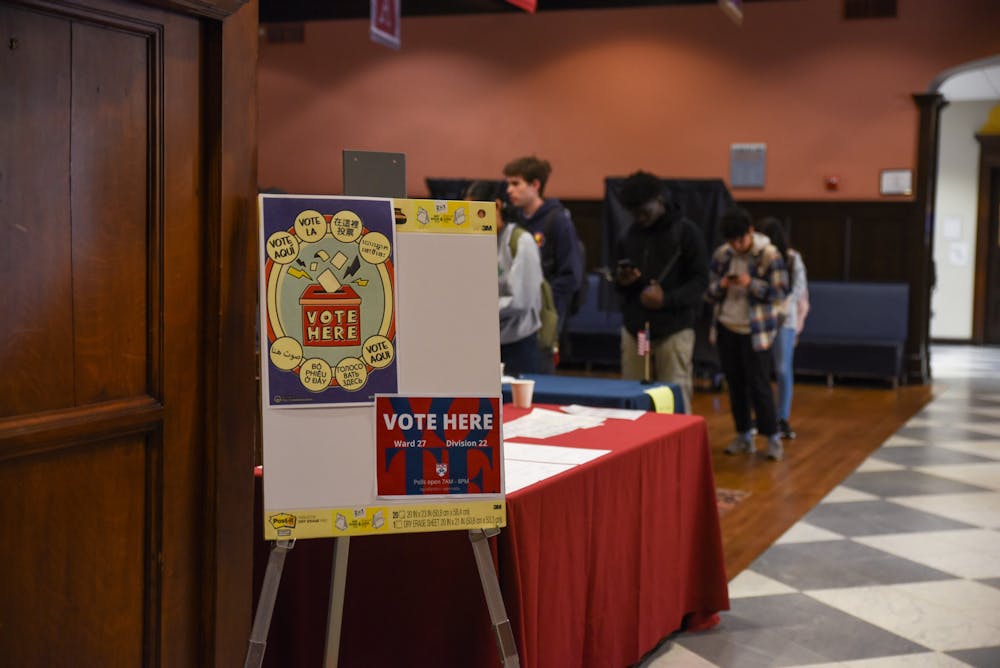
Last week’s Election Day marked record turnout for an off-year election in the last decade, as voters at Penn’s on-campus polling locations voted more overwhelmingly for Democratic candidates than they have in years, according to an analysis by The Daily Pennsylvanian.
A total of 2,126 ballots were cast at Penn’s four on-campus polling locations on Election Day — a substantial increase from recent off-cycle elections. Over the past decade, as Penn affiliates have gained prominence in local and national politics, the University has continued to see increased voter turnout.
Compiling voting records from the nine Philadelphia ward divisions that most frequently correspond to on-campus polling locations at Penn, the DP found that last Tuesday’s turnout was significantly higher than any off-year election in the past 10 years.
In the past decade, this year’s election was the only one that drew over 1,500 voters to the polls at Penn without a national race.
This election was also one of the more Democratic-leaning years on record, with more than 90% of voters at Penn casting their ballots for Democratic incumbent Larry Krasner to serve as Philadelphia’s district attorney.
As turnout has increased, so has the prominence of Penn alumni and affiliates in politics.
RELATED:
Penn community members rally outside Sen. McCormick’s office, denouncing attacks on higher education
Mail-in ballot, voter ID policies that will shape this year’s election
Presidential elections in 2016 and 2024 saw the highest levels of voter participation from Penn in the past 10 years. In both years, 1968 Wharton graduate and President Donald Trump was the Republican candidate on the ballot.
The 2020 presidential election — which lagged behind prior years in Election-Day turnout due to the COVID-19 pandemic — featured Penn affiliates representing both major political parties. Trump ran against former President Joe Biden, who previously served as the Benjamin Franklin Presidential Practice Professor at Penn.
According to an analysis conducted by the Institute for Democracy and Higher Education in 2021, nearly 77% of eligible Penn students voted in the 2020 election — a 9% increase from 2016.
In 2020, Penn students outperformed both the turnout rate for college students across the country and the general population turnout rate, which were 66% and 67% respectively, according to data collected by Penn Leads the Vote.
In 2023, Philadelphia’s mayoral election — in which 2016 Fels Institute of Government graduate Cherelle Parker was the Democratic candidate — drew record turnout for a mayoral race. The 2015 mayoral election, by comparison, saw only 367 Penn voters, making for a 256% increase in turnout by 2023.
In this year’s elections, increased turnout has been attributed to the national prominence garnered by a retention vote for three justices on Pennsylvania’s Supreme Court. Penn overwhelmingly voted to retain all three justices.
The district attorney race between Democratic incumbent Krasner and Republican challenger Pat Dugan marked Krasner’s second time on the ballot for this position. He previously ran and won in 2021 — in an election that only saw 508 Penn voters. This year, over 1,800 Penn students voted in the district attorney election, marking a 258% increase in voter turnout.
Aside from the positions at the top of the ballot, last week’s elections featured several other races for judicial retention as well as local positions. A number of candidates were affiliated with or alumni of Penn.
“I was just really impressed by what I was seeing in just today’s energy, attention, preparation, and turnout — it far exceeded the expectations of everybody I know,” Executive Director of Penn’s Office of Government and Community Affairs Dawn Deitch told the DP on Election Day. “I’ve done this for more than 20 years on Penn’s campus, and it was just impressive in every way.”
RELATED:
Penn community members rally outside Sen. McCormick’s office, denouncing attacks on higher education
Mail-in ballot, voter ID policies that will shape this year’s election
Staff reporter Ishani Modi covers state and local politics and can be reached at modi@thedp.com. At Penn, she studies biochemistry.


