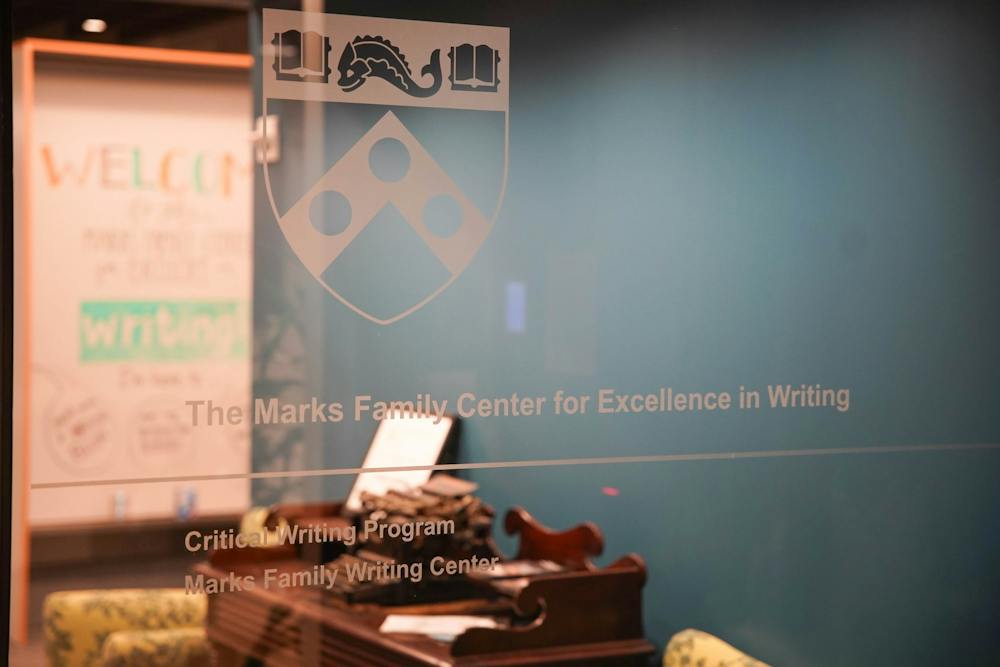
As the College of Arts and Sciences plans to implement the new general education curriculum in Fall 2027, it must make an important update to a continuing undergraduate requirement: Critical Writing Seminars should be free of artificial intelligence.
Since the mainstream introduction of large language models in November 2022, many faculty have changed the content and structure of their courses. Some have begun to train students to use AI, while others try to mitigate the negative effects of AI use on learning. However, the structure of Penn’s common curriculum Critical Writing Seminars has remained unchanged since 2020, focusing on genres like white papers, op-eds, and book outlines. Current policies, in practice, permit the use of AI for writing at any stage of the process.
What does it communicate to students when we surrender to AI-generated ideas, structure, and text in the only course required of all students across Penn’s four undergraduate schools, a course that they take within months of first stepping on campus? It teaches them that reading and writing are about a final product, rather than an iterative process of gathering evidence, tracking arguments, thinking, and communicating. It indicates that Penn expects and condones the use of AI in their written work. It abandons the central task of training students as critical thinkers, counteracting the aims of the College’s new curriculum and its “Kite” course. It sets up everyone to fail — students and other faculty alike — when higher-level courses aim to build on foundational skills.
In a December 2025 white paper, a group of Penn faculty, staff, and students in the Price Lab for Digital Humanities argued that high standards for critical reading, writing, and research can only be maintained at the undergraduate level without AI. When students use AI to summarize reading, collate research, and write papers, it is impossible for instructors to evaluate their true ability, and students do not gain deep knowledge in those areas. Such concerns are not limited to students in the humanities. Reading and writing are the cornerstone of developing expertise in all fields. Further, they are essential in and of themselves. The process of writing is a process of thinking, discovery, and critique. No part of this process can be outsourced without cost. In an age of disinformation and AI-generated text, every person needs to be able to evaluate writing for its plausibility and authenticity.
For these reasons, we argue that Penn has a duty to require some AI-free coursework and authentic assignments. We applaud the new Kite course with a humanities lab that facilitates focused, low-tech reading and writing time for College students. The Critical Writing Seminars are a special curricular space that also requires innovation in AI-free instruction, both because of the importance of the skills Penn entrusts them with imparting and because of their academic and cultural role as gateway courses across the university.
The Critical Writing Seminars are common curriculum courses. Many elements of the syllabi, including course policies, lie outside the control of individual instructors, who have in recent years raised concerns about the curriculum and their academic freedom. Responsibility for change thus rests with the Critical Writing Program and especially the Penn administration.
A true commitment to high-quality writing instruction in the age of AI requires hard limits: AI-free course policies and significant investment in internet-disabled computer labs for students to complete writing assignments outside of class. The goal of these spaces should be to replicate pedagogically and socially important aspects of writing and revising a paper in a dormitory or library environment prior to the advent of AI, as well as to model good academic work habits.
Proctored writing labs are not simple to implement. However, the alternatives — allow AI use to continue to interfere with foundational learning or turn to expensive surveillance or AI transparency software such as Rumi — are unacceptable. To agree to a Critical Writing Program in which students submit AI-conceived and AI-written work is to concede, as one professor argued in a parallel case at Harvard, that there is no longer any reason for a place like Penn’s College to exist.
The Penn administration now budgets huge sums for licensing AI products. Our leaders should devote equal resources toward new physical spaces and staff that support innovations in AI-free instruction. Only through these innovations can Penn ensure students are still gaining the foundational skills they themselves know they need. Is the one course required of all undergraduates not worthy of significant investment at a wealthy institution like ours? On a campus with state-of-the-art athletic facilities, can we not find the resources and will to construct intellectual gyms that provide the spaces and climate we need to build students’ minds?
Our proposals are not anti-AI; they are pro-student. Practicing fundamental skills in an AI-free environment makes students more creative, critical, confident thinkers in any context. It also prepares them to be better users of LLMs and to more effectively evaluate their outputs.
Some of our peer institutions have taken clear steps toward AI mitigation, especially in foundational courses. The University of Chicago, for example, has instituted an AI ban and has gone “analog” in all its social science core courses (as well as in the first year of its law school). A recent MIT report recommends that all courses emphasize AI-resistant assessments such as oral exams, assignment structures that make process visible rather than just output, and in-person projects in staffed AI-free rooms where students can work on long assignments together. It recommends in-person, structured social learning in all subjects, not counting lectures and recitations.
Penn still has a chance to be at the vanguard of these developments — but the clock is ticking. As AI becomes more advanced and widespread, it will only become more imperative to have well-established structures for strengthening the fundamental skills of our students. There is no better — or more important — place to start than with serious investment in AI-free Critical Writing Seminars.
EMILY HAMMER is Associate Professor in the Middle Eastern Languages and Cultures Department and Acting Faculty Director of the Price Lab for Digital Humanities at Penn. Her email is ehammer@sas.upenn.edu. This guest column was written in collaboration with other members of the Price Lab for Digital Humanities Critical AI Working Group.