A block of Market Street was renamed on Wednesday in recognition of Black Bottom, a predominantly Black neighborhood that developers demolished in the 1960s to expand Penn’s campus.
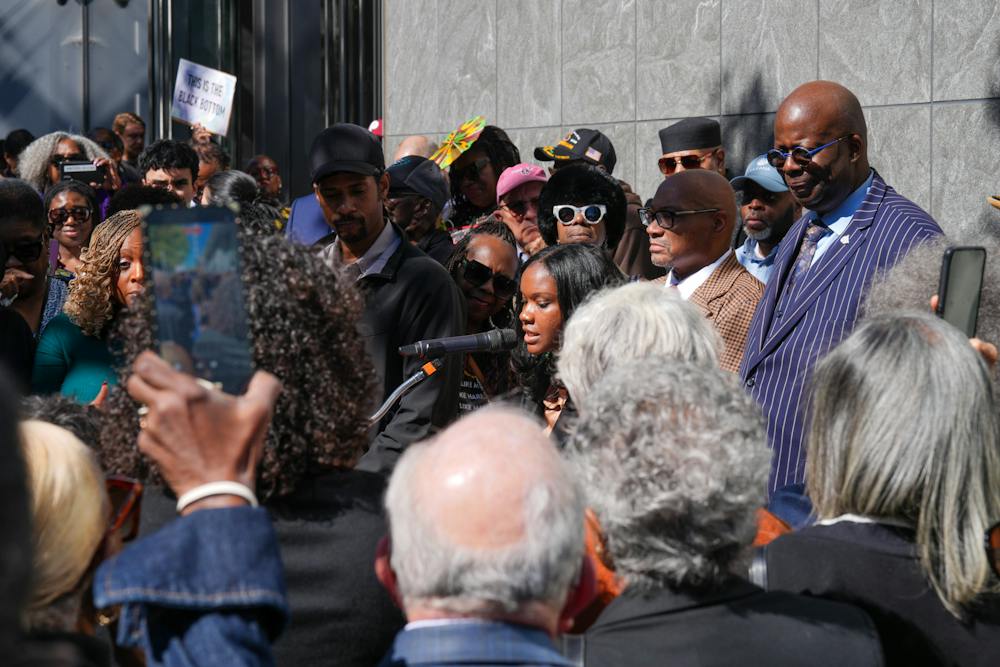
An Oct. 7 ceremony — led by Philadelphia City Councilmember Jamie Gauthier, who represents University City — formally introduced the block’s new name: Walt Palmer-Black Bottom Way. Walter Palmer, who grew up in the neighborhood, now lectures at the School of Social Policy & Practice and teaches a course about the area’s history.
The event was held at 3675 Market St., where Palmer once lived with his 12 siblings, his mother, and his stepfather. The formal renaming comes after the City Council voted to recognize Black Bottom by its original name last week.
“The Black Bottom was a vibrant Black community in West Philadelphia - until the City, Penn, and other institutions razed it to make way for campus expansion during urban renewal,” Gauthier wrote in a statement.
The area known as Black Bottom included much of Penn’s campus, roughly between 32nd and 40th streets east to west, and University and Lancaster avenues north to south. Once a flourishing neighborhood established as early as the 1840s, it was cleared to make space for University infrastructure. As a result, thousands of Black residents were displaced.
“This celebration is not only for Walt Palmer, but for the many residents, past and present, who lived in this area,” one speaker said at the event. “This street sign will always be here, proudly standing for you.”
When the city demolished Black Bottom, Palmer helped orchestrate an agreement to ensure the community could be involved in future land-use decisions. In 2022, members of the neighborhood circulated a petition demanding reparations for former Black Bottom residents and their descendants.
“The city didn’t care,” Palmer said in a 2024 interview with The Daily Pennsylvanian. “[Penn] had the backing of the courts, city council, the state legislature, and the land authorities.”
RELATED:
Penn students, volunteers are excavating West Philadelphia’s Black Bottom neighborhood
Penn owns over $3 billion in University City real estate, DP analysis finds
Palmer went on to found The W. D. Palmer Foundation, an organization dedicated to “advocating for at-risk communities, providing leadership education and training, and promoting anti-racism.” He additionally founded SP2’s Center on American Racism and Social Justice, and has taught courses on American racism and social change for decades.
At the event, visual and cultural historian Jasmine Cobb said Palmer has “fought against segregation” throughout his life. She highlighted his commitment to improving educational access for Black communities.
In 1955, Cobb said, Palmer established the Black People’s University of Philadelphia and began developing what became the “foundation of research and training” on slavery, race, and racism.
“For decades, he used education to empower teachers, mentor communities, and younger students and others who understand the history of slavery, racism, and gender, and more importantly, to develop resilience, persistence, and self-determination,” she added.
Palmer is a “torchbearer for the Black Bottom,” Gauthier said at the event. She recalled interactions with Palmer a few years back, when he was protesting the clearing of University City Townhomes — a low-income housing development built on the site where Black Bottom stood.
“Palmer was standing on the corner of 48th and Market streets with a mic in his hand, explaining how the planned destruction of the townhomes was the second generation of top-down community erasure,” Gauthier said. “To see it cleared 40 years later shows us that this pattern is real, and it’s only going to keep repeating itself.”
Gauthier said it was important to continue acknowledging past harms, and called for a “tough conversation about what it means for government and institutions to own, acknowledge, and account for the harm that they inflict.” Institutions — such as Penn — have continued to benefit from this harm which “entitles its community members and descendants not just to recognition but to reparation,” she added.
Currently, Penn archaeology students are working with local volunteers to excavate the former West Philadelphia neighborhood. Undergraduates are involved in this project through the course — “Archaeology in the City of Brotherly Love” — taught by Penn anthropology professor Megan Kassabaum.
RELATED:
Penn students, volunteers are excavating West Philadelphia’s Black Bottom neighborhood
Penn owns over $3 billion in University City real estate, DP analysis finds
Senior reporter Lavanya Mani covers legal affairs and can be reached at mani@thedp.com. At Penn, she studies comparative literature. Follow her on X @LavanyaMani_.