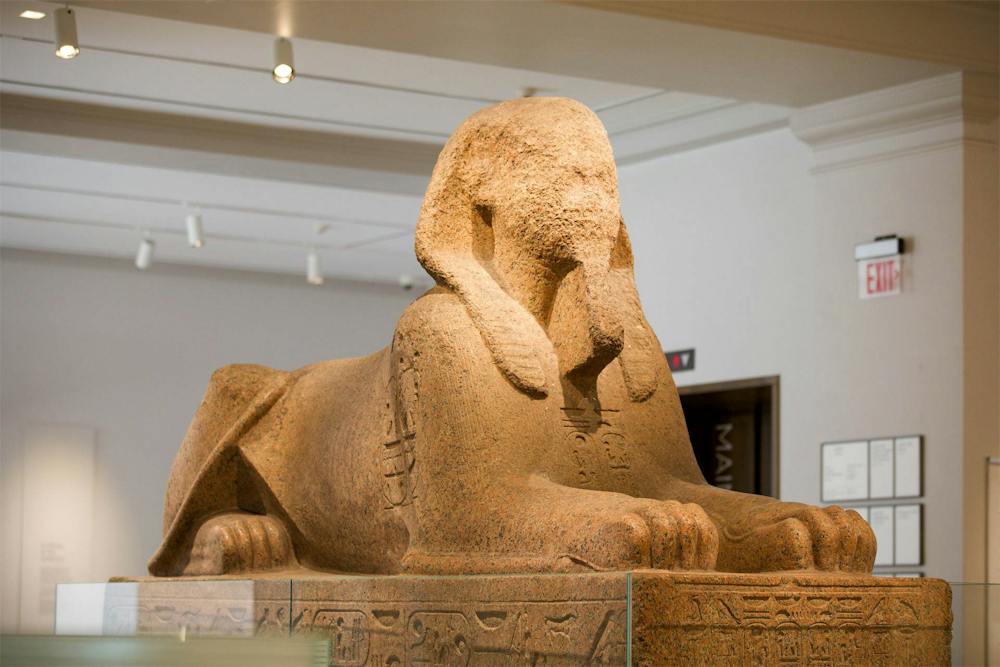
Penn Museum recently received a Mid-Atlantic Emmy Award for a video project documenting its newly renovated Egypt and Nubia galleries.
The National Academy of Television Arts and Sciences bestowed the project with the honor on Sept. 26 and recognized it under the Arts and Entertainment, Short Film category. The video was made in collaboration with Maestro Filmworks and highlights the largest gallery transformation in Penn Museum’s 139-year history.
Jennifer Houser Wegner, the curator in charge of the Egyptian Section and a 1991 College graduate, shared that the museum’s plans to remodel the Egyptian exhibits have been in discussion for a quarter century.
“We submitted that first planning grant in 2001,” she said, explaining that “at the time, the museum wasn’t able to take on a project of this size.”
One of the largest new installations was a reconstruction of an Egyptian tomb chapel, which visitors will be able to physically enter.
“This is one of the very few places in the United States where you can be in an ancient Egyptian tomb, so that’s a pretty exciting thing,” Wegner said.
Jo Tiongson-Perez — Penn Museum’s chief marketing and communications officer — highlighted that the exhibition aims to reveal how Egyptian life took many forms by “centering their humanity.”
For Wegner, one goal for the remodel was to “personalize and humanize the ancient Egyptians” — who she said many people view as “exotic and mysterious.”
RELATED:
‘Irreplaceable’: Academy of Natural Sciences shutters doors after nearly 200 years
A ‘history in bricks and mortar’: How Penn designs campus architecture
“A lot of times people don’t think of the ancient Egyptians as regular people,” she added.
2019 Wharton MBA graduate Kris Mendoza is the executive producer and founder of Maestro Filmworks.
To him, “video has emerged as a necessary storytelling tool.” He led the film’s production and expressed that having the ability to share the stories of an ancient civilization was “fascinating.”
Tiongson-Perez highlighted that while curation and conservation are often regarded as a “behind-the-scenes” process, it’s “a story to be amplified in itself.” As such, it became a focus of the short film.
“Sometimes it takes years and years to carefully care for an object, so that the next generation can learn from it,” she added.
This Emmy recognition reflects a broader shift in Penn Museum’s attempts to engage audiences through media platforms.
“We try to stay on top of all of those different channels right now, mostly social media,” Tiongson-Perez explained.
The goal, she said, is to make it “attention-grabbing enough that will hopefully stop them mid-scroll and they’ll learn something interesting about the museum.”
Tiongson-Perez added that the team’s reaction to receiving an Emmy was originally “disbelief” that was soon “overtaken by a lot of gratitude.”
Penn Museum hopes to use the recognition to garner excitement over the reimagined Egyptian galleries.
Wegner emphasized that the importance of a regional-Emmy can alert viewers in Philadelphia that “one of the largest collections of Egyptian material in the country” is “in their own backyard.”
Maestro Filmworks was essential to another University-affiliated Emmy win last month.
The company partnered with Penn Medicine on a video about the institution’s Camp Erin project, which won an Emmy in the Short Form Content – Social Issues category.
Camp Erin is run through Penn Medicine Hospice and serves as a space for children and teens who have lost a loved one.
Penn Museum’s exhibition Egypt Galleries: Life and Afterlife will be open to the public on Dec. 12, marking the completion of the first phase of a multi-year gallery renovation.