

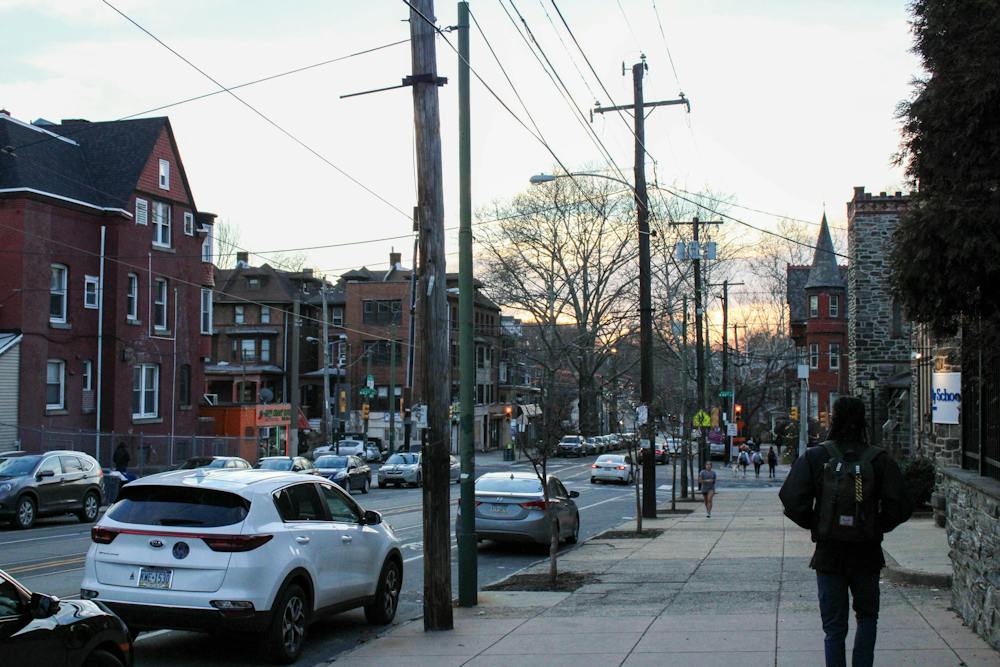
Penn archaeology students are working with local volunteers to excavate Black Bottom, the former West Philadelphia neighborhood that the University demolished in part to make room for campus infrastructure.
Undergraduates are involved in this project through a course — “Archaeology in the City of Brotherly Love” — taught by Penn anthropology professor Megan Kassabaum. Its 11 students contribute to Heritage West, a community archaeology project that studies the neighborhood through excavation and oral histories.
Kassabaum, a co-director of Heritage West, explained that the first two weeks of the semester focused on teaching the neighborhood’s history within Philadelphia. Students attended lectures and took a walking tour that examined Penn’s expansion into Black Bottom. Then, they moved to the excavation itself.
“When we’re on-site, they’re working side by side with community members,” she said, adding that many of these volunteers “have history in the Black Bottom — either themselves or their families.”
Kassabaum emphasized that community volunteers offer perspectives that supplement classroom instruction by building a well-rounded understanding of the area.
“I think that if you talk to the students at the end of the semester, they will probably have learned much more from the community members than they do from us,” she said.
The course was previously offered in fall 2023 — when the excavation began — and returned for enrollment in 2026.
On Oct. 2, Philadelphia's City Council voted to formally recognize Black Bottom — a predominantly Black neighborhood that existed in West Philadelphia as early as the 1840s, and was demolished in the 1960s. The neighborhood stretched roughly between 32nd and 40th Streets east to west, and University and Lancaster Avenues north to south — the space University City currently occupies.
RELATED:
New book traces Penn’s landscape, trees through the years
According to Penn Museum, up to 10,000 people were displaced “under the guise of ‘urban renewal’” when the West Philadelphia Corporation — a consortium of institutions — wanted to redevelop the area.
Laura Wolf-Powers — the author of “University City: History, Race, and Community in the Era of the Innovation District” — said that Penn, Drexel University, and other academic institutions were part of the corporation. They worked with the city’s redevelopment authority to construct a new plan for the area, leading to the demolition of homes and businesses for projects including the University City Science Center and University City High School.
Developers claimed that the Science Center could bolster employment in the neighborhood, according to Wolf-Powers. The efforts faced strong resistance from Black Bottom residents, who argued that demolition would displace the community and destroy cultural history.
“It was people’s neighborhood,” Wolf-Powers said. “There were social ties that they had there.”
She added that housing discrimination limited the places to which displaced Black residents could move, and that compensatory payments to homeowners were insufficient to purchase replacement homes.
“The redevelopment authority did provide some compensation to the homeowners in the Black Bottom, but it was not very much, and it was certainly not enough for them to buy another home somewhere else,” Wolf-Powers stated.
Darnell Holmes, a Heritage West community volunteer whose grandmother grew up along Lancaster Avenue, said that accounts from his relatives provide insight into daily life in the historic neighborhood.
He recalled his mother’s descriptions of clam shops where residents gathered and purchased food for family and neighborhood celebrations. He also described the act of residents making clothing and other handmade items in their homes.
“A lot of the people there had things that we would consider now to be hobbies, but that was just daily life,” Holmes said.
Black Bottom emerged during the Great Migration when Black Southerners moved to Philadelphia for new opportunities. After the 1949 Federal Housing Act passed, Penn and Drexel-backed projects overtook the neighborhood.
Kassabaum noted that Penn students arrive in the course with varying levels of knowledge about Black Bottom.
“There are some students who’ve really taken it upon themselves to learn the history, and when they come and visit the excavation, were pleasantly surprised by how much they already know,” she said.
Other students, however, have not considered what occupied the area before it became University City.
The Heritage West project is considering ways to present its research after excavation season ends. According to Kassabaum, an 11-member community advisory board is discussing various projects — including a K-12 curriculum and an exhibition featuring artifacts and oral histories.
For Holmes, this project is a chance for students learn about the families who lived in Black Bottom and consider how redevelopment affected the community. He explained that the excavation sites also give volunteers the opportunity to discuss the neighborhood and explain archaeological methods to students passing by.
“The stories help us have access to why, but the material culture helps us have access to how and what,” he concluded.
A celebration and renaming ceremony will take place at 11 a.m. on Wednesday at 36th and Market Streets.


