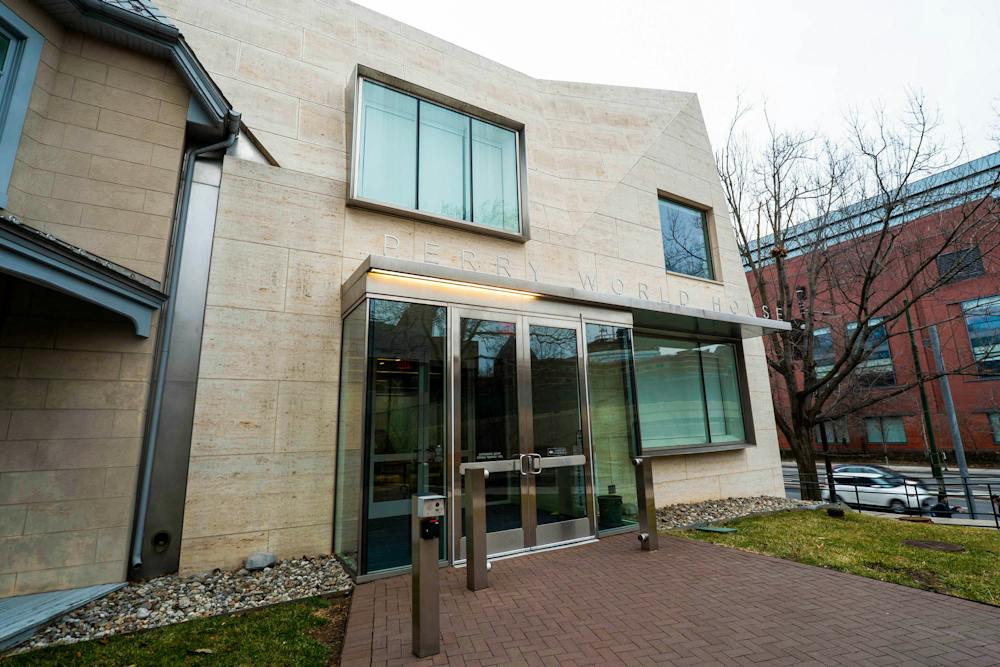
Ten years after Perry World House opened its doors at Penn, the center has adapted to a changing world while retaining its founding mission.
PWH opened in September 2016 following a $10 million gift three years earlier from 1977 Wharton graduate and then-Trustee Richard Perry and his wife, Lisa. Since then, the center has expanded its reach across campus while engaging students, scholars, and policymakers.
In an interview, Political Science professor and PWH Faculty Director Michael Horowitz — who has long been affiliated with the center — said that former Penn President Amy Gutmann envisioned PWH as a way to bring together expertise on global policy issues across Penn’s 12 schools.
The goal, he said, was to “make the whole bigger than the sum of the parts in a way that could create transformational experiences” for the Penn community. In preparation for that role, PWH began its programming even before its physical space opened.
The building replaced the Kappa Alpha Society’s old house on Locust Walk. Most of the old building was torn down, leaving “a huge hole in the ground” during construction, Horowitz explained.
“While all of that construction was going on from 2014 to 2016, World House was starting to ramp up programming across the University,” he added.
Just a year after its opening, the center received nearly $500,000 from the Carnegie Corporation of New York — now known as the Andrew Carnegie Foundation — to assist its Global Innovation Program. The grant-funded workshops and initiatives focused on interdisciplinary conversation and international policy issues.
Over the following years, the center broadened both its programming and its network.
RELATED:
Perry World House panel celebrates Benjamin Franklin’s role at Constitutional Convention
Perry World House announces inaugural cohort of faculty research fellows
“The mission of World House has always been the same,” Horowitz said, describing its focus as “bridging the gap between academia and the policy world.”
One example is its Distinguished Visiting Fellows Program, a key avenue for connecting Penn students and faculty with policymakers, government officials, and scholars from around the world. The program, which has existed since PWH’s inception, has a cohort of 14 global leaders this academic year.
While its institutional values have remained steady, other aspects of PWH have changed over time.
When it first opened, the center’s work focused on two broad themes: global order and global shifts. In summer 2024, the center reorganized its work around security, climate change, global justice and human rights, and democracy.
“World House is an institution that is supposed to reflect a changing world, and so what we do reflects that as well,” Horowitz said.
Political Science professor Beth Simmons, a member of PWH’s faculty council, said the change was intended to give the center “a little more precision” in what it focused on. She explained that the revised structure better matched the faculty, visiting fellows, and other resources the center has built over time.
“When it was first established, it had no built-in networks or anything like that — those had to be developed over time,” Simmons said. “It took true dedication by the staff, by the University to fund the efforts, by the faculty, by various people who have come in contact with the Perry World House.”
Faculty involvement has expanded alongside the center’s growth. According to Horowitz, PWH engaged more than 200 faculty members from all 12 of Penn’s schools during the last academic year.
The center also recently launched a Faculty Fellows program built around its four research areas.
“These faculty fellow projects are a way for World House to not just build broad relationships with lots of faculty, but deep relationships with faculty who are already doing transformational research,” Horowitz said. “What World House can help them do is connect with the global policy world to have impact.”
Student engagement is also a central part of PWH’s work, with three distinct programs offered. One of them, the World House Student Fellows program, includes 31 students from all four of Penn’s undergraduate schools this year.
Students participate in weekly seminars, work on yearlong policy projects, and travel to meet policymakers and other global affairs professionals.
College senior Ashti Tiwari, a World House Student Fellow and former staffer for The Daily Pennsylvanian, said that the program has shaped much of her experience at Penn.
“Places like Perry World House help you make sense of the world and the global issues of the world,” she said.
She also pointed to the interdisciplinary nature of the center.
“They really do try to bring people together from all parts of campus,” Tiwari said.
Evan Stubbs, a College senior who was previously a World House Student Fellow and a DP staffer, said the program gave him opportunities to engage directly with international policy organizations.
“I don’t know if those opportunities would really exist without Perry World House facilitating the connections and guiding people’s interests,” Stubbs said.
Through PWH, he had the opportunity to travel to Washington, New York, and Geneva. He also worked on a policy project with the United Nations Institute for Disarmament Research.
Stubbs also said that the program serves a “dual purpose” by helping students pursue policy opportunities they are passionate about while also giving organizations a way to recruit Penn students.
As PWH enters its second decade, Horowitz said that further increasing student involvement will be a priority.
“Our task over the next decade is to continue to integrate Penn students even more into our thinking and programming and activities in a way that helps create transformational opportunities to help shape not just people’s careers, but how they think,” he said.
RELATED:
Perry World House panel celebrates Benjamin Franklin’s role at Constitutional Convention
Perry World House announces inaugural cohort of faculty research fellows
Staff reporter Mbresa Simnica covers administration and can be reached at simnica@thedp.com. At Penn, she studies economics and political science.