SEPTA’s newly announced Accelerate plan promises new trains, accessibility improvements, and more frequent service, but for Penn students who commute to campus every day, the proposal may still fall short.
Announced on Sept. 22, the plan imagines a “generational transformation” for SEPTA made possible by a decade of investments, including 130 new low-floor trolleys, 230 new regional rail cars, and 15-minute-or-better service at nearly half of the system’s stations. The program’s implementation hinges on continued funding from Harrisburg, a dependency that has prompted concern over its feasibility.
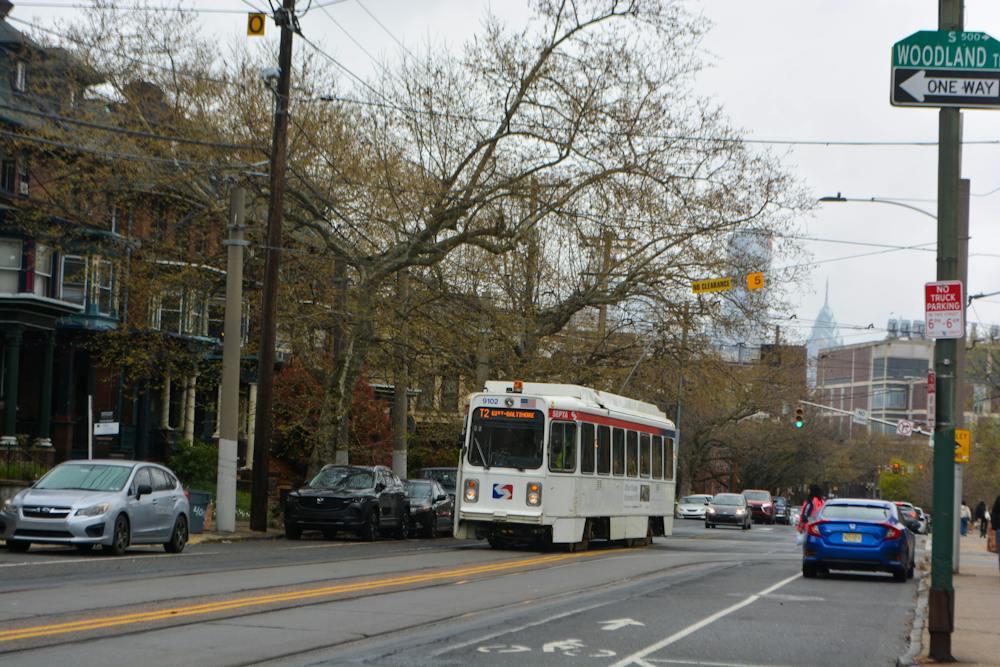
SEPTA spokesperson John Golden wrote in a statement that the plan would bring significant changes to University City, which he called “the core” of the regional rail network. According to Golden, the process for modernizing the trolley system will feature upgraded light-rail cars and fully accessible stations, while the arrival of new L cars in 2029 will mark “a major leap forward in safety, customer experience, and operational efficiency.”
Near Penn’s campus, the 34th Street L Station is already under construction. Several regional rail lines serving University City — including those to Paoli, Norristown, and the Philadelphia International Airport — are slated for 15-minute service as part of the proposal.
For students who ride SEPTA daily, however, the plan may not address the problems they face most urgently.
College sophomore Nestor Fioretos — who commutes within the city by trolley and the Market-Frankford Line — said the age of equipment matters less to him than whether it runs on schedule.
“I don’t really care too much about how old the trolleys are, or how old the subways are,” Fioretos said in an interview. “That doesn’t really bother me so much as issues in timeliness or communication.”
SEPTA’s reliability has waned in recent years, according to Fioretos.
“You can look at Google Maps on your phone and it says that a train is coming in two minutes, but you wait five minutes, 10 minutes, and nothing has come still,” he added.
Zion Brown, a College sophomore who commuted on the Paoli-Thorndale Regional Rail line during a summer research job at Penn, spoke to a similar issue. She welcomed the promise of 15-minute regional rail service but said that it targets the wrong window.
“The 15-minute system is good, but I think that where SEPTA struggles the most is during rush hour,” Brown said. “SEPTA isn’t delaying trains or canceling trains that are coming in the middle of the day.”
After a series of bus route and rail service cuts were enacted last year, many Penn students and faculty members described longer waits, crowded stations, and more difficult commutes.
Brown said she would rather see more frequent rush-hour service — both local and express — to reduce delays at the start and end of the workday.
College junior Victoria Viera, who rides the L on her way to Penn, spoke of the rush hour strain as well. Morning and evening peaks, she said, leave cars “so full” that “everyone is touching each other.” Regional rail delays, in her experience, are routine, and maintenance issues occasionally leave trains stuck in the tunnel.
However promising the Accelerate overhaul may be, Viera questioned how SEPTA will pay for it — and whether those expenses will fall on riders.
“I don’t know how they’ll be able to not raise the prices, which can most definitely harm lower-income working-class individuals,” Viera said. She added that the clearest discounts tend to go to children and students, while “low-income working-class people have to bear costs.”
She estimated that her largest regular expense is $95 per month with the monthly pass Penn offers at a 10% discount. Viera said she wishes the University did more for commuters and highlighted SEPTA’s college transit program, which includes a far greater discount than Penn’s 10%. The University’s parking costs, billed by the academic year, struck her as another barrier.
Fioretos said he was “not super optimistic” about the funding prospects, citing a longstanding divide in Pennsylvania “about things that benefit urban voters more than suburban or rural voters.” He mentioned that while Pennsylvania Gov. Josh Shapiro has backed sustained SEPTA support, “a lot of Pennsylvanian lawmakers don’t.”
Brown framed the plan’s fate as a question of how Harrisburg chooses to see the city. Philadelphia generates an outsized share of Pennsylvania’s revenue, she said, with much of it tied to the workers SEPTA carries into the city each morning.
“Improving SEPTA would behoove the state’s budget at large,” Brown said.
Fioretos also described a problem the plan’s new hardware cannot address: the perception, common among Penn students from outside cities, that SEPTA is unsafe or unclean.
“I’ve taken SEPTA since I was in fifth grade and it’s been nothing but good to me,” Fioretos said, adding that any revitalization effort should take safety seriously.
Philadelphia City Councilmember Jamie Gauthier, whose district includes Penn’s campus, wrote in a statement that “no community stands to gain more from SEPTA’s ambitious Accelerate Plan than ours.”
Gauthier added that few campuses are as connected to public transit as Penn. She encouraged administrators to “press GOP lawmakers in Harrisburg to come to the table in good faith and work with Governor Shapiro and Democrats on a long-term, sustainable funding solution for public transit.”
“My constituents, and all Pennsylvanians, deserve world-class public transportation,” Gauthier wrote.
Senior reporter Riana Mahtani covers national politics and can be reached at mahtani@thedp.com. At Penn, she studies political science. Follow her on X @Riana_Mahtani.