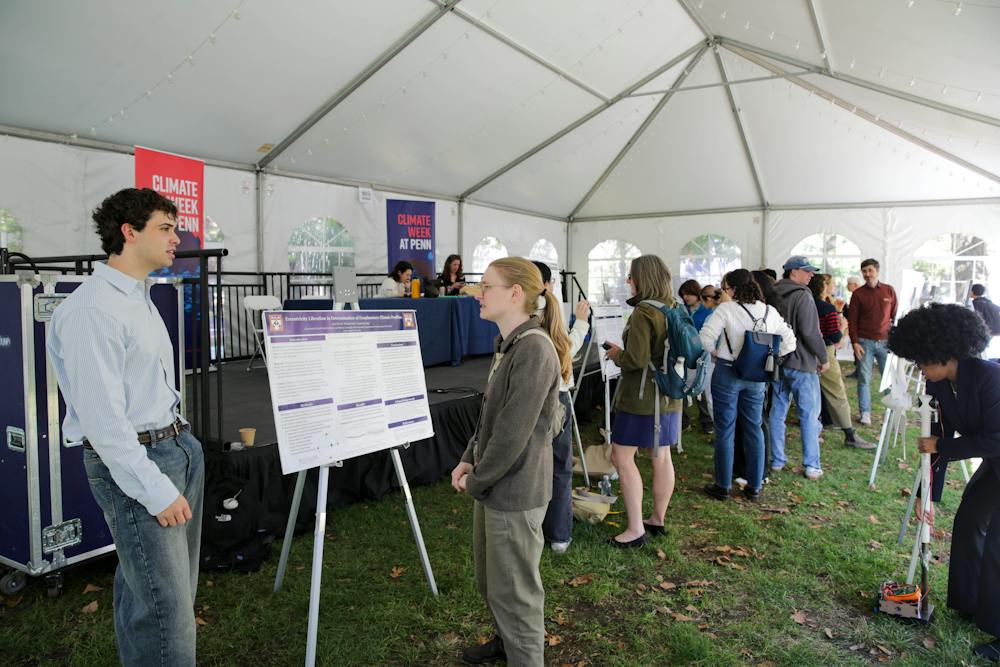
Penn students presented their environmental research at a Wednesday poster exposition.
The Oct. 7 research fair was part of the University’s annual Climate Week programming and was held on College Green. The Penn community was invited to view the roughly 20 posters on display — all highlighting climate-related subjects ranging from policy proposals to avian collisions.
Penn Climate Research Program manager Xime Trujillo said that she hoped to engage a variety of community members regardless of their interests.
“We’re really giving everyone the spotlight and everyone the possibility to connect and find their community here on campus,” she added.
The expo featured contributions from a variety of researchers — including undergraduates and postdoctoral students. Projects were facilitated in conjunction with various research centers, professors, and universities.
Trujillo emphasized the importance of engaging with the entire Penn community on environmental issues, adding that “climate change is a challenge that requires everyone to take some action.”
“There’s a whole diversity of perspectives that could offer an opportunity for students to get their hands on into any climate challenge that’s out there,” she said.
Maya Halma, who graduated from the School of Arts and Sciences in 2026 with a master’s degree in environmental studies, presented work on the relationship between socioeconomic status and climate change intervention.
RELATED:
Penn Climate Week returns with emphasis on student action
Penn athletes discuss environmental awareness at Climate Week panel
She currently works as a research and communications specialist at the Water Center and hoped to understand if certain interventions were more or less effective depending on a person’s socioeconomic status.
Halma tested participants’ receptivity to three behaviors; selling more vegetarian meals, driving gas-powered vehicles less often, and adapting their homes increased renewable energy use. She used two techniques to promote this behavior — one based in social norms and one on ease of behavior.
The results were “pretty uniform” between participants of higher and lower socioeconomic status, according to Halma. She noticed, however, that the norms-based intervention was slightly more effective and that driving preferences was “the most malleable behavior.”
She was inspired to engage in the field after taking an undergraduate class about the principles of behavioral change.
“A lot of the time, we’re using those theories to describe health behaviors,” Halma added. “I wanted to see if that theory was applicable to climate as well.”
This year’s Climate Week began on Oct. 5 and will conclude through Oct. 9.
Other programming included 1.5-minute climate lectures, a climate-themed “Jeopardy!” session, keynote speakers, and a movie screening. Organizers explained that the week was centered around the theme “Empowerment and Action” to help the Penn community engage with climate-related issues.
On Friday, Penn students will compete in Transform Penn: A Green Fund Pitch Competition, and the winning pitch will receive further mentorship to develop a proposal for the Green Fund.