

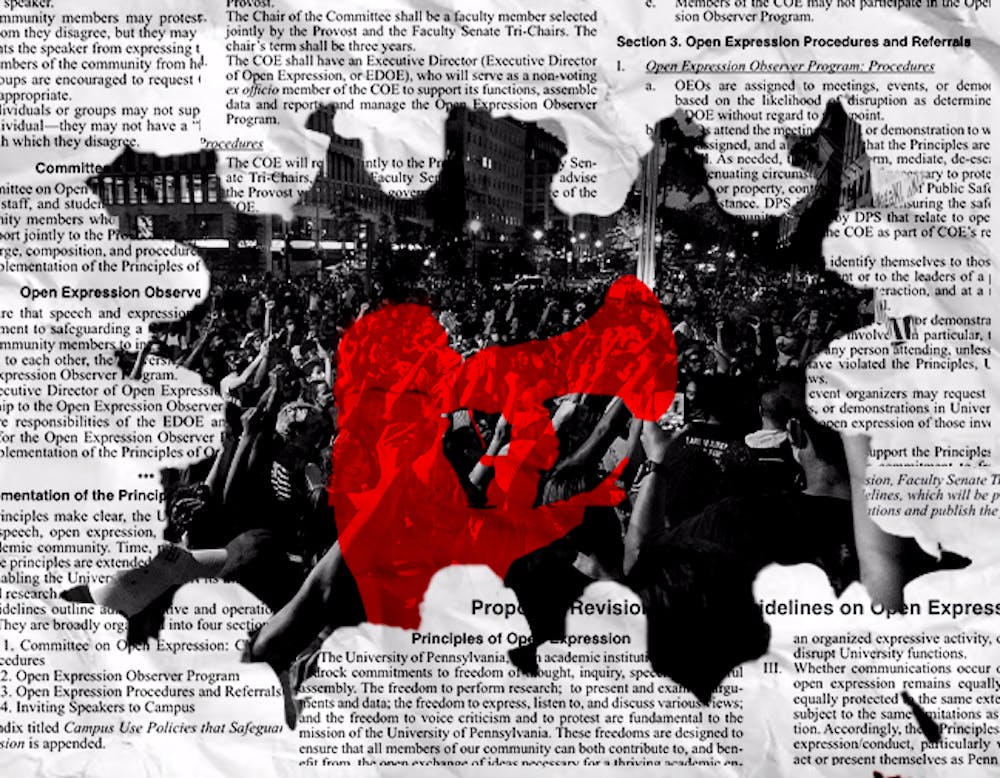
On March 31, Penn released a draft of its revised Guidelines on Open Expression. These new provisions, proposed to replace the 2024 temporary guidelines, signal a troubling path forward in the University’s relationship with student protest. Wrapped up in language around permit requirements and limits on excessive noise, the guidelines seem to suggest that “open” means “only open for some,” and “expression” means “only expressions that the University agrees with.”
Over the past three years, Penn has made every attempt to quell student activism in all its forms. From repeated union busting to arresting its own students, the Penn administration has made it clear that campus organizing is unwelcome. This notion is best underscored by the University’s response to the Gaza Solidarity Encampment in 2024. In May of that year, University officials empowered police in riot gear to arrest Penn community members, including students and faculty. In the fallout from the encampment, students were suspended or placed on mandatory leaves of absence. Well into the next academic year, barricades loomed over Locust Walk to discourage protests from occupying space on College Green.
The proposed guidelines are strikingly similar to the 2024 temporary guidelines and almost every bit as restrictive. Their stringent regulations on University spaces and complete ban on overnight activities effectively put a damper on any meaningful disruptive protest. With the threat of disciplinary action attached to any violations, we are moving toward a future in which all campus demonstrations are University-sanctioned — and therefore do not influence administrative policy in any meaningful way.
Penn’s annual Take Back the Night rally is a strong example of this type of University-sanctioned demonstration. Rooted precisely in the power of disruption for a cause, the women’s movement at Penn dates back to a 1973 sit-in at College Hall in which students demanded stronger protections against sexual violence on campus. The four-day campaign ended with the University meeting every single one of the students’ demands, including increased campus safety measures and the creation of the Penn Women’s Center.
Today, though, Take Back the Night has lost its disruptive edge. The peaceful sit-ins of 1973 wouldn’t be allowed now under the proposed policy. And planned with the full backing and support of the University, the focus of campus advocacy surrounding sexual violence has moved from holding institutions accountable to giving them an even louder voice.
The participation of greek organizations in the event, so heavily encouraged by the Office of Fraternity and Sorority Life, is troublingly ironic, considering the culture of violence these groups have historically perpetrated. In fact, it is the past actions of many of these organizations that necessitated the night to be “taken back” in the first place. On top of that, when representatives of Penn University Life are allowed megaphones and designated speech time, it places survivors’ testimonies on the same level as those whose only stake in the matter is following University policy. It funnels expressions of pain and calls for change into institutionally sanctioned events and forces them to embrace what’s already allowed, not what’s possible for victims’ empowerment.
Indeed, when it comes to sexual assault on Penn’s campus, the University administration has a lot of work to do. In 2024, 16.7% of female undergraduates at Penn reported that, since entering college, they have experienced “sexual contact involving physical force or inability to consent or stop what was happening.” Yet in the 2024-25 academic year, there were only four documented reports of sexual violence at Penn. This points to a dire underreporting issue that Penn must address and a crucial flaw in assuming that institutionally sanctioned solutions can prevent or properly reckon with the conditions that disruptive protests hope to change.
In other words, a resource fair, an awareness-raising event, and a University-sponsored march down Locust are meaningful shows of support, but they won’t force administrators to take action. In a world where the proposed guidelines limit what our expression and, in turn, our reality can be, Penn’s administration only allows demonstrations that ask nothing of them. Students are welcome to organize, march, and chant, so long as they do not make any real demands.
SEE MORE FROM THE DAILY PENNSYLVANIAN EDITORIAL BOARD:
Editorial | Penn has an AI problem
Editorial | Students should choose their Commencement speaker
Perhaps the proposed guidelines say it best: “Disrupting University operations is not permitted.” The implicit message here is that what’s “not permitted” is any dissent beyond where, when, and at what volume the University allows it to occur.
Editorials represent the majority view of members of The Daily Pennsylvanian Editorial Board who meet regularly to discuss issues relevant to the Penn community. This body is led by Editorial Board Chair Jack Lakis and is entirely separate from the newsroom. Questions or comments should be directed to letters@thedp.com.
SEE MORE FROM THE DAILY PENNSYLVANIAN EDITORIAL BOARD:
Editorial | Penn has an AI problem
Editorial | Students should choose their Commencement speaker


