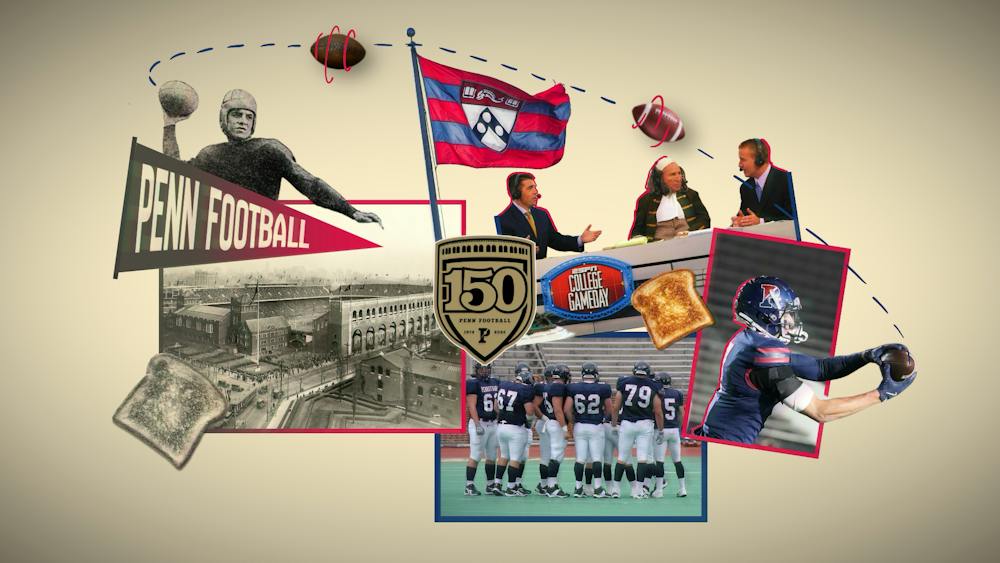
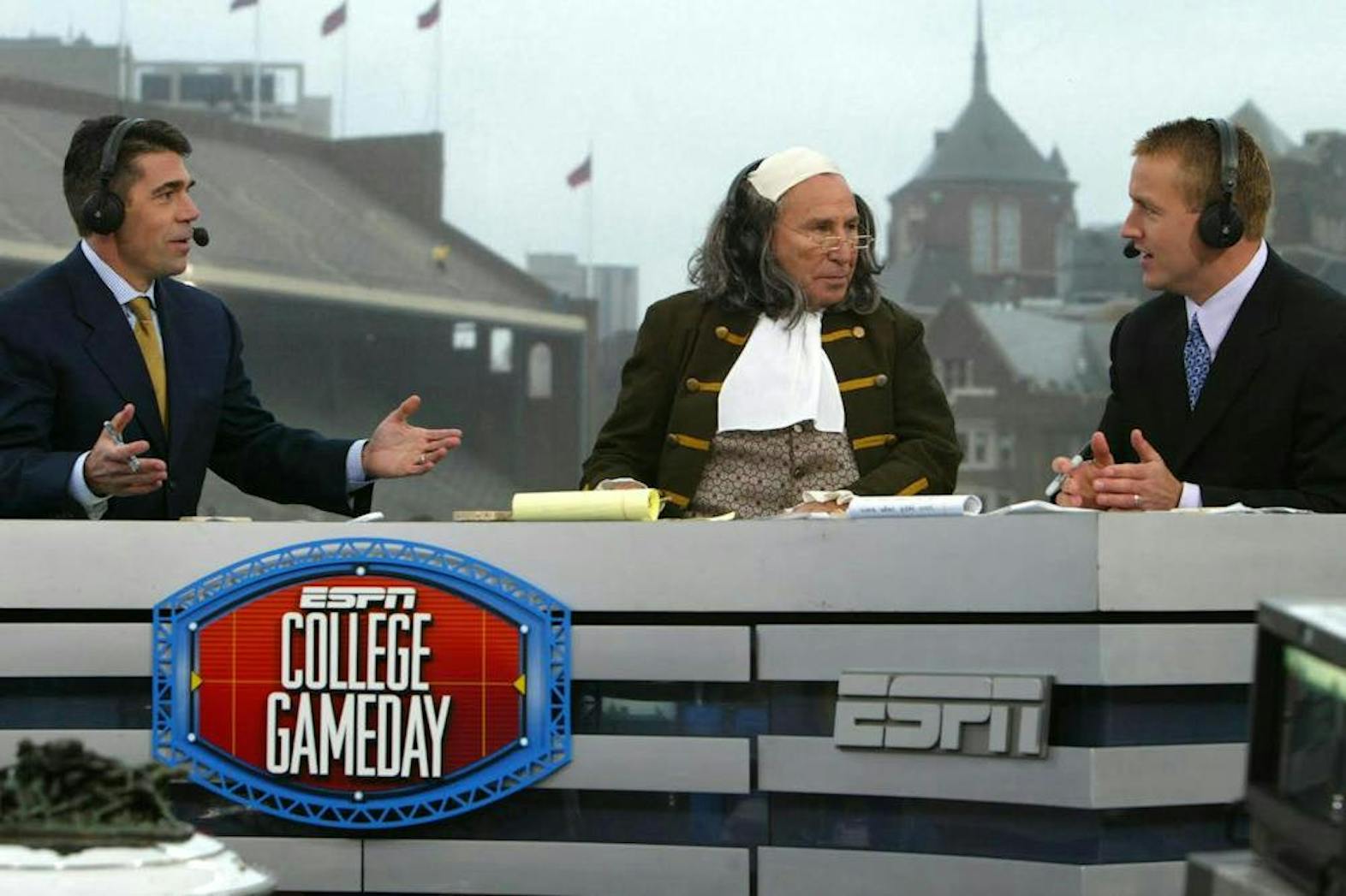
It’s hard to nail down the peaks of Penn football’s storied history, but 2004 Wharton graduate and former NFL player Ben Noll has an answer: when college football analyst Lee Corso sported Benjamin Franklin headgear on national television.
Somewhere between the dominant championship runs of the 1980s and the sensational moments of the modern era lies Penn football’s appearance on ESPN’s “College GameDay” on Nov. 16, 2002.
It was a landmark moment for the Ivy League and the broader NCAA Division I-AA, known as the Football Championship Subdivision today. “GameDay’s” appearance at the Quakers’ Homecoming game in the midst of an undefeated conference season roused a silent collective of Penn football fans to mobilize on Franklin Field that quiet Saturday morning. After all, the legendary television program had never before focused on an FCS school, let alone an Ivy.
The Red and Blue garnered national attention as they embarked on a “Cinderella season,” as then-coach Al Bagnoli said in a 2002 article in The Daily Pennsylvanian. Despite going 8-1 the previous year, the Quakers were selected to finish fourth in the conference in the 2002 season after graduating a strong squad of starters.
Perhaps echoing the 1982 Ivy League championship squad, the Quakers wouldn’t settle for a middle-of-the-road conference record, setting their sights on defying the odds and winning the conference. It came down to the wire, the season depending on one game: a Homecoming contest against Harvard, which had handed the Quakers their only loss in the 2001 season one year earlier.
RELATED:
https://www.thedp.com/article/2026/10/penn-football-special-teams-needs-to-step-up-sports-column-2026
https://www.thedp.com/article/2026/10/penn-vs-howard-football-2026-family-day-thriller
With the eyes of the nation on them, the Quakers were ready. They steamrolled past the Crimson, 44-9, securing a share of the Ivy League title they would go on to secure the following week with a win against Cornell.
Twenty-four years later, Noll — who played for Penn that day — views the game a little differently, focusing less on the moment and more on everything before and after.
“Ryan Fitzpatrick was the quarterback of that [Harvard] team. I got a chance to play with him on the [St. Louis] Rams, so that was also entertaining,” Noll said. “When the outside media recognizes what you see in the locker room every day, you’re kind of like, ‘Huh, yeah, maybe the Ivies are where football first started.’”
Noll would go on to become more familiar with the national media as an offensive lineman for the St. Louis Rams, Dallas Cowboys, and Detroit Lions, becoming one of a handful of Quakers to ink an NFL contract in the early 2000s.
“I think either the 2002 or 2003 Penn football team might have run the table and won a [national] championship if they were eligible for the playoffs because those teams were loaded,” 1983 Wharton graduate and former Penn quarterback Gary Vura said.
2007 Wharton graduate Sean Estrada joined the offensive line in 2004 as the Quakers were coming off an undefeated season and a 16-game win streak. Even though Estrada couldn’t see himself “doing anything else” since he started playing tackle football in sixth grade, he thought professional football was firmly off the table when he began his collegiate career.
An Orange, Calif., native, Estrada wasn’t your typical Ivy League recruit. He was drawn to Penn because of the “pedigree of the guys” and pronounced presence of Quakers offensive linemen on the national level. He figured he could become an elite college football player at a program that regularly sent big guys to the big leagues.
Fast-forward to 2007. Estrada earned first team All-Ivy honors on a squad that ranked in the top three in the country for the fewest sacks given up across the entire division. The San Francisco 49ers were knocking on his door, and Estrada answered.
Although his time as a player in the NFL was relatively short, Estrada quickly transitioned into a management role, working for the NFL Management Council shortly after graduating from law school in 2014. Despite the demands of the position, Estrada made a point to come down multiple times a season to support Penn football from the sidelines and as a mentor on a more personal level.
“Back when I used to know the coaches a lot, they’d be like, ‘Hey, can you talk to this one player [be]cause he reminds me a lot of you and we want to unlock this part about him,’” Estrada said.
Estrada isn’t an anomaly. Penn football alumni emphasize the importance of coming back to support the program by offering rousing pregame pep talks, pledging continued financial support, or simply attending the annual Homecoming game.
Alumni in the Greater Philadelphia area and surrounding cities can participate in Penn football’s mentorship program. Although the program was ostensibly created to provide professional development opportunities, alumni involved in the program stress the importance of providing a base level of support for Ivy League student-athletes beyond the gridiron.
“They gave me California kids [be]cause I knew what they were going through training from sunny Southern California to their first winters in Philadelphia,” Estrada said. “[We’d] just talk about stuff, stuff they don’t want to talk to the coaches or their parents about, just kind of the experience or problems or whatever.”
This kind of support and involvement is what draws people into the program. It’s a key part of a “Penn kind of football” and a major reason why the program is able to keep going strong after 150 seasons. The spirit of support is fostered over a student-athlete’s four years at Penn, encouraging them to give back when they become alumni.
The Penn football advisory board plays a vital role in maintaining the vast alumni network’s involvement with the program. Led by 2005 Wharton graduate and former defensive end Robert “Bobby” Fallon, the board champions fundraising efforts and supports current student-athletes with mentorship opportunities.
The football advisory board is currently working in conjunction with the Penn Champions Club’s 1876 Society to recruit at least 150 new donors to ring in Penn football’s 150th season. The effort hopes to bring the donor total to 500 while keeping Penn football on track to meet its annual fundraising goal.
Career development support is also an important part of the advisory board’s efforts. Current student-athletes have the opportunity to work closely with alumni across a variety of sectors to lock down critical internships while focusing on school and training.
“I always knew I wanted to play professionally. I didn’t know what that looked like at the time — it really depends on how your career goes in college, especially at the Ivy League level,” 2025 Wharton graduate and current Columbus Aviators quarterback Aidan Sayin said. “They’ve [alumni] always been great though at just giving you anything you need, whether that’s professional football or an internship in the summer.”
The board isn’t just focused on the current student-athlete experience — it also emphasizes the importance of “getting people together,” according to 2006 College graduate and former defensive back/running back Kelechukwu Okere.
“There’s regular community events,” Okere said. “For our championship years, they’ll do five- and 10-year reunion events.”
At the 2026 Homecoming game in just under a month, you can expect to see a biblical plague of Penn football players descend on the aptly named Locust Walk, celebrating the Ivy League championship teams from 1986 and 2016.
Former players don’t just come back for the big events, though. Take it from 1990 College graduate Bryan Keys, a two-time MVP, Penn Athletics Hall of Fame inductee, and first team All-American running back.
“Whatever I can do, I would come back, and when they had recruits in, I would actually go and talk to the recruits and try to encourage them to come to Penn as well,” Keys said back in September. “A couple of years ago, I was able to come and give a pregame speech to the team. I’m going to be there October the 10th, and hopefully I’ll get an opportunity to speak to the team there as well.”
It’s unclear whether Keys’ presence in the stands contributed to the Quakers’ last-minute victory over Howard last Saturday. But no matter rain, sleet, or snow, no matter the odds or the outcome, Penn football alumni will show up and show out for their alma mater, even if it means traveling far beyond Franklin Field.
The Kansas City contingent of Penn football fans took to the streets three times when 2018 Wharton graduate Justin Watson won a Super Bowl as a wide receiver with the Kansas City Chiefs. Former teammates and supporters of 2012 Wharton graduate Greg van Roten can catch the Greyhound or Amtrak out of 30th Street Station to watch the former Ivy League champion suit up for the New England Patriots.
Perhaps no person feels the support more than 2004 College graduate and current Atlanta Falcons coach Kevin Stefanski.
“I have a very tight-knit group of former Quakers that I hear from quite a bit via text,” Stefanski said. “I feel the love certainly from the brethren of the times that I played. I really do. I get text messages from former coaches, former players, former trainers that we’ve had over the years, so the bond is very strong.”
“I was shaped by Franklin Field and that program,” Stefanski added. “I owe a lot of who I am today to how I was impacted in the years I was there.”
RELATED:
https://www.thedp.com/article/2026/10/penn-football-special-teams-needs-to-step-up-sports-column-2026
https://www.thedp.com/article/2026/10/penn-vs-howard-football-2026-family-day-thriller