The multiple wings of Van Pelt-Dietrich Library Center host resources and exhibits dedicated to supporting the Penn community’s academic interests.
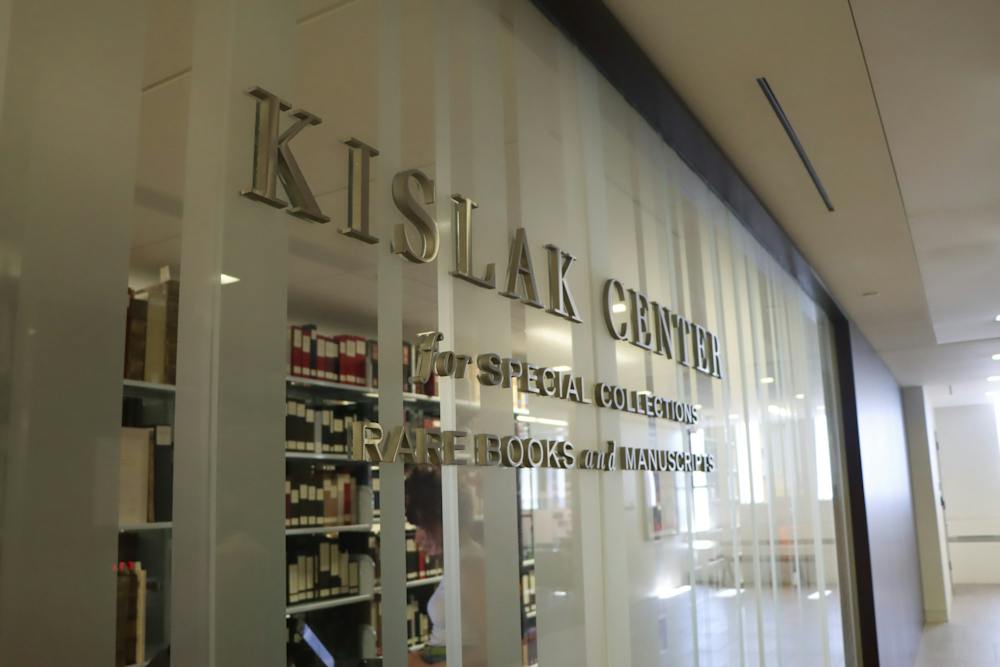
The Kislak Center for Special Collections, Rare Books and Manuscripts contains materials ranging from the oldest items in Penn’s collections to newly added contemporary works. The Zilberman Family Center for Global Collections — which is currently undergoing a lengthy renovation — will feature global collections and foster interdisciplinary research.
Kislak Center Associate Vice Provost and Director Sean Quimby said in an interview that the hub is a “vital” part of students’ educational experience.
“We’re responsible for the pre-writing of history — that’s our place in the knowledge creation process,” he added.
Located on the sixth floor of Van Pelt, the center boasts a collection of primary sources spanning from 18th century poetry to comic books created in the late 1990s. Quimby emphasized that these items are brought together within the Kislak Center by a mission to preserve the “context of its creations.”
He explained that preservation can extend even to works that do not have physical forms, pointing to staff members who primarily handle digital preservation.
“That program is about the preservation of natively digital content that comes into our collections, where it needs to be preserved for authenticity’s sake, faithfully to the original,” Quimby said.
The archival and preservation processes put older materials “in dialogue with what people are doing now,” according to Kislak Research Services curator John Pollack.
RELATED:
Annenberg School displays editorial cartoons from Pulitzer-winning artists
“I like to say that our collections are medieval to modern — or medieval to contemporary, even,” he added.
The center hosts many themed displays throughout the year.
Beginning Oct. 15, the Kislak Center will open its newest exhibit, The Black Hero’s Journey — which focuses on the first Black-owned comic book companies and the inaugural Black superheroes that made their way to mainstream media.
Quimby emphasized that one thing the Kislak Center team does “better than anyone” is teach students through its collections — made possible by many Penn classes frequently interacting with various collections.
Alicia Meyer, the center’s curator of research, works with students through the center and explained classroom experiences are among her “favorite ways to work with the Penn community.”
“Students bring their background knowledge from what they’ve learned in class into the library, and we have more sustained, engaged conversations about the materials in front of us because of that spirit of knowledge sharing,” Meyer wrote in a statement.
Alongside in-class pursuits, the hub researchers a chance to supplement their own interests and explore new materials.
“I like to think of the Kislak Center as a laboratory where you can go and consult documents that relate to other work you're doing,” Pollack added. “The collection’s kind of living in that way, you know, it’s changing. It’s growing. It’s adapting.”
He emphasized that the collections offer opportunities to all members of the Penn community — not just those who are interested in the humanities. He pointed to historical archives as an example of this.
“A lot of that history is about science,” Pollack said. “If you are an astronomer, it might be very valuable to know what previous astronomers have tried to understand about the universe, or to know that on the sixth floor is one of the most famous pieces of astronomical equipment ever built — by David Rittenhouse in the 18th century to study the planetary rotations in the solar system.”
The Zilberman Center is located on the fifth floor of Van Pelt and aims to engage with societies around the world.
A major year-long overhaul of the fifth floor began in summer 2026 and is expected to conclude in fall 2027. During this time, the majority of the floor will be closed to visitors and many of its collections will be shifted to alternative locations.
Jef Pierce, the center’s assistant director, explained that the collections are designed to meet the needs of faculty and students on campus through “constant conversations” that are tailored to both academic pursuits and “what they are interested in for fun.”
The hub hosts materials ranging from one of the largest global collections of South Asian manuscripts to a burgeoning collection of Japanese and Korean comics. It also works to keep the primary sources in its archives connected to their personal and historical contexts.