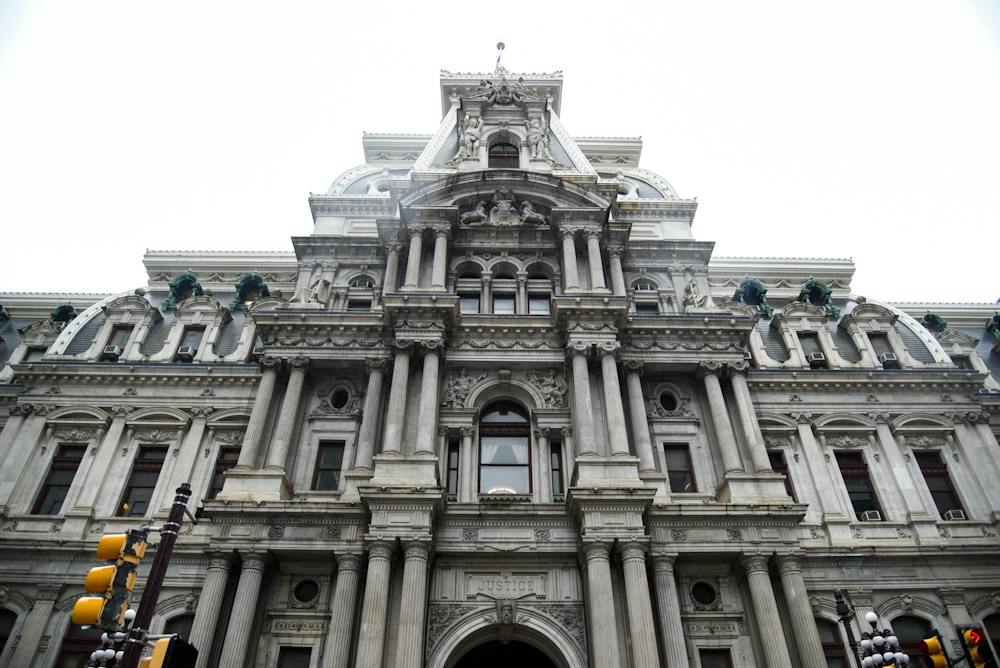
Several Philadelphia-based advocacy groups gathered outside City Hall on Monday to advocate for a citywide moratorium on data centers.
The Sept. 14 event launched a campaign titled “No Data Centers in Philly,” which urges the Philadelphia City Council to pause construction of hyperscale data centers for three years until protections are put in place. Campaign members cited pollution, economic disparities, and surveillance as concerns.
Philly Thrive president Sonya Sanders argued that “city officials have the power to protect us before it’s too late.”
“The city has no rules for how communities should be protected,” Sanders said during the event. “There’s way too much at stake to let data centers expand without guardrails.”
Philadelphia already houses eight data centers, though none of them are the hyperscale developments needed for artificial intelligence. A Planning Commission meeting in July raised the possibility of constructing such data centers on two sites — the Bellwether District in South Philadelphia and a city-owned plot near the Northeast Philadelphia Airport — but no specific proposals have been made.
Last month, Pennsylvania Gov. Josh Shapiro signed an executive order requiring local approval for new data center installations across the state.
Still, the issue remains top of mind for activists who attended the event, including Senia Lopez, an organizer with 215 People’s Alliance, a justice collaborative in the city.
During the event, Lopez said that “Philadelphia has no clear rules governing where data centers can be built and no meaningful process to ensure that people who are affected by these decisions — our neighbors, our families — have a say.”
RELATED:
Amid rising concerns over data centers, Penn’s supercomputer aims for sustainability
Events at Penn’s sixth annual Energy Week highlight data center growth, sustainable AI
“City Council can either leave the door open for corporations to shape our neighborhoods around their interest,” she added. “Or it can establish rules to protect the people that live here.”
One major concern linked to data centers is air pollution, which Physicians for Social Responsibility member Daniel Wolk said could “increase rates of asthma in our children and death from cardiovascular disease, cancer, dementia, and lung disease in our elders.” Wolk further pointed to concerns about “forever chemicals” entering the city’s water supply.
Activists also argued that those impacts might disproportionately affect Black, brown, and working-class communities.
Nikki Grant, who serves as the co-executive director of Amistad Law Project, argued that data center construction empowers AI surveillance under a “police state.”
“For people that are seeking reproductive healthcare, for immigrants looking for safety, or folks returning from incarceration, data centers are a real threat,” Grant said. “They take that data, and they use it to train their tools used by private companies, by landlords, by cops, and by the courts.”
RELATED:
Amid rising concerns over data centers, Penn’s supercomputer aims for sustainability
Events at Penn’s sixth annual Energy Week highlight data center growth, sustainable AI
Staff reporter Cathy Sui covers politics and can be reached at sui@thedp.com. At Penn, she studies finance and statistics.