

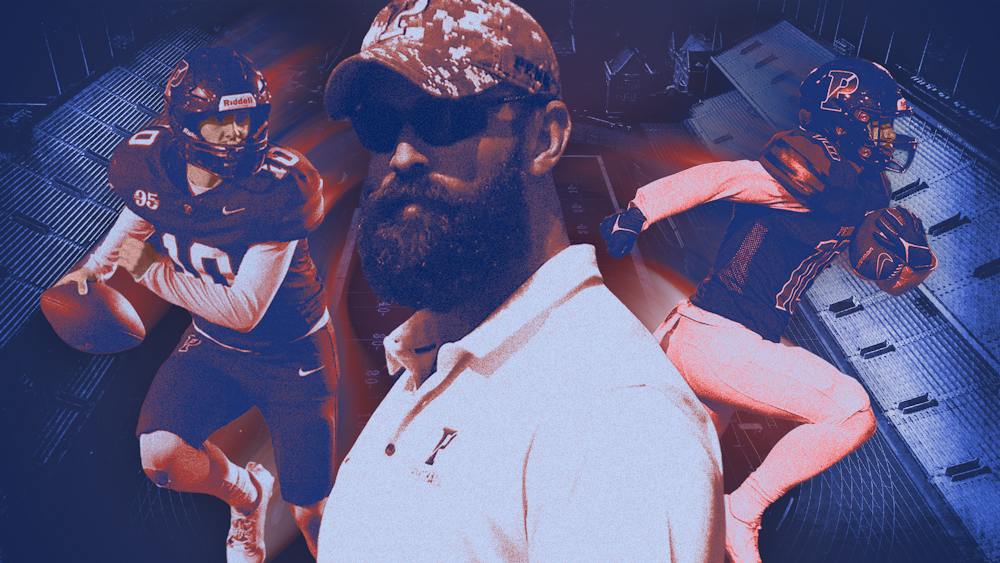
What does a college football player look like?
In a traditional sense, you might guess someone huge. A 300-pound lineman, perhaps. Or a 6-foot-6, 265-pound big guy like Rob Gronkowski. Football, in many ways, has been defined by athletes known for their large stature.
But, in 1934, Rutgers football coach George E. Little wanted a different kind of football, a league where smaller players could compete at the collegiate level. His solution was to create a new conference that had a weight limit of 150 pounds.
And, with Little’s idea, Penn created the Eastern 150-Pound Football League alongside six other member schools. Throughout the decades, other schools joined the league, evolving from a regional conference to the Collegiate Sprint Football League.
Today, sprint football is one of 33 varsity sports Penn students compete in.
“This is a varsity sport,” said coach Jon Dupont, who is in his first season leading the team. “We have access to all of the amazing athletic facilities that every other varsity sport team here has.”
Last season, Penn sprint football went 2-6 on the season and 0-3 in conference play, recording wins against St. Thomas Aquinas and Molloy. The Quakers opened the 2026 campaign with a 27-6 conference loss against defending CSFL champion Navy on the road.
Like all varsity sports, the sprint football team has a recruiting process. The team brings in roughly six recruited players each year, but the rest of the roughly 50-person roster is made up of walk-ons who discover the program after arriving at Penn.
Senior defensive back and captain Josh Johnson first encountered the sprint football program during his junior year of high school. During a football camp at Penn, one of the coaches introduced the program, explaining the weight limit and how, besides that requirement, the rules are the same as traditional football.
“Wow, this sounds like something I would love to be a part of,” Johnson, a two-time All-CSFL first-team honoree, remembers thinking.
Although many players on the team played football in high school, students don’t necessarily need a background on the gridiron to reach out to the team. While previous experience in football, flag football, or similar sports can help, the team also welcomes athletes from other sports backgrounds.
“If they played a varsity sport — swimming, wrestling, basketball, any sports in high school or at any point in their life where they’ve competed and want to spark that competitive fire back up. … This is a great opportunity to do that,” Dupont said.
“We’re always looking to add student-athletes who are interested,” he added. “Any form of communication is a great way to contact and reach out to me.”
Senior wide receiver Mudit Marwaha knows what it’s like to try out. Though football had never seemed like an option in college, Marwaha decided to give sprint football a try during his junior year.
“As someone who didn’t have the opportunity to play in high school because I was a smaller guy, it seemed exciting that there was a sport available for me,” he said.
Over the course of the semester, Marwaha learned what it’s like to be a varsity football player. He described going through a “large learning curve” to know where to be during practice drills, or how to complete stretches and workouts that he’s never done before.
“It requires you to be focused during practice,” he added.
“People see the NFL on TV and they’re like, ‘Oh, how hard can it be? You just run and catch the ball,’ but there’s so much more that goes into putting a football team together,” Marwaha said.
The learning came with many fun moments, too. Marwaha recalled his first practice, struggling to pull his jersey over his shoulder pads. Eventually, one of the seniors had to show him how.
“It was a little embarrassing,” he said jokingly. “But that was a fun memory for sure.”
Throughout the season, Marwaha bonded with his teammates, particularly his mentor, 2026 Engineering graduate Jake Wang. From Wang, Marwaha learned the “basics” of football and how to grind through the intense practice drills.
While he expected he could be judged for being a walk-on, that wasn’t the case.
“The guys are really nice. Everyone’s rooting for each other,” Marwaha said.
“The team is most excited when a walk-on … makes a big play during practice,” he added. “I was really surprised at how welcoming people were and how willing people were to teach you.”
Johnson echoed the same about training with the walk-on players.
“They’re always bringing really good energy, and they’re just really good guys,” Johnson said. “We love having them on the team.”
For those stepping onto the field for the first time, there is plenty to learn, but they are not expected to figure it all out on their own. Dupont said the team takes the time to teach new players the basics and make sure they understand how to play the game safely.
“We will teach the fundamentals,” said Dupont. “We’ll teach the techniques that will keep them safe.”
In the end, playing a varsity collegiate sport is not going to be easy. It requires spending many hours with the team and pushing yourself to perform at a high level on the field while managing academics. But Dupont has a clear priority.
“We’ll always have their academics first, never second,” Dupont said. “Academics will always be first, and then football will always come second.”
“You will be worked, but it is very rewarding,” Marwaha said.
It can be intimidating to walk on a football team. There are new teammates and coaches to meet, and a new environment to adjust to. If you are new to the game, there are plenty of rules to learn, too. For Marwaha, though, the answer is simple.
“Give it a chance,” Marwaha said. “You’ll never know if you don’t try.”


