

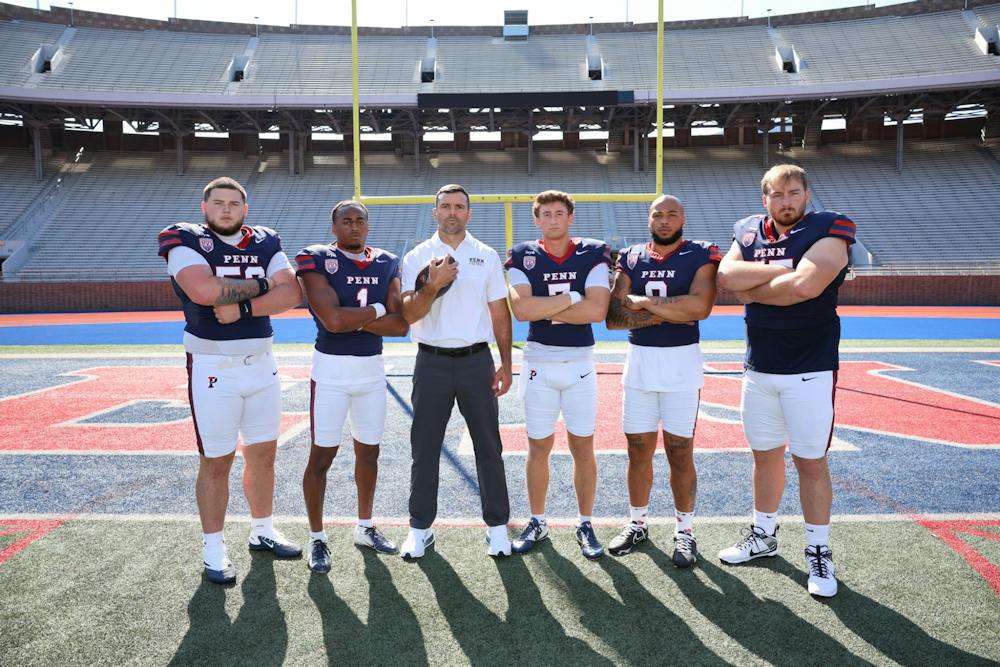
Penn football is at a crossroads, and its new coach, Rick Santos, knows it.
Player compensation, the transfer portal, and new eligibility standards are dominating the conversation both in and outside of the Ivy League. After years of national rankings with no postseason payoff, the Quakers are finally eligible for the Football Championship Subdivision playoffs. What a time to join a football program!
Santos is the first coach hired from outside the program since 1992, and he’s got big shoes to fill. Since Jerry Berndt established the championship standard for Penn football in 1982, all but one coach since has claimed an Ivy League title within their first two seasons leading the program.
The pressure is personal for Santos. He worked closely with former Penn coach Al Bagnoli during his three-season stint at Columbia as a quarterbacks coach.
“I think learning from Coach Bags, him being a legend here, knowing of how good Penn has been in the past,” Santos said in an interview. “Having him as a resource in this process, I called him quite often to get feedback and pull back behind the curtains.”
And it was Bagnoli’s advice that led Santos to make the difficult decision to leave his alma mater, New Hampshire, where he served both as a standout coach and Walter Payton Award-winning quarterback. The academic strength of the Ivy League and its ability to retain players season after season were key selling points for Santos.
“We’re all about the recruitment and development of our young men in our program, and I think the transfer portal was a little overbearing, always having to re-recruit your entire roster every single year,” Santos said of his time at New Hampshire. “It was kind of wearing our staff down.”
Now, Santos can focus more of his energy on the field, where he brings the knowledge and experience as a quarterback with professional experience. He had a short stint in the NFL as an undrafted free agent for the Kansas City Chiefs, but he found his footing in the Canadian Football League, earning a Grey Cup — the CFL equivalent of the Super Bowl — with the Montreal Alouettes in 2010.
It’s safe to say championship pedigree is in Santos’ blood. He took to the field as a first-year starting quarterback at Bellingham High School after an injury took out the original starter. It was “baptism by fire” for the junior varsity standout according to an interview with Santos’ former high school coach Dale Caparaso. But, Santos adapted, holding onto the starting position until he graduated.
By the time he graduated, Santos was a three-sport letterman, earning all-state honors on the field and a state championship on the basketball court.
When he came to New Hampshire in the fall of 2004 with football as his only athletic focus, Santos was determined to exceed expectations. Moving from fifth string to starter in the span of a season, Santos began rewriting the Wildcats record book.
Since he hung up his cleats, Santos coached at the high school level before returning to New Hampshire as a wide receivers coach. After a brief stint at Columbia, Santos returned to his alma mater, rising through the ranks before becoming coach.
Although Santos boasts an impressive 37-24 career record as the Wildcats’ coach, he hopes to emphasize winning and building on the strong culture he developed at New Hampshire.
“We talk about culture all the time,” he said. “The first thing we do, we want to lay the foundation of our expectations, our programmatic standards, our core values, and the thing we say all the time is an elite culture has three things: how you act, so your behaviors, how you interact, so what type of relationships you have with your teammates, how connected are you, and then most importantly, how you respond. Most importantly, how you respond to adverse effects.”
Between quarterback changes, coaching controversy, and last-second losses, Penn has endured a difficult stretch. Santos hopes to right the ship and won’t take no for an answer.
“We’re going to have an unwavering belief that we are going to turn this back into a championship-caliber team. And guys that aren’t all in are not going to make it in this program,” he said.
“We’ve been abundantly clear from day one that you have to have full buy in. You have to believe in a team-first mentality,” Santos added. “You have to want to embrace how hard we’re going to work, and if not, then just remove yourself from it, because elite people and performers don’t see eye to eye with people that believe in being average.”
Santos hopes to bring intensity to the field, too. He describes himself as a “high energy” coach who works in “the business of winning, make no mistake about it.” At the same time, though, he knows he’s coaching a group of growing young men and hopes to be a “stable force in their life, so they can be the best versions of themselves.”
Although Santos didn’t completely replace the Quakers coaching lineup that former coach Ray Priore left behind, he emphasized creating a sense of continuity for both the program and his coaching style. The opinions of his fellow coaches at New Hampshire were invaluable assets as he crafted Penn’s 2026 coaching staff.
He utilized a “core group of guys” who weren’t afraid to call him out whenever necessary. That gave assistant coaches the autonomy and opportunity to have uncomfortable conversations.
“I’m someone that always wants to grow and get better, and I don’t pretend to think I know everything,” Santos said. “We had a really good thing in place. So when this job opportunity came up, most head coaches probably don’t do this, but we grabbed dinner … I said, ‘If I get this, is this something you guys would entertain as well? I don’t want to start from scratch.’”
At the end of the day, Santos will do whatever it takes to win. He wants this season to feel like a breath of fresh air for Quaker fans, emphasizing a standard where each team “leaves this program better than they found it.”
“We want to win. We want to win championships, and a lot of them,” he said. “I want it to be a place of winning and collaboration, and developing elite men.”


