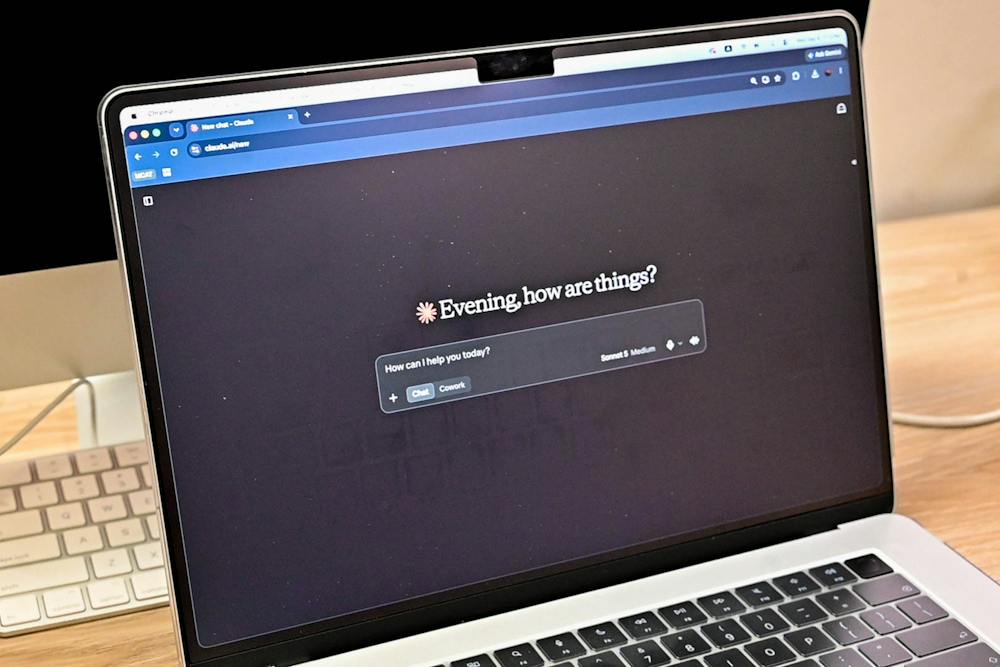
Less than four years ago, none of us had any idea what ChatGPT was. Three years ago, Claude was just being introduced to the public. For decades, we believed in the validity of using our own critical thinking and cognitive skills, because that’s what we knew worked and worked well. Just a few days ago, Penn decided to release its Claude Enterprise access to the entire University — giving faculty, staff, and students the option of two differently priced tiers of Claude artificial intelligence.
Good news! In return for your financial support in the form of a small monthly fee, Claude promises they won’t steal your data (as long as it’s only moderate to low risk) or use it to train other AI models. In a dystopian but unsurprising development, Penn is actually advertising that we pay an AI company to not track, steal, and use our data.
It’s no surprise that Penn is making yet another pro-AI change; after all, we do have an entire month dedicated to it (ironically, the same month that “Earth Week” is held in). Partnering with Claude is just another step to becoming the AI-forward university Penn dreams of being, one where they can cut out old majors to make room for new AI programs, invest millions of dollars in AI research, and ignore the well-documented dangers of everyday AI use.
But it’s all in the name of education, right? Creating the newest generation of empowered, intelligent, critical thinkers who could someday change the world. And of course, there’s no possible way we could do that without AI.
The terms “critical thinking” and “AI-generated” cannot coexist. This idea that AI will enhance your intelligence or help you create “novel content”, as Penn suggests, makes no sense — you get no intellectual benefit from asking an artificial chatbot to think for you. Though the sentiment seems to hold little weight now, it’s worth repeating: You, an Ivy League student with unlimited resources and opportunities in front of you, do not need AI. In fact, nobody truly needs these AI applications.
Think back to a short four years ago: What did you do when you didn’t know how to do something? What did you do when you needed to look something up? What about when you needed to create an outline, read a paper, or design a graphic? It’s not as though you were stranded with no way to do anything without AI back then, and it’s the same way now. The desensitization of AI’s presence in our everyday lives is the decline of reliance on our cognitive abilities.
When the topic of AI gets brought up in conversation, there seems to be a fear of falling behind. That if we don’t hop on board immediately, we’ll drown in irrelevance. Penn reinforces this narrative by partnering with AI companies and throwing up posters all over Locust Walk, then calling it “innovation.” Just to be clear, there’s nothing innovative about asking Claude to write an email for you. Or solve a problem set. Or create a slide deck. You are not critically contributing to society by asking a chatbot to do your homework.
Not using Claude or ChatGPT isn’t going to set you back; there is no race when it comes to everyday AI applications. You aren’t in a competition with anybody to see who can use the most generative AI, and you certainly don’t need to pay a monthly subscription fee to stay afloat.
SEE MORE FROM CHARLOTTE PULICA:
Penn can’t hold true to its values of being “open-minded and curious, inventive and practical, exhibiting brilliance across fields, imperfect but self-improving, and relentlessly focused on enhancing social good” while also partnering with and promoting AI on campus. There is no financial gain for Penn in this deal, and there are no real academic or intellectual benefits for students. This is purely a fundraiser for generative AI.
If tomorrow, every student at Penn stopped using generative AI all together, nothing about us would fundamentally change. We wouldn’t suddenly lose all of our academic capabilities or “fall behind,” the same way students four years ago weren’t doomed because of the absence of AI. Penn throws these advertisements for Claude around in the strange hope that we will believe we need it, but we don’t. There is no reason a world class university should be abandoning its values by encouraging students to financially empower an AI program, and the very fact that Penn would promote this shows us exactly where its priorities are.
CHARLOTTE PULICA is a College sophomore studying cognitive science from Enoch, Utah. Her email is cpulica1@sas.upenn.edu.

Charlotte Pulica is a College first year studying communications and consumer psychology from Enoch, Utah. Her column focuses on student life and administrative policy. She currently serves as a Deputy Opinion Editor and can be reached at cpulica1@sas.upenn.edu .