All across Penn’s campus, Benjamin Franklin gazes down at passersby from pole-mounted street flags celebrating the nation’s semiquincentennial. This August, first-year students encountered that history up close.
Since 1990, the Penn Reading Project has served as a cornerstone of New Student Orientation and a first taste of the University’s intellectual life for first years. Before arriving on campus, incoming students from Penn’s four undergraduate schools receive reading materials to prepare for the event, which marks their first college lecture at Penn.
In an interview, Penn Reading Project and New Student Orientation Director David Fox described the event as a “commitment to the educational and intellectual mission of the University.”
“We felt that it was really important that people are here because it’s a major university,” Fox said. “We should make that a kind of groundbreaking part of New Student Orientation.”
Fox acknowledged the tendency for Penn students to “start to really identify” with their respective schools “very quickly after orientation.”
“There’s interaction across schools, but there are very few experiences that everybody has,” Fox said. “That was really a significant idea behind the Reading Project that whether you’re in Nursing, or the College, or Wharton, or Engineering, you could talk with your fellow students and you could share this experience.”
The project was put on pause between 2022 and 2025 while resources were dedicated to different programs for incoming undergraduates.
This year, three American History professors — professor of History Sarah Gronningsater, professor of American History William Sturkey, and professor Karen Tani — jointly curated a selection of written material that showcased the evolution of modern democracy in the United States.
RELATED:
NSO targets community-focused events after Penn task force recommendations
NSO introduces fewer mandatory activities, 'Friday Night Lights' themed class photo
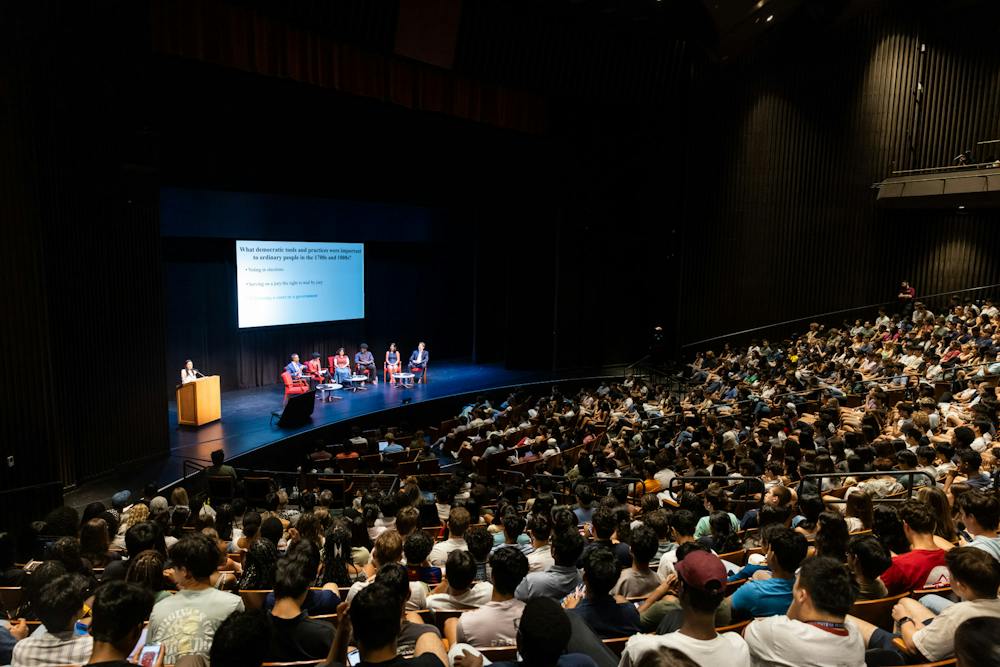
Gronningsater served as this year’s event moderator, leading students through a brief lecture on “ordinary people and their role in American democracy.” In an interview, Gronningsater reflected on “the specialness of having 2,000 students enter their first year at Penn having a common experience.”
To Gronningsater, one of Penn’s strengths is its reputation as “a massive research university,” where people have the opportunity to "chart your own path in all these different ways.”
“But sometimes there needs to be something that’s holding us together or tying us together in some form of common conversation,” she said. “I think that the Penn Reading Project is used to serve that function.”
This year’s readings were primary sources from American history, spanning 1747 to 1968 and including petitions, speeches, newspaper articles, and poetry. The authors ranged from Benjamin Franklin to “Cherokee Women,” Walt Whitman, and “Natives of Africa.”
Sturkey’s lecture focused on moments in American democracy when groups fought for inclusion and civil rights. He explained why teaching that history matters especially as the country celebrates its 250th anniversary.
“We’re at a moment where a lot of people are thinking that maybe we won’t have a democracy, and because of those reasons, it’s very important to center the American democratic traditions,” Sturkey said in an interview.
Sturkey also stressed the importance of giving incoming Penn students a window into this field of study.
“We’re thinking more about who you are, as opposed to what you will do,” he added. “History skills will make you better at life, a better citizen, better at any job.”
Tani, a panelist and lecturer for the event who teaches in both the History Department and at the University of Pennsylvania Carey Law School, also discussed how Penn Reading Project highlights the “skills that the humanities can give” to students.
She explained in an interview that she got involved with the project because she “wanted to make sure that this entering class of freshmen know that at this moment, these classes will not only be interesting, but could provide you with vital skills that will make you more valuable going forward in the job market.”
“I think we all really believe that close reading, being able to engage with a text in human ways, these will actually be the sought-after skills in the AI moment,” Tani said.
While Fox clarified that he does not think the Penn Reading Project is “anti-AI,” he said the programming centered around “processing information yourself and coming up with your own understanding of it.”
“These are the deepest values of an education, and things that I think the Penn Reading Project has come to really be known for,” he added.
Gronningsater also described the Penn Reading Project as a “beginning step in signaling that we broadly think reading is important.”
“I think many of us living at this moment in American educational history are aware that there’s just less reading,” she stated. “People are reading fewer books, young people to old people, for a whole host of reasons, so to me at least, there’s something particularly important and vital about bringing back reading as core to what we do.”
The event featured several student panelists, including upperclassmen who helped demonstrate a classroom discussion.
“Part of what we do in the humanities is we get people in rooms, talking about the human condition across time through different kinds of humanities disciplines, and what I loved about the Penn Reading Project is, yes, we were in a classroom,” Gronningsater said.
Beyond fostering discussion about the material, the event also offered first-year students the opportunity to engage with upperclassmen.
College senior Anna Lugovskoy, who is minoring in history, described the benefits of connecting with new students over historical discussions.
“There’s that value of showing people what a history curriculum could look like, getting them interested in it,” she said in an interview.
Lugovskoy also mentioned the importance of instilling a commitment to the “public good” among students.
“History helps you understand these core fundamentals to like American society and like American principles,” she said.
“To speak to the entire incoming class and to form an impression of what college could be like, to me, was an incredible privilege,” Tani concluded. “It’s like you get to have some role in shaping their experience of this really important new phase of their life, so that was really special.”
RELATED:
NSO targets community-focused events after Penn task force recommendations
NSO introduces fewer mandatory activities, 'Friday Night Lights' themed class photo
Senior reporter Christine Oh leads coverage of student life and can be reached at oh@thedp.com. At Penn, she studies English and philosophy. Follow her on X @ChristineOh_.