

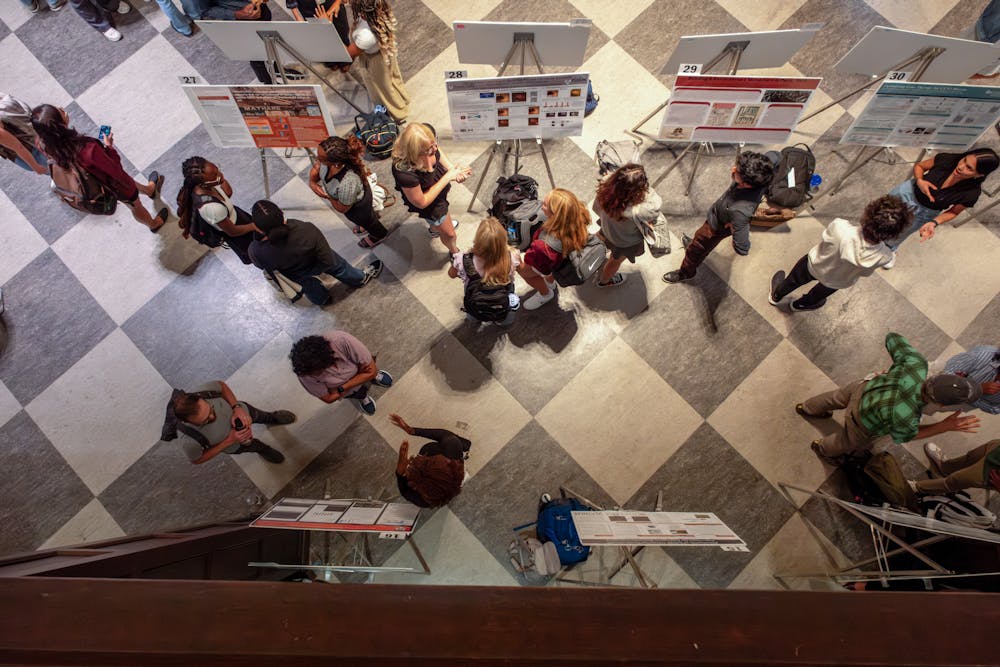
Penn’s Center for Undergraduate Research and Fellowships hosted its 2025 Fall Research Expo on Monday, displaying work from over 350 undergraduates across the University.
The projects — which were displayed from 5-7 p.m. at Houston Hall on Sept. 15 — ranged in topics from children’s bone health to artificial intelligence literacy. Undergraduate researchers received funding for their projects through CURF’s various programs, including the Penn Undergraduate Research Mentorship Program and the Summer Humanities Internship Program.
College sophomore Sophia Wang, who is pursuing a degree in architecture, was funded $5,000 through PURM as a student research assistant for DumoLab Research at the Stuart Weitzman School of Design.
Headed by bioengineering architect and assistant professor of architecture Laia Mogas-Soldevila, the lab works to translate biomaterial systems into everyday products that support health during their processing, use, and end of life.
Wang highlighted the support she received from PURM, which offers students the opportunity to undertake faculty-mentored research over their first-year and sophomore summers in a wide range of academic fields.
Her project — which she presented with another PURM student research assistant — focused on “Terrene 4.0,” a more sustainable biocomposite that could replace concrete as the industry standard for buildings.
“We looked into particularly weather resistance and compressive strength testing and … into many coatings, including control shellac, tongue oil, linseed oil, soy wax, and beeswax,” Wang said in an interview with The Daily Pennsylvanian. “[We] found that beeswax and shellac performed the best.”
Wang described her research experience as “really interesting,” adding that she was able to learn about new techniques, including how to measure experiments and obtain results.
Penn Medicine study identifies methods to debunk COVID-19 vaccine misinformation
Research programs, funding opportunities that let Penn students earn money while learning
College junior Pètra de Beer, a political science and cognitive science double major, received the Frances Velay Fellowship for women in the sciences to conduct research through the Annenberg Public Policy Center.
De Beer worked alongside Annenberg Communication Neuroscience Lab Scientific Director Danielle Cosme on a project about the influences of climate action among youth. She found that young people currently engaged in climate advocacy are only concerned with “personally impactful” action, as opposed to those that impact the environment.
“It tells us that young people are only really engaging in good things for the environment when they care about it for themselves,” de Beer told the DP.
She also noted that while social media emphasizes a perception of “climate anxiety” among people, her data found that people were far more “positive and approach-oriented towards their climate action than might be expected.”
As an international student, de Beer said that recent federal action limiting research funding played a role in what she decided to research.
“I do have to take consideration of certain legislation in the country at the moment in terms of what I want to research, especially because I care a lot about the social implications of my research,” de Beer said.
Engineering sophomore Oluwatomisin Adenekan researched differences in how advanced software systems analyze data related to temporal lobe epilepsy as part of his project.
Adenekan, who collaborated with assistant professor of neurology Erin Conrad, described running into difficulties while developing his project’s workflow, which refers to a set of instructions used by software developers.
“Everything shut down,” Adenekan said in an interview with the DP. “But we were able to — through discussion — get it together.”
Despite the difficulties, Adenekan said that the workflow proved to be the aspect of his research that he was “most proud of.”
He also noted that his findings could potentially be “huge” for patients considering temporal lobe epilepsy surgery, adding that there’s a possibility that the software could soon be incorporated into medical procedures.
Penn Medicine study identifies methods to debunk COVID-19 vaccine misinformation
Research programs, funding opportunities that let Penn students earn money while learning
Staff reporter Sameeksha Panda covers science and health and can be reached at panda@thedp.com. At Penn, she studies chemistry.


