

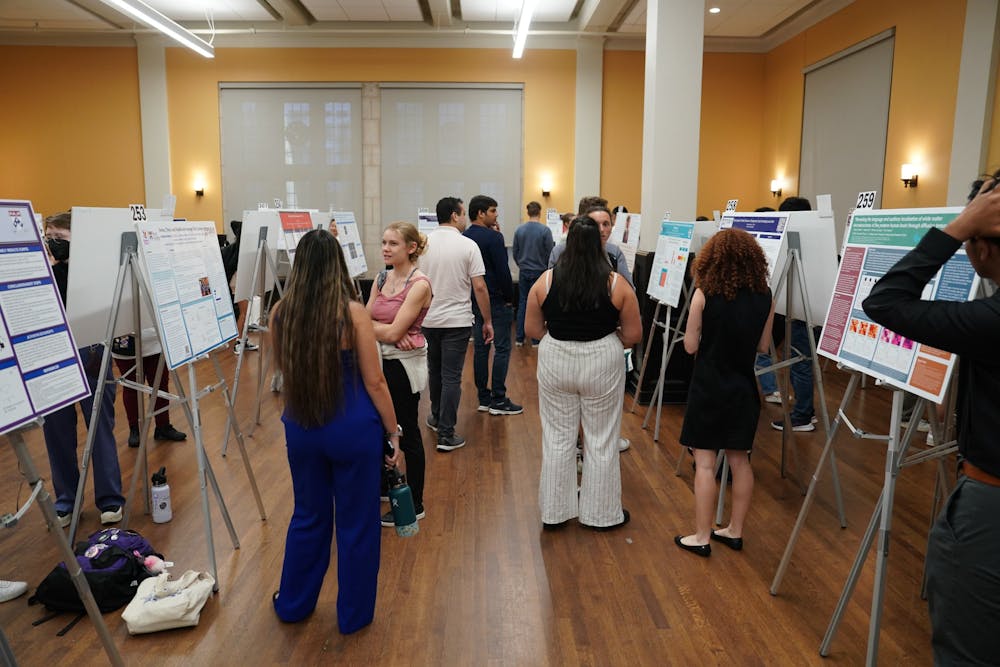
This summer, dozens of students will stay in Philadelphia to conduct research through the Penn Undergraduate Research Mentoring Program.
Organized by the Center for Undergraduate Research and Fellowships, PURM offers first- or second-year Penn undergraduates the opportunity to spend 10 weeks researching under the guidance of a University faculty member. The summer program invites students across Penn’s four undergraduate schools to apply.
According to the CURF website, PURM operates as a “matching program rather than a funding vehicle,” and faculty members are not allowed to engage with prospective mentees before students submit applications.
Faculty members in “any discipline” are encouraged to apply, and their project proposals must demonstrate how their research opportunity will “provide meaningful mentorship” to an undergraduate student. Historically, about 35-40% of faculty proposals are accepted each year.
In a statement to The Daily Pennsylvanian, CURF Director Ann Vernon-Grey wrote that prospective mentors are encouraged to highlight “the academic and transferable professional skills, experiences, and other benefits a student would derive from their mentorship.”
Students can apply to be considered for up to three projects and rank preferences among them. Faculty members then receive a pool of applicants to review and select those to interview. Following interviews, faculty rank their preferences.
Once selected, PURM students receive a $5,000 stipend to support their participation in the program.
Several professors who are mentors in the program spoke to the DP about designing their projects and PURM’s application process.
Statistics and Data Science assistant professor Bingxin Zhao told the DP that he believes his proposal stood out because his research about cloud computing was able to “attract some students from a computer science engineering background.”
He explained that “if you can identify with the mass, you have the opportunity to get the funding, otherwise you cannot really get the funding.”
Zhao also explained that he considered that the program is meant for students without prior research experience when designing his project.
“You don’t want to really give a very, very professional research question because we have the education purpose of how to introduce the research concepts to the college students, so I tried to simplify what I was doing,” Zhao said.
Courtney Wolk, an associate professor at the Perelman School of Medicine, said she designs projects by considering what “tends to be a good match” for undergraduates to realistically accomplish in a limited timeframe, including work that involves “literature reviews, data management, or assisting with analysis.”
“We want to make sure activities are going to be a learning experience, but also achievable with the time that they have,” Wolk explained. “The mentoring piece is a really big part of the PURM experience, and it’s important that the project and the study team are able to provide the right level of internship support.”
When selecting a student, Wolk said that she looks for students who “understand the gist of the project and can articulate why they’re interested in working on a project like this,” adding that “it’s helpful if they’ve had maybe some experiences that are relevant to the particular project, but it’s not always necessary.”
“Clear communication, professionalism, and the ability to work both independently and as part of a team also stand out,” Wolk continued.
Laurel Redding, an associate professor at the School of Veterinary Medicine, will be leading a research project on honeybee behavior and pollen collection this summer. Redding told the DP that she designed the project to be accessible to students while still contributing to an emerging area of research.
“I try to think of things that don’t require super specialized knowledge that are accessible at an entry level,” she said, echoing Zhao and Wolk. “Just so that someone who's never had research experience can get into it and enjoy it, and someone who has had research experience can delve a little deeper if they want to.”
Redding added that “Penn undergrads tend to be generally very creative and resourceful,” and that she “always appreciates having them.”
College sophomore Jacob Flores, who participated in PURM last summer to conduct lab research at the Children’s Hospital of Philadelphia, told the DP that he applied to the program because he was “really interested in pursuing research” as someone with no prior experience.
According to Flores, other factors that interested him included the “wide variety of different projects there were to choose from,” and “the funding that you’re able to get,” which he emphasized is “a big help for people who are just starting out, since it might be difficult to apply for grants when you’ve never done research before.”
Flores said that his faculty mentor told him that his application stood out because “it looked like I actually read his research papers because the way that I structured my responses was to briefly talk about something that I was interested in, and then connect that to their research.”
He explained that while “it was really difficult to tell” how competitive the process was and that he felt like he was “in the dark” while applying, he estimates that “about half of the people that applied got in based on the interview process or orientation.”
“I remember my professor said that I think 20 people applied to his specific program, and he could only take two,” he noted.
Flores said that the program made him “a lot more interested in research as a long-term career goal, and not just as something to do as a stepping stone to medical school.”
Both Redding and Zhao also acknowledged the impact that they hope students can take away from the experience.
“I hope students leave with a sense of what it actually means to do research,” Zhao said. “Even if they don’t pursue it long-term, they’ve built something and been part of that process.”
Redding added that she hopes students will view future studies that they encounter with “a more nuanced understanding of what actually went into it.”
“I hope the main thing that they take away is an appreciation of how research works and a critical eye for interpreting research findings and their future lives,” Redding said.
Staff reporter Hailey Hilsabeck covers facilities and infrastructure and can be reached at hilsabeck@thedp.com. At Penn, she studies cinema and media studies and English. Follow her on X @hhilsabeckk.
Senior reporter Amy Liao covers student life and can be reached at liao@thedp.com. At Penn, she studies philosophy, politics, and economics and cinema and media studies. Follow her on X @amyliiao.


