

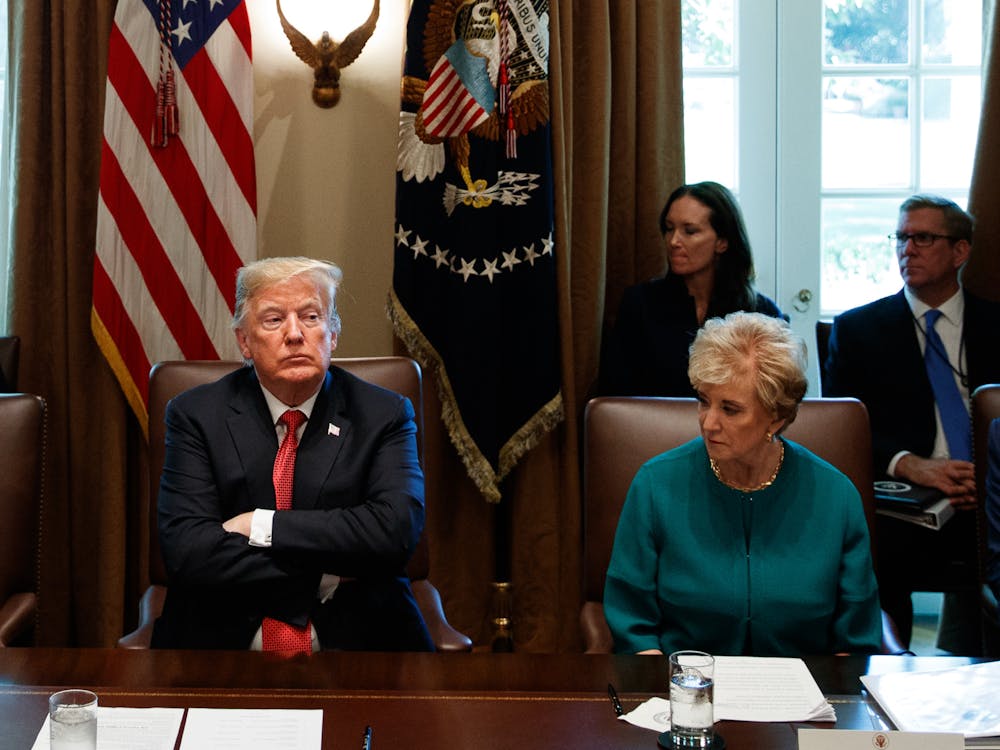
United States Secretary of Education Linda McMahon published a letter Monday calling on universities to publicly disclose answers to a list of questions on institutional reform by the end of 2026.
The message, titled “A National Call to Action to University Presidents and Governing Boards,” asks universities across the country to respond to seven prompts ranging topics from admissions and tuition to free speech and political ideology. The effort comes after Penn rejected the White House’s October 2025 preferential funding compact, which was sent to only nine schools but listed similar higher education reforms.
A University spokesperson declined The Daily Pennsylvanian’s request for comment. Requests were left with the Education Department and the White House.
In the letter, McMahon wrote that universities should “reaffirm their commitment to serving the American people” given that “Americans’ trust in universities has reached record lows.” She referenced Yale University’s Committee on Trust in Higher Education and a report on politicization from Vanderbilt University and Washington University.
The message additionally cites changes already enacted by universities such as “adopting positions of institutional neutrality and improving policies related to campus protests.”
Penn President Larry Jameson announced that the University would adopt a position of institutional neutrality on local and global events in September 2024. The University’s open expression policies have been in the process of revision since the June 2024 institution of temporary standards for campus demonstrations that tightened restrictions on events and protests.
The interpretive guidelines adopted by Penn’s Committee on Open Expression in 2015 emphasize “the value of creating a robust marketplace of ideas” in the context of allowing controversial speakers to come to campus. McMahon’s letter pushes for “a thriving marketplace of ideas” and “open-minded campus discourse.”
McMahon further explained that the “statements of principle should be posted prominently on institutional websites” and should detail “adopted and planned reforms.”
Unlike the compact, the Aug. 3 letter does not explicitly condition federal support on university reforms and is instead framed as encouraging universities to “provide full transparency to the American people.” It is unclear whether universities will face consequences for failing to respond to the Department of Education’s questions.
Still, the reform language echoes ideas from the compact — and from the list of questions circulated by former Wharton School Board of Advisors Chair Marc Rowan. The questions were sent to the University Board of Trustees in December 2023 just days after former Penn President Liz Magill stepped down.
McMahon’s letter asks for transparent admissions criteria “based on merit, achievement, and … educational purpose,” similar to the compact’s push for universities to publish their “objective criteria” for admissions policies on their websites.
Free speech and a “marketplace of ideas” are present in both documents, along with points about preventing disruptive protestors.
The new letter alleges that some academic disciplines “have subordinated the scholarly pursuit to political and social goals” and asks each university how it will “encourage intellectual pluralism in all its academic units.” The compact similarly asked signatories “to seek a broad spectrum of viewpoints” within each “field, department, school, and teaching unit.”
Both documents also ask universities to combat grade inflation and maintain high academic standards. Harvard University faculty voted in May to cap A grades, potentially setting up similar moves at other universities such as Yale — though little to no action has occurred yet at Penn.
Financial responsibility is a shared theme in the letter and the compact, which both emphasize cost containment and contributing to the U.S. economy. They also call on universities to shield themselves from foreign influence.
But some of the language in the letter is markedly less pointed than the stipulations proposed in the compact, which was rejected by most of the universities it was offered to. McMahon’s letter recognized that “there is no single template for academic excellence” and mostly shied away from imposing specific policies.
The compact asked signatories to commit to “transforming or abolishing institutional units that purposefully punish, belittle, and even spark violence against conservative ideas.” On the contrary, the letter refrained from mentioning a particular ideology, only stating that some disciplines may “skew toward one side of the ideological spectrum.”
Measures of the compact such as a five-year tuition freeze, a 15% cap on international students, and definitions of “‘male,’ ‘female,’ ‘woman,’ and ‘man’ according to reproductive function and biological processes” are absent from McMahon’s letter.
Senior reporter James Wan leads administration reporting and can be reached at wan@thedp.com. At Penn, he studies communication and computer science. Follow him on X @JamesWan__.





