

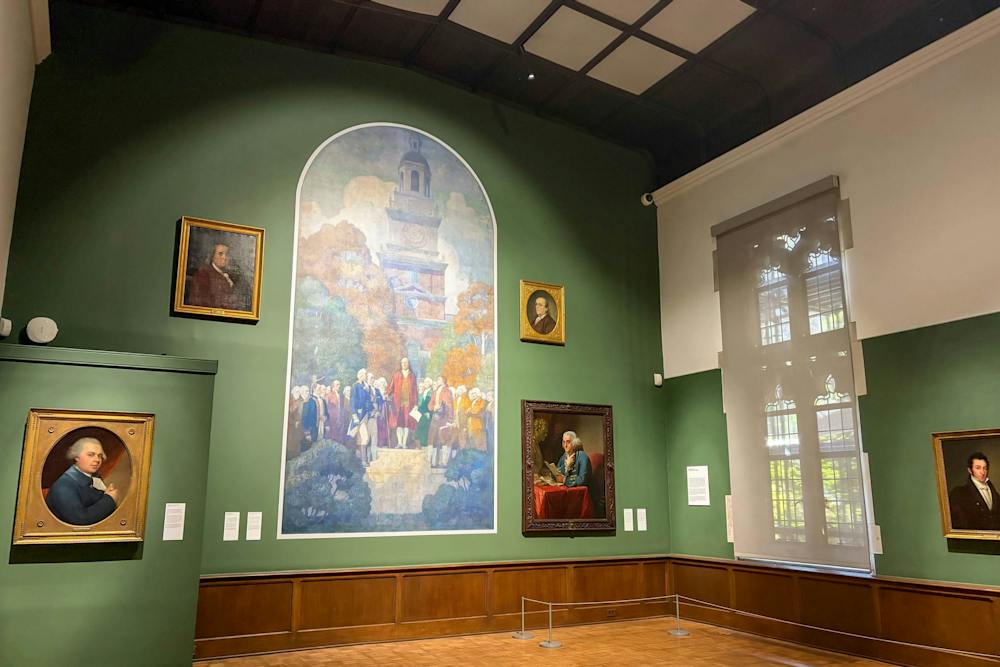
In celebration of the United States’ semiquincentennial, the Arthur Ross Gallery recently opened an exhibition dedicated to Philadelphia’s early history.
The display, titled “At Liberty: Life in the City of Brotherly Love During the Early Republic,” held its opening reception on Sept. 9 and will remain on view free to the public until Dec. 13. Located on the first floor of the Fisher Fine Arts Library, it features over 40 works — including paintings, prints, drawings, and sculptures.
History of art professor Gwendolyn DuBois Shaw, the gallery’s faculty director and curator, explained in an interview that she intentionally selected pieces to highlight local U.S. history.
“I wanted to do an exhibition that engaged with American history, but really think about it in a local context in Philadelphia,” she said. “As we were heading towards this moment, I wanted to think about what Philadelphia was then and what it is now — and how similar and how different it is.”
The display focuses on work from the late 18th century to the middle of the 19th century because Philadelphia has “preserved a lot of that architectural legacy.”
It also includes several pieces depicting the University’s founder, Benjamin Franklin — including a recreation of N.C. Wyeth’s “The Apotheosis of Franklin” mural displayed at Hill College House and a bust that had been previously located in the Provost’s office. Alongside these representations of Franklin are pieces that provide a glimpse into the everyday lives of the City of Brotherly Love’s denizens.
Lynn Smith Dolby, director of the Penn Art Collection, worked with Shaw to prepare exhibition works from the University’s collection.
“I think this exhibition is focused on not just the luminaries of the early republic, but also some figures who may not have gotten as much representation as they might today,” she said.
RELATED:
Penn researchers find nearly half of observational social science studies overstate causality
Dolby pointed to female silhouettes in the exhibition as an example, explaining that “we don’t have a whole lot of examples of formal portraiture of women from that time period.”
Each work is paired with an accompanying question about the piece’s historic relevance so that visitors can consider who is absent from the historical record and why, according to Shaw.
She emphasized that Philadelphia was “really diverse” with immigrants across the world even in the 18th century, adding that many of these people “are absent from the kind of big fancy portraits that we have.”
“How did people who were here see each other and engage with the city?” Shaw asked. “What were the challenges to representing a diverse city that we can see in both the visual record that we have, but also what’s absent?”
Many of the works from the exhibition came from collections across the broader Philadelphia community and beyond — including the Penn Art Collection, Pennsylvania Hospital, Pennsylvania Academy of Fine Arts, and the Metropolitan Museum of Art.
Emily Zimmerman, who serves as the director of Exhibitions and Curatorial Affairs at the Arthur Ross Gallery, believes that gallery can serve as a consumable translation of the University’s inquiry.
“A lot of research happens in labs, it happens in individual rooms where one is reflecting and writing, but it doesn’t always make it to a public venue,” she said, adding that the gallery can serve as “that meeting point between what happens on campus and the greater Philadelphia community.”
The Arthur Ross Gallery frequently hosts exhibitions that bring art and research to the Penn community and the public. In February 2025, Shaw worked on “After Modernism,” an exhibit featuring select pieces from the Neumann Family Collection.
The current exhibition was developed alongside a series of University programming devoted to the nation’s semiquincentennial.


