

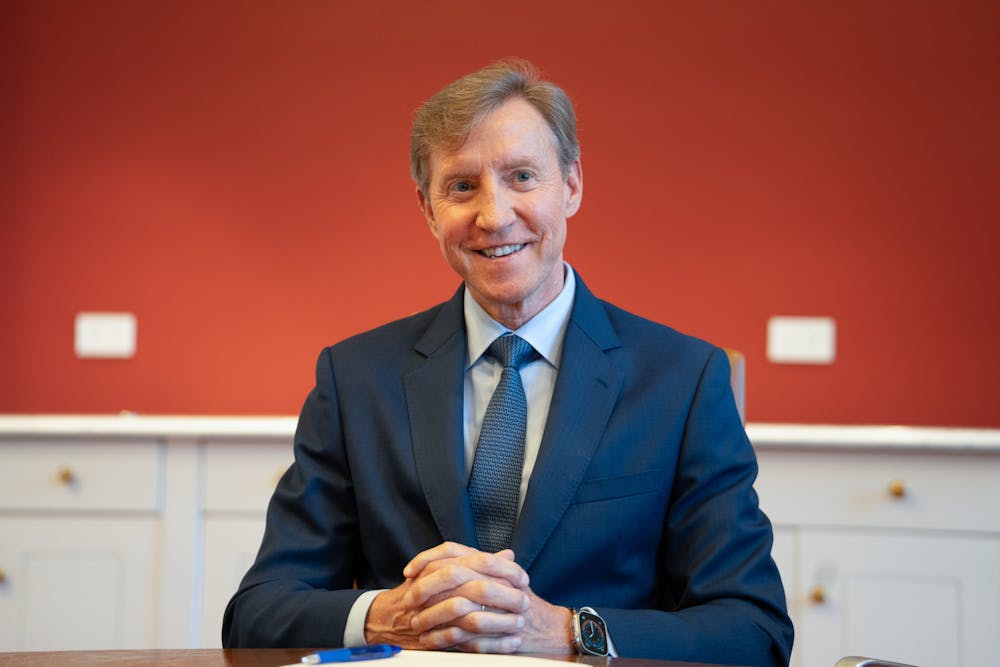
As Penn President Larry Jameson prepares to step down next year, he leaves behind a reputation as a stabilizing force during a turbulent era for higher education.
Jameson announced his intention to leave his position as president by next year in a June message to the campus community. Since being named interim president in December 2023, he has steered the University toward institutional neutrality and launched campus-wide initiatives while confronting the lasting effects of student protests and federal turmoil.
His term as permanent Penn president, which began in March 2025, will be the second shortest — longer only than that of his predecessor, Liz Magill. The University Board of Trustees has begun the search for Penn’s next leader and is currently inviting community feedback through a survey.
Here are key takeaways from Jameson’s time as Penn president.
Open expression and institutional neutrality
Jameson was appointed interim president in December 2023 after Magill resigned amid backlash for her remarks regarding Penn’s response to antisemitism.
The following months were marked by pro-Palestinian protests, culminating in the Gaza Solidarity Encampment on College Green which was dismantled by police in May 2024. Weeks later, Penn instituted temporary standards for campus demonstrations — which tightened requirements for event planning and banned encampments — and initiated a review of the Guidelines on Open Expression.
Nearly a year into his interim term, Jameson announced new guidelines surrounding Penn’s “response to external events.” At the time, Jameson wrote that Penn would “refrain from institutional statements made in response to local and world events except for those which have direct and significant bearing on University functions” in an email to the University community.
RELATED:
Penn begins search for Jameson’s successor, invites community input
Jameson updates campus community on ‘Penn Forward’ initiative progress
The policy was similar to peer universities that had adopted guidelines of institutional neutrality. At the time, Jameson told The Daily Pennsylvanian that the process of reviewing Penn’s protocols for institutional statements began several years prior.
Jameson specified that the guidelines would only apply to “leaders communicating in official capacities, where their statements may imply institutional positions.”
“It is not the role of the institution to render opinions — doing so risks suppressing the creativity and academic freedom of our faculty and students,” he wrote at the time.
In April 2025, as Penn and other universities were impacted by sweeping federal changes to higher education, Jameson cited institutional neutrality as the reason for Penn’s quieter stance in an interview with the DP.
Penn community members’ ability to express themselves again became a source of debate after the University released a revised draft of its open expression guidelines in March. While noting some improvements over the temporary policies, the campus community largely criticized continued restrictions — with over 40 student groups organizing in opposition.
Jameson is expected to review the final draft recommendations and publish the new open expression guidelines. The deadline for a finalized version was extended further into the fall following campus pushback.
Federal negotiations
In March 2025, the Trump administration froze $175 million in federal funding to Penn, criticizing the University’s failure to remove transgender athletes from women’s sports. Penn entered a resolution agreement with the administration that July — becoming the first Ivy League to settle with the White House and restoring the University’s funding.
On Oct. 1, 2025, Penn was one of the nine universities presented with the Compact for Academic Excellence in Higher Education by the Trump administration. The agreement proposed preferential funding if universities agreed to comply with guidelines surrounding admissions, hiring, and other university operations.
Jameson conducted a two-week long review process of the compact, consulting faculty and staff. He ultimately rejected the proposal on Oct. 16.
“Earlier today, I informed the U.S. Department of Education that Penn respectfully declines to sign the proposed Compact,” Jameson informed the University community in an email at the time.
In July 2025, the United States Equal Employment Opportunity Commission issued a subpoena seeking discrimination complaints filed by Jewish employees, membership lists of Jewish-related campus groups, and Jewish Studies Program employee names. The EEOC filed a lawsuit in November 2025 against Penn alleging that the University failed to provide the documents requested.
Penn remained noncompliant with the EEOC’s demands. Last month, the federal agency dropped the subpoena, ending the months-long legal battle.
Campus civil rights
In September 2024, Jameson announced the creation of the Office of Religious and Ethnic Inclusion. The center officially opened its doors in December of that year.
At the time, Jameson stated that the office was created in response to trends of antisemitism, Islamophobia, and other instances of religious biases.
The office ensures that Penn can continue to “fulfill its obligations under Title VI of the Civil Rights Act of 1964,” he wrote.
Early this year, OREI rolled out “non-discrimination and anti-harassment” Title VI training, which consisted of a series of videos describing Title VI of the Civil Rights Act of 1964 as well as Penn’s policies on equal opportunity, open expression, and non-discrimination.
Penn announced the consolidation of OREI in June, alongside the Office of Equal Opportunity Program and the Office of the Associate Vice President for Equity & Title IX. They will now be housed under a single administrative structure — the Center for Civil Rights. CCR will oversee three “subject-matter areas of responsibility”: equal opportunity, sex and gender-based discrimination and harassment, and religious and ethnic interests.
“This consolidated Center for Civil Rights will help Penn work better for every member of our community,” Jameson wrote at the time. “Faculty, staff, and students will benefit from greater clarity around resources, reporting, prevention, and legal compliance, with our subject-matter experts aligned and working together.”
Penn Forward
At the start of the 2025-26 academic year, Jameson unveiled the Penn Forward strategic framework. The initiative, Jameson’s defining institutional effort as president, builds on efforts established by Magill’s “In Principle and Practice.”
The plan involved the creation of six working groups, composed of undergraduate students, graduate students, and postdoctoral scholars, alongside faculty, staff, and administrative support.
Each working group addressed a particular domain of University action: Undergraduate Education and Innovation; Graduate and Professional Training; Research Strategy and Financing; Global Opportunity and New Markets; Operational Transformation; and Access, Affordability, and Value.
In April, Jameson updated the University community on Penn Forward’s progress, explaining that nine key initiatives will move forward from the working groups’ planning. The projects include efforts to redesign tuition and financial aid, lead artificial intelligence development, and expand the Wharton School’s San Francisco campus.
RELATED:
Penn begins search for Jameson’s successor, invites community input
Jameson updates campus community on ‘Penn Forward’ initiative progress
Senior reporter Kathryn Ye covers central administration and can be reached at ye@thedp.com. At Penn, she studies biochemistry and philosophy. Follow her on X @Kathryn__Ye.





