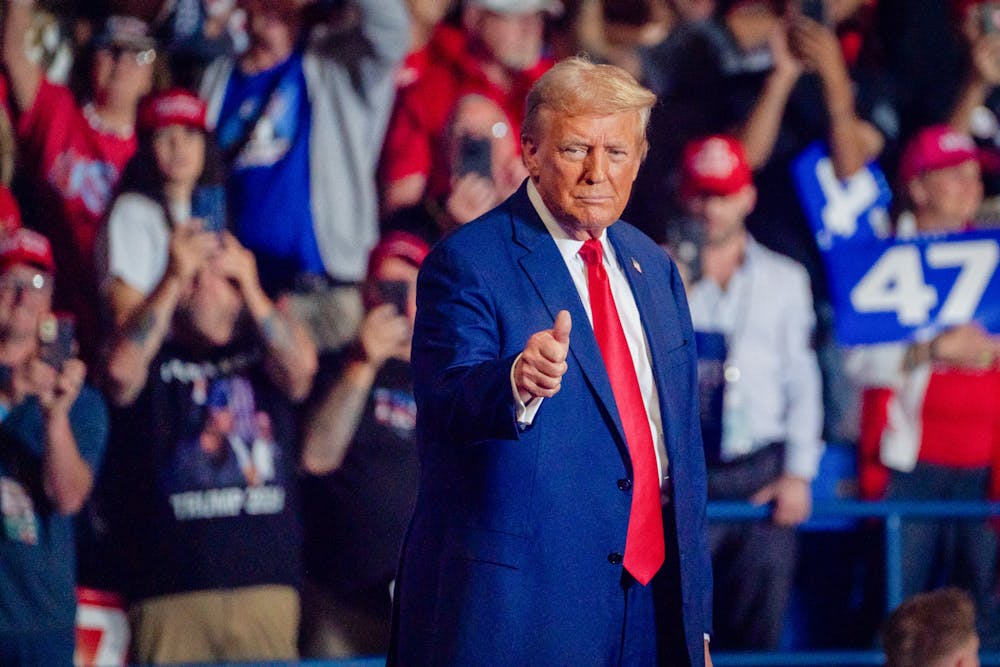
Less than a year into 1968 Wharton graduate and President Donald Trump’s second administration, Penn is offering three courses in the 2026 spring semester that explicitly reference Trump in their titles or descriptions.
The three faculty members set to teach those classes described the process of adapting their curriculum to an “unprecedented” political landscape in interviews with The Daily Pennsylvanian. The courses span disciplines from journalism to political science, each grappling with how to incorporate rapidly evolving current events without sacrificing a scholarly approach.
English professor Peter Tarr — who is teaching “ENGL 3423: Climate and Environment Journalism: Truth-Telling in the Trump Era” — described the class as “one of the most important courses” he has taught.
“This was offered in a slightly different context when Joe Biden was president, and it's about something that I feel — even without the Trump component — is an entirely urgent course to teach,” Tarr told the DP.
The class is primarily a writing course where students will engage in journalistic activities throughout the semester. Students will produce two hard news stories based on scientific research pertaining to climate and environment, two fact-based op-ed pieces, and one long-form interview piece that will be completed over the course of the semester.
According to Tarr, the current political climate has created an “unparalleled threat to the integrity of federally funded science.”
“Science and the entire federally supported research enterprise are under attack from the very top of government. It's a broad-based attack that has absolutely no precedent in American history,” Tarr continued. “I feel like the entire American house is on fire right now.”
Tarr pointed to the Trump administration’s removal of web pages at the National Oceanic and Atmospheric Administration and the Environmental Protection Agency containing decades of climate data as evidence of this pattern.
“The most important threat to truth has always arguably been the ability of power and people who hold power to distort the truth and to bend it to its own purposes — and that is the context of this particular year's edition of the course,” Tarr said.
He expressed his hope that the course will serve as an opportunity for students to ask what purpose journalism can serve “in these times.”
“As a professor in a course, it's not my aim to tell people what to think about Trump. But Trump has objectively done certain things since he became president the second time that are extraordinary, without precedent, and a direct threat to empirical fact-finding, fact reporting, storytelling activities that journalists and scientists engage in,” Tarr stated.
Despite including Trump's name in the course title, Tarr is “happy to say” that students won't be “obsessing about Trump each week” as that would not be “productive.” Instead, the course will focus on helping students improve their writing “in a broader context.”
“We're going to actually try to do some journalism that has some credibility and has some relevance to the matter at hand,” Tarr said. “I have to believe that in the end, the facts will matter — even if, for the time being, they are a sort of total eclipse at the level of the White House.”
Penn in Washington lecturer Aaron Blacksberg, who is teaching “PSCI 2211: The Mechanics of American Foreign Policy,” told the DP that the current moment “feels different from anything he's experienced before.”
“I've never felt more uncertain about what it means to teach American government in the foreign policy or domestic policy spheres,” Blacksberg said.
He added that his course maintains a flexible, “bare bones” structure, with a general outline of topics, but that specific focuses will be determined closer to each session based on current events or guest speaker expertise.
Given the uncertainty of the current political moment, Blacksberg noted that his focus has “shifted toward providing students with practical insights into what it means to enter this field.”
“I want to give them an experience where I can probably, even more so than last year, just provide a forum to answer questions about what it means to work in government now, what it means to work in policy, and what the future might hold — which I of course do not know, because no one does,” Blacksberg concluded.
For Penn instructor Brian Rosenwald, who will teach “PPE 4900: Advanced Seminar in PPE: American Conservatism From Taft to Trump,” the challenge lies in balancing historical context with rapidly evolving current events. He described writing the syllabus as “very tricky,” particularly with regard to finding the balance between including information about the present while also informing students of the historical origins of conservatism.
As a result of the Trump administration’s policies changing “minute to minute,” Rosenwald noted that he will try to include current events in class discussions.
“Things were much more sort of set in stone from week to week during the Biden administration, because Trump wasn't in power,” Rosenwald said. “[Biden] wasn't changing government policy every day.”
While Rosenwald noted he has always maintained flexibility in his course planning, he said that with the current administration “it just has to be more.”
“I try to integrate Trump in without sacrificing the backstory and without sacrificing any rigor, where we're just sort of talking about the news, as opposed to applying our knowledge to it and applying the literature we read in class,” Rosenwald said. “But certainly he's a part of the story.”
Rosenwald emphasized the importance of maintaining academic grounding even while engaging with current events, noting the risk of letting the course become “overwhelmed by Trump-related news.”
“You don't want your class to become Trump, right?” he continued. “Simultaneously, I don't think I would be doing my job very well if I came into the classroom every week and ignored what Donald Trump was doing.”
Staff reporter Riana Mahtani covers national politics and can be reached at mahtani@thedp.com. At Penn, she studies political science. Follow her on X @Riana_Mahtani.