

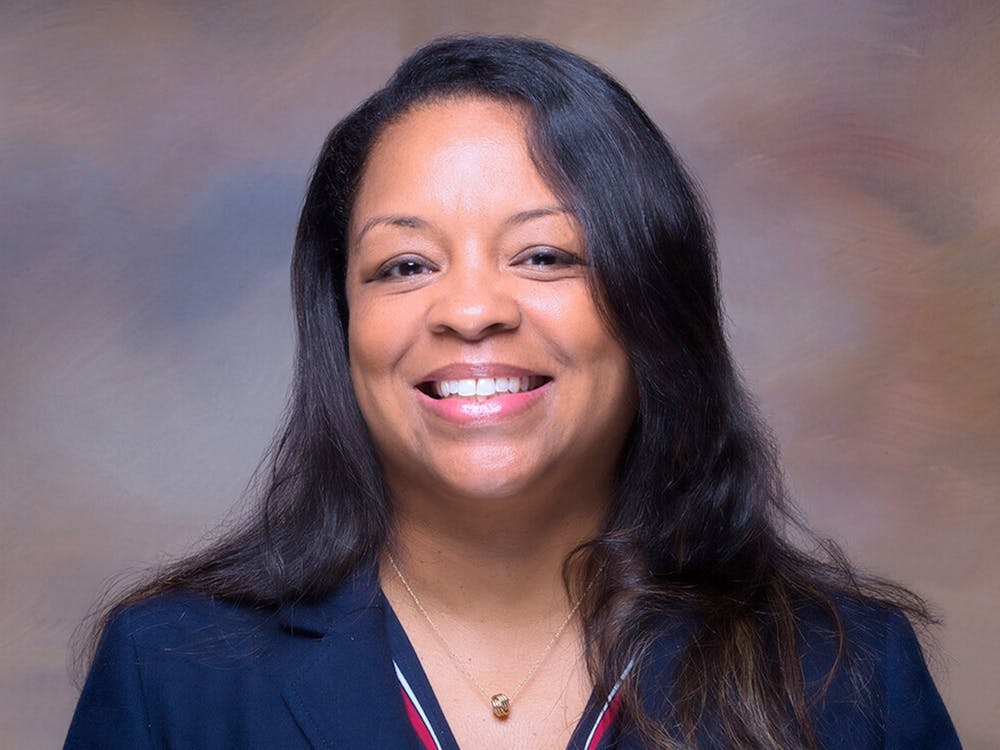
The Daily Pennsylvanian sat down with Vice President for Government and Community Affairs Leigh Whitaker to discuss the first months of her tenure and the University’s evolving relationship with the federal government.
Whitaker — who stepped into her role in October 2025 — outlined her priorities for strengthening Penn’s engagement across local, state, and federal levels. She also detailed some of Penn’s individual interactions with the government officials, including lobbying efforts and the University’s rejection of the preferential funding compact proposed by the Trump administration.
She said Penn’s dealings with the federal government have “shifted in some really significant ways” over the past year. Whitaker added that those changes are not unique to Penn, but rather reflect broader shifts in how higher education institutions interact with the White House.
“The federal government is one of higher ed’s biggest business partners, and so we have to maintain a constructive, open relationship with them,” she said. “Where there are things that we disagree about, we have to find places of agreement — like the importance of research funding, like the importance of innovation, like the importance of the importance of immigration policy on our international students and scholars.”
Whitaker stated that the University has tried to maintain that relationship by inviting policymakers to “come over to campus and meet the folks that are doing the work.”
“Come to the robotics lab and see how we’re deploying [National Institutes of Health] funding to serve the public interest,” she said. “Come out and see the things that we are doing and the ways that we’re deploying the resources, but also working in partnership with all of those stakeholders to do good stuff, both for our students and for the general public.”
In this way, she noted that giving policymakers direct exposure to Penn’s work — rather than relying solely on traditional advocacy — is a priority for her office. She spoke about bringing congressional staffers to campus to meet researchers and patients, allowing them to see firsthand how federal funding translates into tangible outcomes.
According to Whitaker, a “healthy relationship” with all levels of government is rooted in “mutual respect” and “open communication,” regardless of disagreements.
RELATED:
Pentagon drops Penn from list of ‘woke’ universities set to lose military tuition aid
Penn spent record-high $510,000 lobbying the federal government in fourth quarter of 2025
Whitaker spoke about her approach to balancing Penn’s relationships with local, state, and federal governments who may be proponents of contradicting courses of action. While lawmakers at different positions in government carry differences in responsibilities, her office aims to “come from a place of yes.”
“We pride ourselves on being a resource and a partner to all of our stakeholders and policymakers at all of the levels of government and community,” she said.
Whitaker argued that disagreements can be productive, adding that her approach extends to moments of tension between Penn and the government.
“People are not always happy with us, and we don’t shy away from that,” she said. “We lean into it. I personally find that conflict makes you better.”
The start of Whitaker’s tenure coincided with the release of the White House’s “Compact for Academic Excellence in Higher Education,” which it sent to Penn and several other universities.
The compact — conceived in part by outgoing Wharton Board of Advisors Chair Marc Rowan — offered universities preferential funding in exchange for institutional reforms, including a five-year freeze on tuition and a 15% cap on international student enrollment.
Nearly 2,000 members of the Penn community signed a petition urging the University to reject it, while legislators threatened to pull state funding if Penn did not decline.
Whitaker said that University leadership gathered feedback from administrators, faculty, and other stakeholders across campus before ultimately declining to accept the compact as it stood at the time.
While there were “areas of alignment,” Whitaker said the proposal was not compatible with the University’s governance — particularly with respect to academic freedom and institutional autonomy.
“As this is written right now, it is not in alignment with our mission,” she said. “The impact on our community is just too great.”
Whitaker also discussed Penn’s lobbying efforts, describing them as part of a broader network of universities and coalitions working to inform policymakers.
Penn spent a record $510,000 lobbying the federal government in the fourth quarter of fiscal year 2025. Whitaker said that the policy decisions Penn lobbies for affect not only colleges, but a larger ecosystem of research institutions, industry partners, and patients relying on University-driven innovation.
“We do not do this in a vacuum,” Whitaker said, highlighting that Penn collaborates with organizations across higher education and health care to advocate for issues such as federal research funding, immigration policy, and student financial aid.
Whitaker additionally clarified that advocacy efforts often extend beyond Penn-specific concerns to encompass sector-wide priorities such as biomedical research, Medicare and Medicaid policies, and regulatory frameworks affecting teaching hospitals.
“You win some, you lose some — but you keep at it,” she said.
Summing up Penn’s approach to federal engagement in what she described as “different” times, Whitaker said that Penn must maintain its relationships with policymakers.
“We’ve got to live to see another day,” she said. “The way to do that is being open to continuing to work through what could seem like difficult times.”
RELATED:
Pentagon drops Penn from list of ‘woke’ universities set to lose military tuition aid
Penn spent record-high $510,000 lobbying the federal government in fourth quarter of 2025
Staff reporter Ishani Modi covers state and local politics and can be reached at modi@thedp.com. At Penn, she studies biochemistry.
Senior reporter Riana Mahtani covers national politics and can be reached at mahtani@thedp.com. At Penn, she studies political science. Follow her on X @Riana_Mahtani.


