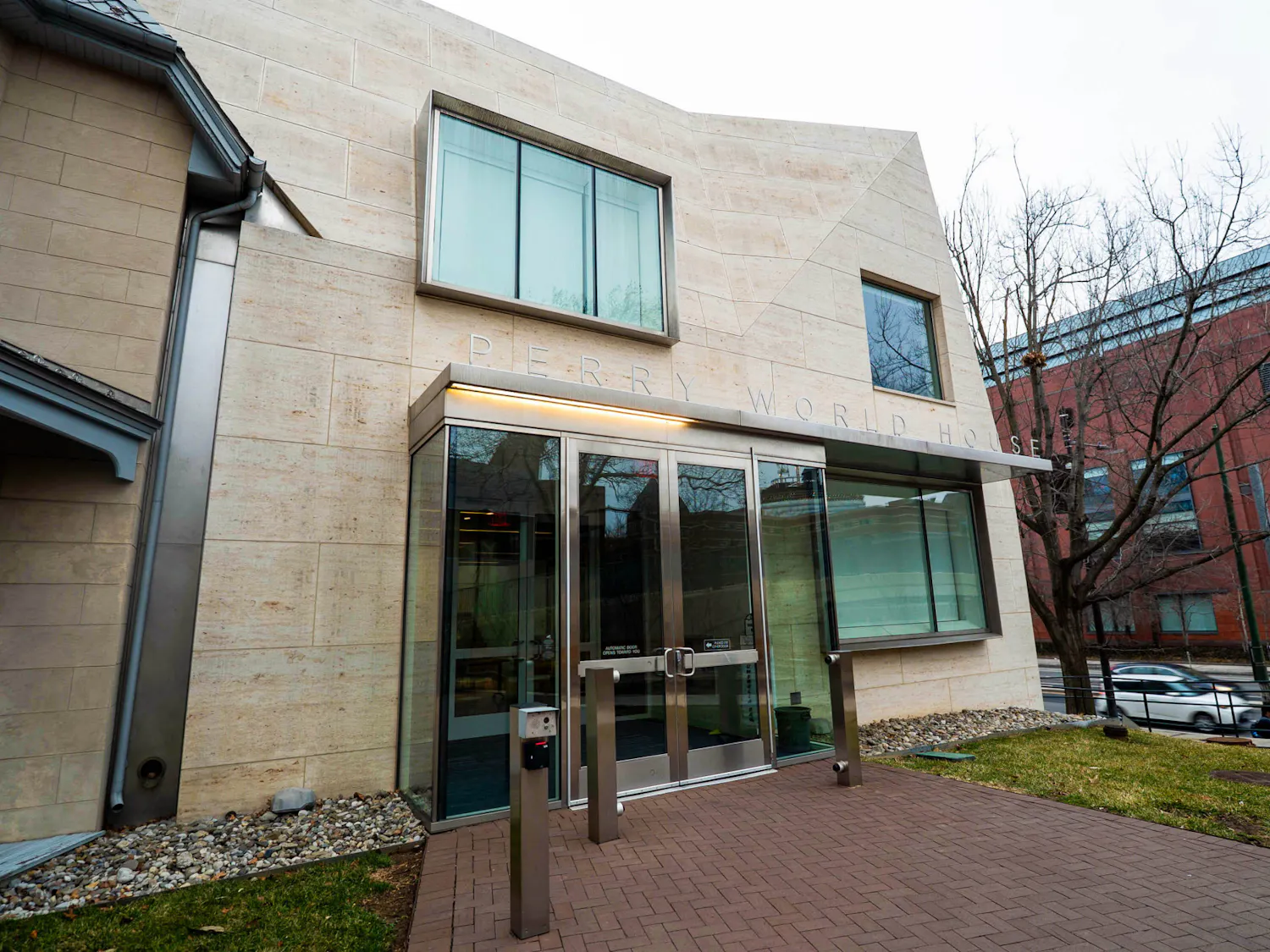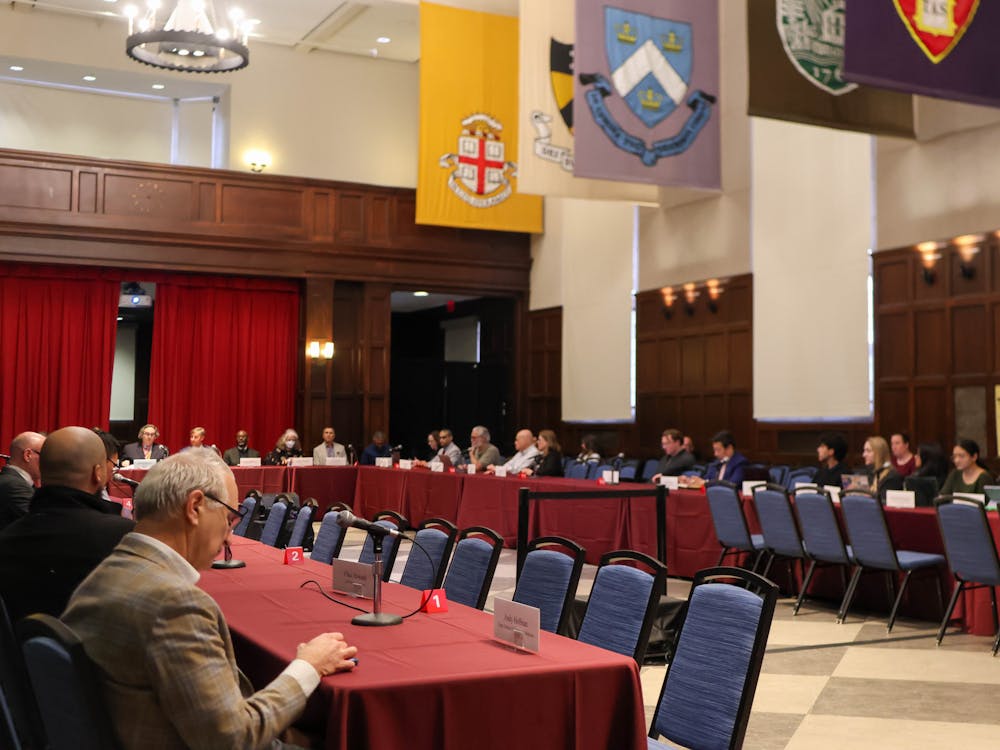
At Wednesday’s University Council meeting, members of Penn’s administration heard community concerns about federal immigration policy, transportation accessibility, and campus-wide Title IX training.
The March 25 meeting featured remarks from multiple student groups, including the Latinx Coalition, the Asian Pacific Student Coalition, and Abuse and Sexual Assault Prevention. The event also facilitated a discussion of Penn’s operating budget.
The meeting opened with a statement from Penn President Larry Jameson, who emphasized the importance of “opportunity, respect, intellectual openness, and the conviction that diverse interests and backgrounds are essential to our future.”
“I’m aware that the starting line for everyone is not in the same place, and sometimes the hill that you climb after that is steeper for some than others,” Jameson said. “I wanted to reaffirm Penn’s commitment to diversity and inclusion.”
Jameson previously addressed equality, opportunity, and diversity in a March 19 message to the University community.
Students present at the meeting also discussed continued concerns about the possibility of Immigration and Customs Enforcement activity on campus — first raised at the Feb. 18 meeting of the University Council.
A representative from Penn for Immigrant Rights described the earlier meeting as “inconclusive and empty.”
“What was supposed to be a collaborative and productive meeting and conversation ended up being a very dismissive and performative meeting,” they said.
RELATED:
Penn to gather community input on open expression guidelines amid faculty calls for ‘transparency’
How Penn’s UA will allocate its $3 million budget next year
“We were met with empty statements of support, with no tangible evidence of care and concern to back it up,” the representative added. “We were met with condescending power plays and vile attempts at fielding every single one of our questions and concerns.”
A representative from Penn’s Latinx Coalition echoed these sentiments, urging the University to “be quicker” with their communication to the community.
“It cannot take a whole semester to figure it out, because many of us are counting on it,” the representative said. “As it’s been said many times before, students are scared whether or not they may be undocumented.”
In the absence of widespread guidance, Penn students and organizations have shared resources and hosted workshops to inform the campus community about how to prepare for possible confrontations with federal agents.
The meeting also included a review of the University’s fiscal year 2026 operating budget, spearheaded by Vice President for Budget Planning and Analysis Trevor Lewis.
“The main takeaway is that [financial] aid is growing faster than tuition and fees,” Lewis said. He also discussed the impacts of the federal endowment tax set to begin on July 1, 2026.
Lewis noted that the budget for fiscal year 2027 — which includes a recently announced 3.9% increase in tuition — would be submitted for formal review by the University’s Board of Trustees in June.
“The essential message of the FY26 budget in our office is constraint in the face of revenue uncertainty,” he said.
Kate Kramer, a senior lecturer in Penn’s Critical Writing Program, discussed the lack of proper restriction enforcement surrounding bikes, electric scooters, and skateboards in pedestrian areas during the meeting’s open forum section.
“These vehicles threaten our physical safety,” Kramer said.
College sophomore Greyson Forster also proposed the implementation of transit passes and better public transportation accessibility, explaining that it would be “a smarter allocation of resources Penn is already spending.”
Some students also expressed discontent with Penn’s Title IX process.
“We strongly encourage the University to implement a comprehensive rollout strategy for Title IX training, similar to Title VI,” a representative from Penn’s Abuse and Sexual Assault Prevention said. “One that ensures meaningful participation and completion across staff and faculty.”
In January, Penn released a “nondiscrimination and anti-harassment” training module for University students and faculty. The modules consisted of a series of videos describing Title VI of the Civil Rights Act of 1964 as well as Penn’s policies on equal opportunity, open expression, and non-discrimination.
College junior James Glomb described the current process as “a failure by Penn” that “shifts the burden onto survivors and signals that coming forward may cost more than staying silent.”
“It raises a serious concern that protecting the University’s reputation is being prioritized over protecting its students,” Glomb said.
RELATED:
Penn to gather community input on open expression guidelines amid faculty calls for ‘transparency’
How Penn’s UA will allocate its $3 million budget next year
Senior reporter Kathryn Ye covers central administration and can be reached at ye@thedp.com. At Penn, she studies biochemistry and philosophy. Follow her on X @Kathryn__Ye.